 Birch Bay
 Two Products Built From the Same Basic Idea
If you've been getting quotes for siding in Birch Bay, you've probably heard both names: James Hardie and Allura. It's a fair question to ask why we only install one of them when both are fiber cement products made from the same basic recipe — cellulose fiber, sand, cement, and water, cured into a plank that's far more durable than vinyl or wood. We're not going to tell you Allura is a bad product, because it isn't. It's a legitimate fiber cement siding with a real manufacturing history. Our decision to install James Hardie exclusively comes down to how each company backs its product once it's on a house in a climate like ours, not some claim that one material is fake and the other is real.
That distinction matters more here than in a lot of the country. Birch Bay sits right on the water, which means salt air working on fasteners and finishes year-round. Whatcom County gets long stretches of driving rain off the Salish Sea, and our siding sees a moss season that can run eight or nine months if a wall doesn't get much sun. Every product decision we make gets filtered through those three facts, and that's the lens this page is written through.
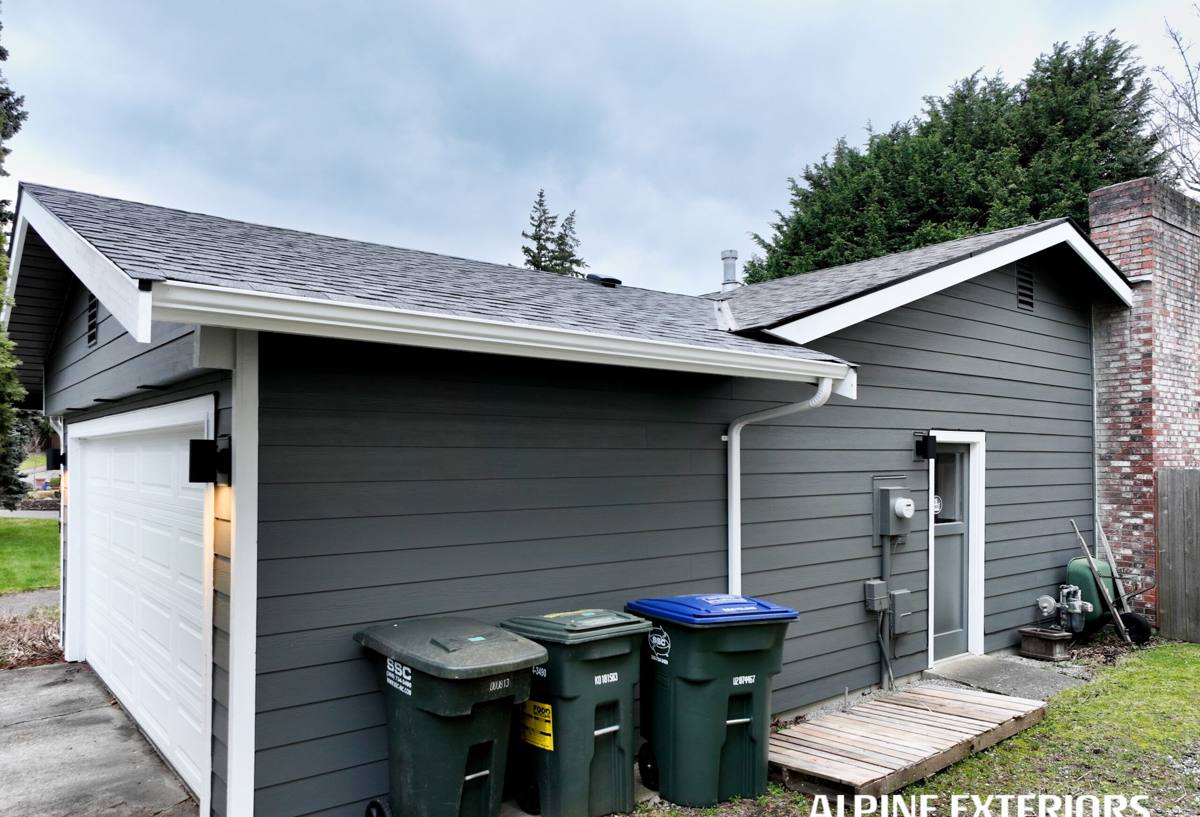
What Allura Gets Right
Credit where it's due. Allura fiber cement resists fire, insects, and rot far better than wood or engineered wood siding, and it holds paint or factory finish longer than vinyl ever will. It's manufactured to recognized fiber cement standards, it's sold through legitimate building supply channels in the Pacific Northwest, and plenty of contractors install it successfully. If your only two choices were Allura or vinyl, we'd tell you to take the Allura every time. This isn't a "one product is garbage" argument — it's an argument about what happens after year one, year ten, and year twenty on a house that's fighting salt spray and standing moisture most of the year.
Where the Similarities End
The raw material is close. What's not close is the depth of engineering behind the specific product lines, the factory finish process, the warranty language, and the local support network — and those are the things that actually determine how the siding looks and performs a decade from now.
Factory Finish Is Where the Difference Shows Up First
Fiber cement siding is only as good as the finish bonded to it. A raw or thinly coated panel will absorb moisture at the surface, and in a climate that stays damp as long as ours does, that moisture is what feeds streaking, color fade, and the algae and moss growth homeowners around Birch Bay fight constantly.
James Hardie's ColorPlus finish is baked on in a controlled factory environment, in multiple coats, specifically engineered to resist UV fade and moisture intrusion, with touch-up product formulated to match. Allura offers factory-finished options as well, but the coating systems, warranty terms, and color-matching support behind them vary more by product line and region than Hardie's does. When a plank needs to be cut, notched around a window, or replaced after a repair five years down the road, having a finish system with consistent, well-documented touch-up and match support saves you from a visibly different patch on your wall.
| Factor | James Hardie (ColorPlus) | Allura (Standard/Field-Finish Options) |
|---|---|---|
| Finish application | Factory-baked, multi-coat, standardized process | Varies by product line; some lines rely more on field priming/painting |
| Color-match touch-up | Dedicated matched touch-up system | Available but less consistently standardized |
| Climate-specific product lines | HZ5/HZ10 zone-engineered formulations | General-purpose formulations, less zone differentiation |
| Regional installer network | Extensive certified installer base in WA/PNW | Smaller, less consistent regional presence |
| Transferable warranty structure | Long-term, non-prorated coverage with clear transfer terms | Warranty exists but terms and coverage detail vary by line |
Climate-Engineered Lines Matter More Here Than People Think
James Hardie builds separate product formulations for different climate zones — an HZ5 line engineered for cold, wet, freeze-prone regions like Whatcom County, versus a hot-and-humid Southern formulation. That's not a marketing label; it changes the moisture absorption rate and freeze-thaw performance of the plank itself. Birch Bay sees enough freeze-thaw cycling in the winter, combined with near-constant humidity off the water, that a siding product not specifically engineered for this zone is working harder than it should be to hold its shape and finish.
Allura doesn't offer the same degree of zone-specific product differentiation. That doesn't make it unsuitable for our climate, but it does mean you're getting a more general-purpose product in a location that punishes general-purpose choices — especially on north-facing walls and shaded elevations where moss and mildew get a head start every fall.
The Moss Season Problem
Anyone who's owned a home in Whatcom County long enough has scrubbed moss off a wall, a fence, or a roof. Moss doesn't rot fiber cement the way it can degrade wood, but it does hold moisture against the surface longer, and a finish that isn't built to shed water efficiently will show staining and green growth faster. This is a maintenance issue as much as a material one, and it's one more reason the finish quality argument above isn't academic — it's the difference between pressure-washing your siding every other year versus every year.
Why We Standardized on One Manufacturer
There's a practical reason beyond the product spec sheet: we install James Hardie exclusively because our crews are trained and certified on one flashing detail, one fastening pattern, one set of manufacturer installation instructions, and one warranty registration process. Every fiber cement brand has its own nuances around butt joint treatment, minimum clearances, fastener spacing, and caulking versus no-caulk trim systems. Splitting our crews across two manufacturers means splitting our expertise, and installation errors — not material failure — are the number one cause of fiber cement siding problems nationwide. We'd rather be excellent at one system than average across two.
That standardization also means when we say a job is installed to manufacturer spec, we can back that statement with certification, not just intention.
Warranty Structure: Read Past the Headline Number
Both brands advertise long warranty periods, and on paper the numbers can look similar. The difference is in the fine print — what's prorated, what requires the original installer to still be in business, what voids coverage if a repair was done by someone other than a certified installer, and how the finish warranty is separated from the substrate warranty. James Hardie's warranty structure is well documented, widely understood by the installer network, and backed by a manufacturer with decades of consistent presence in the Pacific Northwest market. That matters when a warranty claim is 12 years out and you need someone to actually honor it.
We're not saying Allura's warranty is worthless — we're saying that when we've compared the actual coverage terms side by side, Hardie's has consistently been the more homeowner-favorable structure for the way we build in this region.
Availability and Long-Term Parts Matching
One thing homeowners rarely think about until they need it: what happens when a tree branch cracks three boards and you need an exact match five or ten years after your original install. A manufacturer with deep regional distribution and a stable, long-running color line makes that repair simple. A less established regional presence can mean discontinued colors, batch variation, or a longer wait for materials — all things that turn a small repair into a visible patchwork.
- Confirm whether the siding brand has an active, certified installer network in Whatcom County — not just a distributor
- Ask how touch-up paint and replacement plank color-matching works five-plus years after installation
- Get the actual warranty document, not the marketing summary, and read the transfer and proration clauses
- Ask whether the specific product line is climate-zone engineered for the Pacific Northwest
- Check how the manufacturer's flashing and clearance details handle wind-driven rain, since that's a daily reality here
- Ask your contractor whether they're certified on the brand they're proposing, or just familiar with it
What This Means for Your Home in Birch Bay
None of this is about scaring anyone off a legitimate building product. It's about why, as a company that only wants to install one thing and stand behind it fully, we picked the fiber cement system with the deepest climate-specific engineering, the most consistent factory finish, the clearest warranty language, and the strongest regional installer support. On a home that's going to face salt air off the water, driving winter rain, and a long moss season every single year, those differences compound over time in ways that are hard to see on a spec sheet but easy to see on a fifteen-year-old wall.
If you're weighing Allura, Hardie, or anything else for your next siding project, we're glad to walk through what we'd actually install on your house and why — no pressure, no scare tactics. Reach out for a free estimate and we'll give you a straight answer, using the form below.