 Birch Bay
 Two Popular Siding Systems, One Coastal Climate
If you've priced out a siding replacement in Birch Bay, you've almost certainly run into two names: James Hardie fiber cement and LP SmartSide engineered wood. Both are a step up from vinyl in terms of durability and curb appeal, and both are marketed as low-maintenance, long-lasting products. But "low-maintenance" means something different depending on what a siding board is actually made of, and that difference matters a lot more here on the Whatcom County coastline than it would in a drier inland climate.
Birch Bay sits right on the water, which means siding here deals with salt-laden air, driving rain off the Strait of Georgia, and a wet season that stretches long enough to grow moss on just about anything that holds moisture. That combination is a real-world stress test for exterior building materials. We install exclusively James Hardie fiber cement siding, and this page explains why we made that call after weighing both products against what actually happens to a house exposed to this kind of weather year after year.
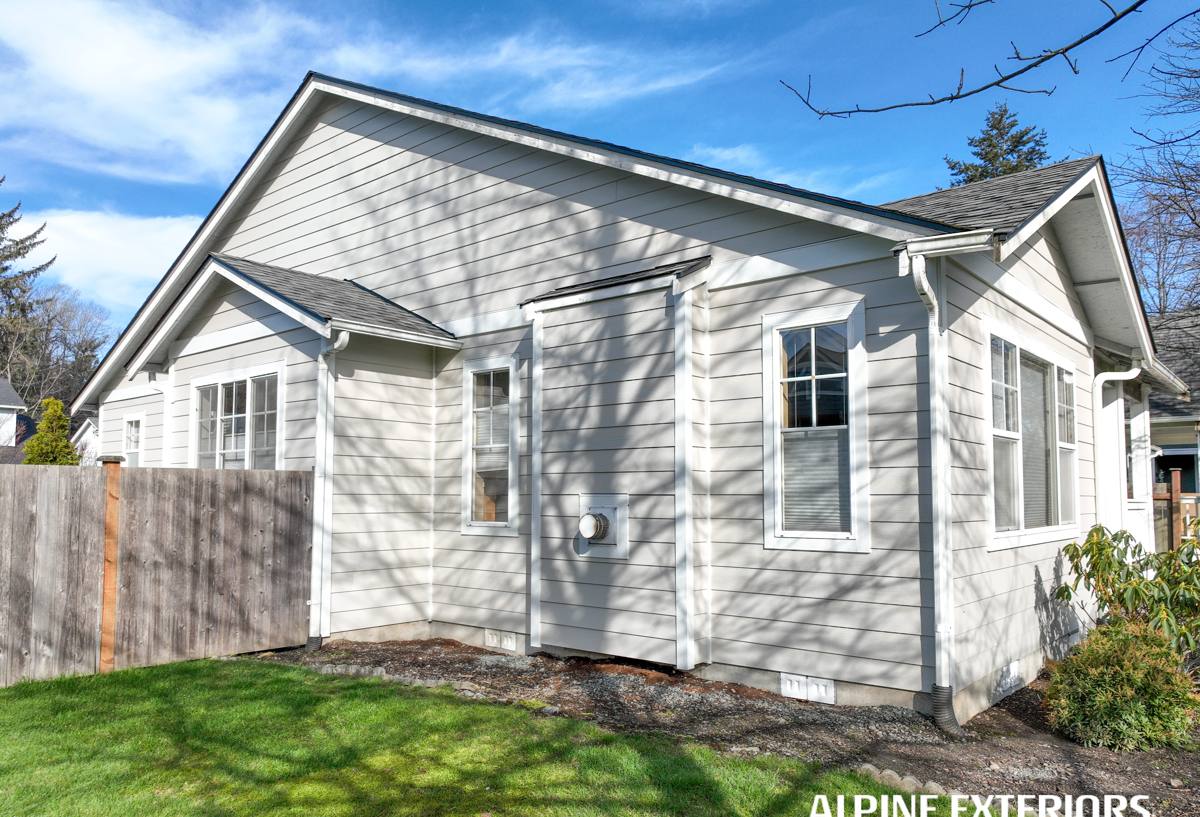
What LP SmartSide Actually Is
LP SmartSide is an engineered wood product — strand board or wood fiber pressed and bonded with resins, then treated with a zinc borate additive for fungal and insect resistance, and coated with a resin-saturated overlay. It's a legitimate improvement over old-style hardboard siding, which had a rough history with moisture failures in the 1990s and 2000s. LP has addressed a lot of those old weaknesses, and it's a product plenty of contractors use successfully.
Where it can struggle is at the core of what it's made from: wood. Wood fiber, no matter how it's treated or sealed, expands and contracts with moisture, and any breach in the factory coating or field-cut edge becomes a potential entry point for water. In a hot, dry climate that's a minor concern. In a marine climate with prolonged wet seasons and salt air working on caulk joints and cut edges, it's a bigger variable to manage over the decades a homeowner expects siding to last.
Where Edge Sealing Becomes Critical
LP SmartSide manufacturer guidelines are explicit about field-cutting: every cut end, notch, and drilled hole needs to be primed and sealed before installation, and any gaps need to stay properly caulked and maintained over the life of the siding. That's a reasonable ask on paper. In practice, it means the long-term performance of the product depends heavily on installer discipline on every single cut, and then on the homeowner keeping up with caulk maintenance indefinitely. Skip a step once, on one board, and that's where a moisture problem starts.
What James Hardie Fiber Cement Actually Is
James Hardie siding is made from cement, sand, and cellulose fiber, cured into a rigid, dense board. There's no wood fiber core to swell, rot, or feed fungal growth. It doesn't burn — it carries a noncombustible rating, which matters for both fire risk and, in many cases, insurance considerations. It ships pre-finished with Hardie's ColorPlus factory baked-on finish, which is more consistent and more fade- and chip-resistant than field-applied paint, and it comes in HZ5 and HZ10 formulations engineered specifically for regions that see the kind of moisture and temperature swings the Pacific Northwest coast delivers.
Cut edges on fiber cement still need to be primed, but the material underneath isn't the same kind of moisture liability wood fiber is — a cement-based board that gets rained on doesn't swell, delaminate, or invite rot the way an untreated wood edge can. That difference in the base material is the core reason we standardized on it.
Head-to-Head Comparison
| Factor | James Hardie Fiber Cement | LP SmartSide Engineered Wood |
|---|---|---|
| Core material | Cement, sand, cellulose fiber | Wood strand/fiber with resin treatment |
| Combustibility | Noncombustible | Combustible (wood-based) |
| Moisture behavior | Dense, doesn't swell or rot at the core | Resists moisture when intact; wood core vulnerable if coating is breached |
| Factory finish | ColorPlus baked-on finish, 15-year finish warranty on most products | Factory primed or pre-finished options; field paint common |
| Field-cut edges | Must be primed/sealed | Must be primed and sealed, more moisture-sensitive if missed |
| Typical product warranty | Long-term, transferable limited warranty on the substrate | Limited warranty, terms vary by product line |
| Performance in salt air/marine climate | Engineered HZ lines built for this exposure | Performs adequately with diligent sealing and maintenance |
Why the Marine Climate Tips the Scales
A siding decision in, say, eastern Washington doesn't carry the same stakes as one in Birch Bay. Out there, low humidity and less driving rain mean a wood-based product has an easier time. Here, we're dealing with a genuinely different set of conditions:
- Salt air: Airborne salt accelerates degradation of caulk, sealants, and unprotected fasteners — the exact maintenance points a wood-based product depends on staying intact.
- Driving rain: Wind-driven rain off the water pushes moisture into joints and laps far more aggressively than a straight-down rain in a sheltered inland lot.
- Long moss season: Extended damp periods let moss and algae establish on north-facing and shaded walls, holding moisture against the siding surface for weeks at a time.
- Temperature swings: Freeze-thaw cycles during winter cold snaps stress any material that has absorbed moisture into its core.
None of that means LP SmartSide is doomed to fail on a Birch Bay home — plenty of engineered wood siding is out there performing fine. It means the margin for error on installation and long-term maintenance is thinner here than it would be somewhere drier, and that's exactly the kind of risk we don't want to carry on behalf of a homeowner who's paying for siding that should last 30-plus years without drama.
Maintenance Over the Life of the Siding
What LP SmartSide Typically Requires
Periodic inspection of caulk joints and cut edges, repainting on a cycle if the finish isn't a factory pre-finished option, and prompt attention to any nicks or gouges that expose the wood core. In a wet coastal climate, deferred maintenance on any of those items is where problems start.
What James Hardie Typically Requires
Occasional rinsing to keep salt residue and organic growth from building up, periodic caulk checks at trim and penetrations same as any siding, and that's largely it — the ColorPlus finish is designed to go 15 years or more without repainting, and the board itself isn't waiting for a coating failure to become a moisture problem.
Cost Considerations
LP SmartSide typically carries a lower material cost than James Hardie fiber cement, and that upfront gap is real. Where the comparison gets more complete is looking at total cost over a realistic ownership period — factory finish life, repainting cycles, and the labor cost of maintaining caulk and edge-sealing on a wood-based product versus a cement-based one. We'd rather walk a homeowner through that full picture honestly than sell on the lowest sticker price and leave the maintenance math for later.
- Get quotes that specify exact Hardie product line (HZ5 vs. HZ10) and exact LP SmartSide product line — "siding" isn't one price point.
- Ask what's included in factory finish vs. field-applied paint, since that changes both cost and maintenance schedule.
- Factor in trim, fascia, and soffit material, not just the field siding panels.
- Ask about disposal/tear-off of existing siding as a separate line item.
- Confirm whether the quote includes moisture barrier and flashing detail work, not just panel installation.
Why We Only Install James Hardie
We made the decision to standardize on James Hardie fiber cement because it lets us stand behind one system with confidence, on every house, in every part of Whatcom County we work in — from sheltered inland lots to homes sitting exposed right on Birch Bay's waterfront. Fiber cement's noncombustible, non-organic core removes the biggest variable a marine climate introduces, the ColorPlus factory finish reduces the maintenance burden homeowners actually have to manage, and Hardie's HZ product lines are engineered for exactly this kind of coastal exposure rather than adapted to it. That lets us install one product correctly, to spec, backed by a strong transferable warranty, instead of splitting our installation standards across multiple systems with different moisture tolerances.
If you're weighing siding options for a home in Birch Bay or anywhere in Whatcom County, we're happy to walk your specific house — its exposure, its trim details, its sun and shade pattern — and give you a straight answer on what it needs. Reach out for a free, no-pressure estimate and we'll show you exactly what a correct Hardie installation looks like for your home.