 Birch Bay
 Exterior Work Built for a Peninsula Climate
Point Roberts sits in a category of its own. It's a small peninsula of Whatcom County that hangs south of the 49th parallel, surrounded on three sides by the Strait of Georgia and reachable by land only through Canada. That geography means homes here take a version of the Pacific Northwest coastal climate that's even more concentrated than what you'll find a few miles inland — more direct salt air off the water, more wind-driven rain, and a damp season that runs long. If you own a home in Point Roberts, your siding, roof, windows, and decking are working harder than the same materials would on a house set back from the shoreline.
Birch Bay Siding services Point Roberts as part of our regular coverage area. We're a local Whatcom County crew, not a national franchise dispatching whoever's closest — we know what this specific stretch of coastline does to exterior materials over a 20 or 30 year span, and we build our recommendations around that, not around a national average climate that doesn't apply here.
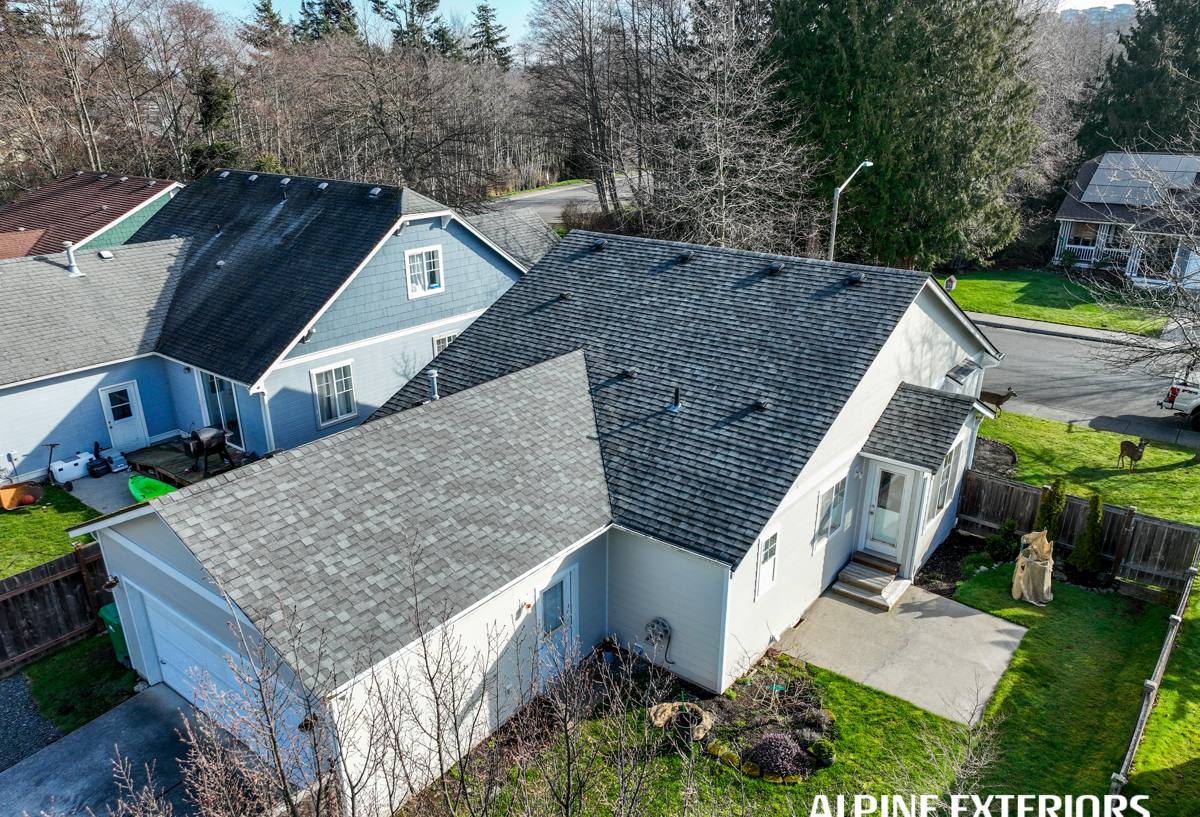
What the Climate Actually Does to a House Here
Salt Air and Coastal Exposure
Being surrounded by marine water on three sides means Point Roberts homes get more airborne salt than most Whatcom County properties. Salt is corrosive to fasteners, flashing, and any exposed metal on a house, and it accelerates the breakdown of paint films and lower-grade siding materials. Over years, that shows up as premature fading, chalking, and finish failure — especially on the sides of a house that face open water or prevailing wind.
Driving Rain
Point Roberts gets weather straight off the Strait, which means rain frequently arrives sideways rather than straight down. Driving rain finds every gap in a building envelope — poorly lapped siding, under-flashed windows, transitions where trim meets wall. It's not the water sitting on a surface that causes the damage; it's the water that gets behind the surface and stays there.
A Long Moss Season
Consistent moisture and mild temperatures give moss and algae a long growing season on north-facing walls, roof valleys, and anywhere shade keeps a surface from drying out fully between rains. Moss holds moisture against whatever it's growing on, which is a slow but real threat to roofing material and to siding that isn't rated to handle sustained dampness.
Siding: Why We Only Install James Hardie
We install James Hardie fiber cement siding exclusively. We don't install vinyl, LP SmartSide, Cemplank, Allura, primed spruce, or cedar, and that's a deliberate standard, not a limitation of what we're capable of installing.
Vinyl
Vinyl is inexpensive and low-maintenance in mild climates, but it's a thin plastic product that expands and contracts with temperature swings, and its seams and J-channels are exactly the kind of detail that driving rain exploits. In a location with more wind-driven moisture than average, those weak points matter more than they would somewhere sheltered.
Wood-Based Siding (Primed Spruce, Cedar, LP SmartSide)
Wood and engineered-wood products can look excellent when new, but they all rely on an intact paint or factory coating to keep moisture out of the substrate. In a long moss season with sustained dampness on shaded elevations, any coating failure or unsealed cut edge becomes an entry point for rot. Maintenance has to be consistent and on schedule — miss a few years of recoating on a coastal property and the damage compounds fast.
Other Fiber Cement Brands (Cemplank, Allura)
These are legitimate fiber cement products, and fiber cement as a category is the right call for this climate. Our standardization on James Hardie specifically comes down to their ColorPlus factory finish, their HZ5 product engineering for harsher climate zones, and the strength and transferability of their warranty — not a claim that competing fiber cement products are defective.
Why Hardie
James Hardie fiber cement is non-combustible, dimensionally stable, and holds up to sustained moisture exposure without the coating dependency that wood products carry. The ColorPlus finish is baked on at the factory and covered by its own finish warranty, which matters on a property where field-applied paint would be fighting salt air and damp shade year after year. It's a system built for exactly the kind of exposure Point Roberts sees.
| Factor | Vinyl | Wood / Engineered Wood | James Hardie Fiber Cement |
|---|---|---|---|
| Moisture tolerance | Moderate; seams are weak points | Coating-dependent | High; engineered for wet climates |
| Salt air durability | Fades, becomes brittle over time | Coating degrades faster near salt air | Factory finish resists fading and chalking |
| Fire resistance | Melts, contributes fuel | Combustible | Non-combustible |
| Maintenance | Low, but limited lifespan | Repaint/reseal on a strict schedule | Repaint only when the owner chooses a new color |
| Typical service life | 15-25 years | Varies widely with upkeep | Decades with correct install and upkeep |
Correct Installation Matters More Here Than Most Places
Fiber cement is only as good as its installation. In a wind-driven rain environment, the details that keep water out are non-negotiable: proper starter strip and clearance off the foundation, correctly lapped and fastened panels, flashing at every window, door, and penetration, and rainscreen or drainage detailing where the wall assembly calls for it. We install to James Hardie's published specifications because those specs exist to handle exactly the conditions Point Roberts sees — not as a generic minimum, but because a peninsula property has less room for error than an inland one.
Roofing, Windows, and Decks for the Same Conditions
Roofing
A roof on this peninsula deals with wind uplift, driving rain working against shingles and flashing, and moss taking hold in shaded valleys and north slopes. We pay close attention to underlayment, flashing details around penetrations, and ventilation, since a roof that can't dry out between rain events is a roof that ages faster than its rated lifespan suggests.
Windows
Window flashing and sealant are one of the most common failure points on coastal homes. Water finds its way behind poorly integrated window units and causes hidden rot long before anything looks wrong from outside. We flash new and replacement windows to shed water outward at every layer, which matters more here than in a sheltered inland location.
Decks
Decks facing open water take the brunt of salt air and standing moisture at ledger boards, fasteners, and any horizontal surface that collects rain. We use fasteners and hardware rated for coastal exposure and pay particular attention to ledger flashing, since that's the connection point most likely to trap water against a house if it's not detailed correctly.
Why a Local Whatcom County Crew Matters Here
Point Roberts is logistically unusual — it's part of the U.S. but only reachable by land through Canada, which means not every contractor is set up to service it efficiently or reliably. We already build our schedules and material logistics around covering this area as part of our normal Whatcom County territory, so a Point Roberts job isn't a special trip or an afterthought. That matters for scheduling, for follow-up service, and for warranty support down the line.
It also matters for judgment calls on site. Knowing that a given wall faces prevailing wind off the Strait, or that a north-facing elevation is going to hold moss longer than the rest of the house, changes small decisions during installation — flashing details, drainage planning, where to spend extra care. That's the kind of knowledge that comes from working this specific coastline repeatedly, not from a general Pacific Northwest playbook.
A Practical Checklist Before You Replace Siding, Roofing, Windows, or a Deck
- Walk the exterior and note which elevations face open water or prevailing wind — those need the most attention to material and detailing.
- Check for moss buildup on north-facing walls, roof valleys, and shaded trim, and note how long it's been there.
- Look for paint or coating failure, chalking, or fading, especially on wood-based or vinyl siding.
- Check window flashing and caulking for gaps, cracking, or separation from the wall surface.
- Inspect deck ledger boards and fasteners for rust staining or soft, discolored wood.
- Ask any contractor bidding the job what fastener and flashing details they use for coastal/salt-air exposure specifically.
- Get warranty terms in writing, including whether the finish coating and the installation labor are covered separately.
What to Expect When You Call Us
We'll walk the property with you, look at how each elevation is holding up against the specific exposure it gets, and give you a straight assessment of what's working, what's not, and what your realistic options are. If siding replacement makes sense, James Hardie is what we'll recommend and what we'll install — for the reasons above, not because it's the only thing we sell. If roofing, windows, or a deck need attention instead of or alongside siding, we'll say so.
If you're in Point Roberts and dealing with premature wear, moss you can't keep ahead of, or you're just planning ahead for an aging exterior, we're happy to come take a look. Reach out for a free, no-pressure estimate using the form below.