 Birch Bay
 Siding in Blaine: A Different Set of Problems Than Inland Homes Face
Blaine sits about as close to the water and the border as a Washington town gets, and that location shapes what happens to the outside of a house here. Homes in this part of Whatcom County deal with a steady mix of salt-laden air off the Strait of Georgia and Semiahmoo Bay, wind-driven rain that hits siding sideways instead of just running down it, and a wet season that stretches long enough to give moss and algae a real foothold on north-facing walls and anything shaded by trees. None of that is unique to any one street or neighborhood in Blaine — it's the baseline condition for exterior materials anywhere in this stretch of the county, and it's the starting point for how we think about siding, roofing, windows, and decks on every Blaine job.
The practical effect is that products which perform fine in a drier, more sheltered climate can struggle here. Moisture that gets behind siding has more opportunities to arrive — through wind-driven rain, through condensation, through splash-back off grade — and it has fewer dry stretches to evaporate out. Add the salt content in coastal air, which accelerates corrosion on fasteners and trim and speeds up UV and moisture breakdown on some paints and coatings, and you end up with a climate that rewards materials and installation details built for exactly this kind of exposure.
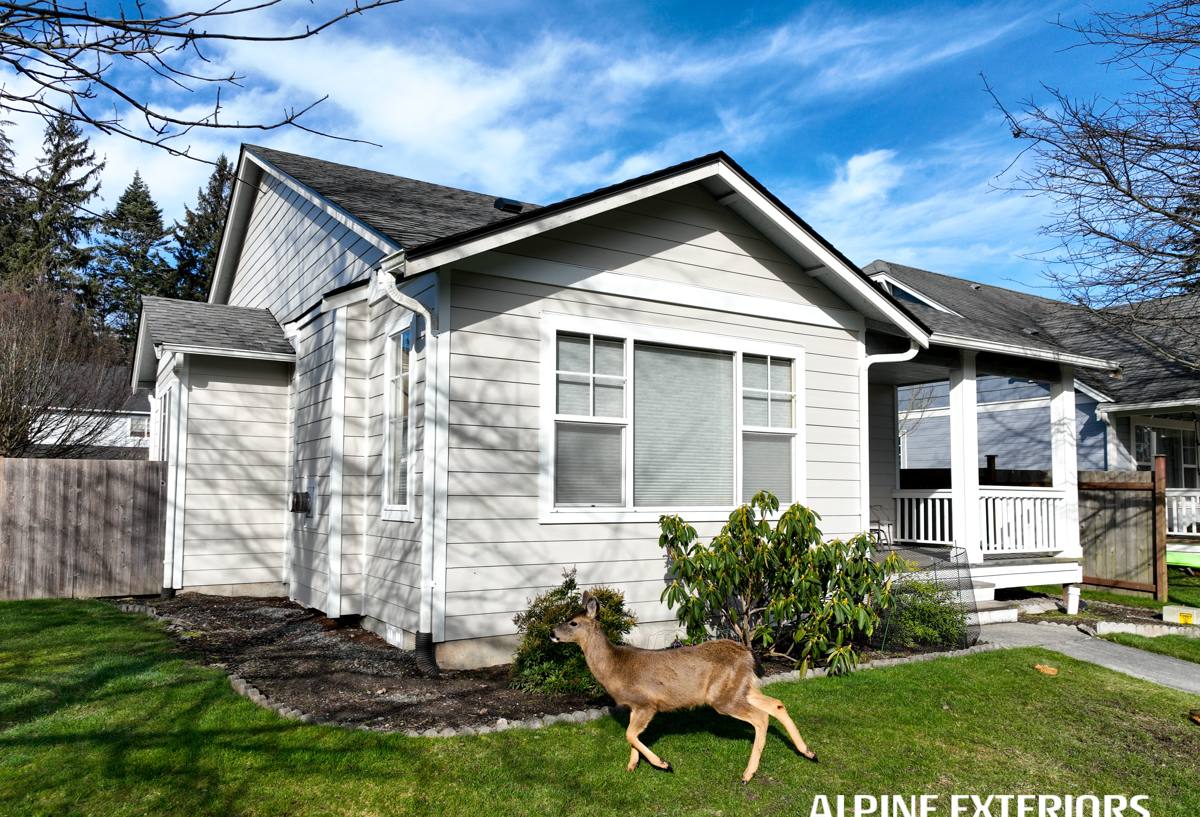
What This Means for Siding Choice
We install James Hardie fiber cement siding exclusively. We don't offer LP SmartSide, vinyl, Cemplank, Allura, primed spruce, or cedar, and that's a deliberate call, not an oversight. Each of those products has real strengths, but each also comes with a trade-off that matters more in a coastal, high-moisture climate like Blaine's than it might somewhere drier.
Vinyl
Vinyl is affordable and low-maintenance in a general sense, but it's a plastic product that expands and contracts with temperature swings and can become brittle over time, particularly with UV exposure. In salt air, the fastener flanges and trim pieces are also more prone to corrosion issues over the long run. It's a reasonable product in the right setting — we just don't think it's the right setting here.
LP SmartSide and other engineered wood
Engineered wood siding has improved a lot over the years, but it's still a wood-based product at its core, meaning it's inherently more moisture-sensitive than fiber cement. In a climate with long wet seasons and driving rain, any gap in the coating or a poorly sealed cut edge becomes a place where water can start doing damage. Maintenance intervals matter more here than they would inland.
Cedar and primed spruce
Real wood siding has genuine appeal, but it demands the most upkeep of any option on this list — recoating, caulking, and monitoring for rot are ongoing responsibilities, not one-time tasks. In a moss-prone, moisture-heavy environment, that maintenance burden compounds quickly.
Cemplank and Allura
These are also fiber cement products, and fiber cement as a category is the right call for this climate. Our reason for standardizing on James Hardie specifically comes down to their climate-engineered HZ product lines (built with region-specific moisture and temperature performance in mind), the factory-applied ColorPlus finish, and a warranty structure we're comfortable standing behind on every home we side.
Why James Hardie Fits Blaine Specifically
Fiber cement is non-combustible, dimensionally stable, and doesn't feed moss or mold the way wood-based products can. James Hardie's HZ5 product line, in particular, is engineered for colder, wetter climates — relevant for a town that sees its share of both freezing snaps and prolonged rain. The ColorPlus finish is baked on at the factory under controlled conditions, which gives it better fade and moisture resistance than field-applied paint, and it removes one of the maintenance headaches that comes with repainting siding on a house exposed to salt air and constant damp.
None of this means Hardie siding is maintenance-free. It still needs proper caulking at joints, periodic washing to keep moss and algae from taking hold (especially on shaded or north-facing walls, which is common on wooded Blaine lots), and attention to flashing and drainage details around windows and doors. The difference is that the material itself isn't the weak link — installation quality and routine upkeep are what determine how it performs over decades.
Installation Details That Matter More Here Than Elsewhere
Correct installation is what separates fiber cement siding that lasts 30-plus years from siding that develops problems in five. In a coastal climate, a few details carry extra weight:
- Proper rainscreen or drainage gap behind the siding so any moisture that does get in has somewhere to go
- Correct fastener spacing and type — stainless or coated fasteners matter more in salt air environments
- Flashing integration at windows, doors, and roof-wall intersections, since wind-driven rain finds gaps that vertical rain never would
- Proper caulking and sealant selection at butt joints and trim, with attention to expansion and contraction
- Correct clearance between the bottom of the siding and grade, decks, or roof lines to avoid wicking moisture
- Painting or finishing cut edges on site per manufacturer spec, since a factory finish only protects the surfaces it was applied to
Skipping or rushing any of these is how a good product ends up with a bad reputation. It's also why we treat installation, not just material selection, as the core of the job.
Roofing, Windows, and Decks: The Same Climate Logic Applies
Siding doesn't work in isolation — the roof, windows, and any deck attached to the house all interact with the same wind, rain, and salt exposure. A roof with poor flashing at valleys or wall intersections will send water somewhere it shouldn't, often straight into the siding assembly below. Windows with failed seals or poor flashing integration are one of the most common sources of hidden moisture damage we see in coastal homes. Decks that sit against the house need proper ledger flashing to keep water from tracking back into the wall assembly.
Because we handle all four — siding, roofing, windows, and decks — we look at a Blaine home's exterior as one connected system rather than four separate trades. That matters most at the transitions: where a deck ledger meets siding, where a window trim meets a wall, where a roof edge meets a gable end. Those intersections are where most long-term moisture problems start.
Cost Factors for Blaine Homeowners to Weigh
Every siding job is priced around the specifics of the house, but a few factors consistently move the number for homes in this area:
| Factor | Why It Matters in Blaine |
|---|---|
| House size and complexity | More corners, gables, and trim details mean more cutting, flashing, and labor |
| Existing siding removal | Tear-off of old wood or vinyl adds labor and disposal cost |
| Moisture damage found during tear-off | Coastal homes more often reveal hidden rot or sheathing damage once old siding comes off |
| Trim and accent choices | Board-and-batten, shake-style panels, or custom trim add material and labor cost over standard lap siding |
| Access and site conditions | Wooded lots, steep grades, or tight setbacks common in the area can affect staging and labor time |
We give straightforward, itemized estimates so homeowners can see where the money is going rather than a single lump number.
Why a Local Crew Matters for This Kind of Work
A crew that works this part of Whatcom County regularly knows what to expect before they pull up to the house — how much moss buildup is normal versus a sign of a bigger drainage issue, how the prevailing wind direction affects which walls take the worst weather, and how local permitting and inspection processes typically run. That familiarity shows up in the small decisions made on-site: where to add extra flashing, which side of the house needs the most attention to drainage detailing, how to sequence work around the wetter months so materials aren't installed in conditions that compromise the job.
It also matters for accountability. A local company is easy to reach if a question comes up two years after the job, and has a reputation in the area worth protecting.
What to Expect From a Siding Project Here
A typical siding replacement on a Blaine home starts with an inspection of the existing exterior, including a look at what's happening underneath the current siding wherever it's practical to check. From there, we walk through product and trim options, provide a detailed estimate, and schedule the work with the local weather patterns in mind. Once installation begins, expect attention to the details above — drainage gaps, flashing, fastener choice — rather than a rushed panel-nailing job. A properly installed Hardie siding system should need little more than periodic washing and an occasional caulking check for many years afterward.
If you're weighing siding, roofing, window, or deck work on a home in the Blaine area, we're happy to walk the property, answer straight questions about what your house is up against, and put together a free, no-pressure estimate.