 Birch Bay
 If you've been collecting quotes for a siding job in Birch Bay, you've probably heard at least one contractor mention Cemplank. It's a fiber cement product, it looks similar to James Hardie on a spec sheet, and it's often priced a little lower installed. So homeowners reasonably ask us: if it's also fiber cement, why won't you put it on my house?
It's a fair question, and the honest answer isn't that Cemplank is a bad product. It's that after years of installing and maintaining fiber cement siding on homes along the Whatcom County shoreline, we standardized on one manufacturer we trust completely for this climate, and we stopped installing everything else — not just Cemplank.
What Cemplank Actually Is
Cemplank is a fiber cement siding brand manufactured by Plycem, sold primarily through Boise Cascade's distribution network. Fiber cement itself is a solid category of exterior material — it's a mix of Portland cement, sand, and cellulose fibers, pressed and cured into planks, panels, and trim. Done right, fiber cement resists fire, doesn't rot, and holds up to weather far better than wood or vinyl.
Cemplank gets the basic formula right. It's not a knockoff or a cheap imitation product. It's a legitimate building material that plenty of contractors install successfully across the country.
Where It Differs From James Hardie
The differences show up in the details: the specific cement formulation, the factory finish system, the range of engineered product lines for different climates, and the manufacturer's track record and support network in the Pacific Northwest specifically. Those details matter more here than they would in a mild, dry climate.
Why Climate Matters More Than the Spec Sheet
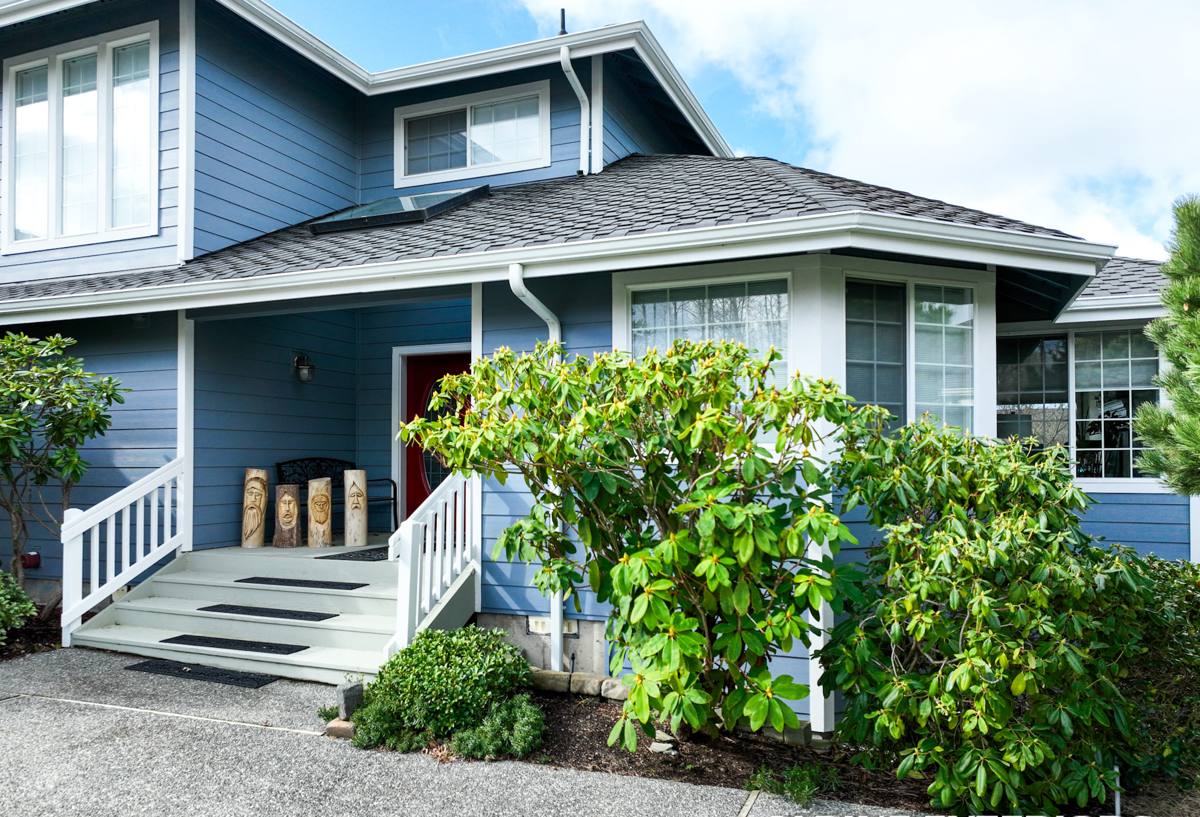
Birch Bay sits right on the water. That means salt-laden air moving inland, wind-driven rain off the Strait of Georgia, and a wet season that runs long — often eight or nine months of the year with some form of persistent moisture in the air. Add in the shade from mature evergreens on a lot of Whatcom County properties, and you get ideal conditions for moss, algae, and mildew to take hold on exterior surfaces.
Fiber cement as a category handles moisture better than wood. But "better than wood" isn't the same as "engineered for coastal Pacific Northwest exposure." That distinction is where our product decision actually lives.
Factory Finish Is the Real Battleground
Bare fiber cement is not weatherproof on its own — it needs a finish system, and that finish is what actually takes the beating from sun, salt, and rain year after year. This is the single biggest factor in how a fiber cement siding job looks in year ten versus year one.
James Hardie's ColorPlus finish is baked on at the factory in multiple coats under controlled conditions, backed by its own dedicated finish warranty separate from the substrate warranty. Cemplank offers factory-primed and some factory-finished options depending on the product line and distributor, but the finish warranty coverage and track record aren't structured the same way. In a climate that batters exterior finishes as consistently as ours does, that gap compounds over the life of the siding.
Installation Sensitivity
Fiber cement siding is not forgiving of sloppy installation, and this is true of every brand, not just Cemplank. Improper fastening, wrong nail placement, missing flashing details, or gaps at butt joints can let moisture behind the panel — and once water gets behind fiber cement in a climate like ours, it doesn't dry out quickly.
Where products differ is in how much documentation, training, and installer accountability exists behind the product. James Hardie publishes detailed climate-specific installation instructions, runs a certified installer network, and backs correct installations with a strong transferable warranty. That structure gives us — and you — a clear standard to install to and a real backstop if something goes wrong.
What Correct Installation Requires, Regardless of Brand
- Proper starter strip and clearance from grade, decks, and roof lines
- Correct fastener type, spacing, and penetration depth for the wind zone
- Weather-resistant barrier and flashing integrated at every window, door, and penetration
- Manufacturer-specified gaps at butt joints and trim, caulked or left open per spec
- Field-cut edges sealed or primed before installation, not left raw
Product Lines Engineered for This Climate
One thing that pushed us toward standardizing on a single manufacturer is the availability of climate-specific engineered product lines. James Hardie makes HZ5 product specifically formulated for wetter, colder climates like ours, with different moisture and freeze-thaw performance characteristics than their products built for hot, dry regions.
That kind of regional engineering — plus a single, consistent manufacturer warranty and support system — is hard to replicate when you're sourcing from a distributor-driven brand with less climate-specific product differentiation. It's one less variable we have to manage on your behalf.
Cost Comparison, Honestly
We won't pretend Cemplank and similar alternatives can't save you money upfront. They often can. The question is what that gap buys you, and what it might cost later.
| Factor | Cemplank / Comparable Fiber Cement | James Hardie |
|---|---|---|
| Material cost | Often somewhat lower | Moderate premium |
| Factory finish system | Varies by line and distributor | ColorPlus, consistent multi-coat baked finish |
| Climate-specific product lines | Limited regional differentiation | HZ5 engineered for PNW moisture/cold |
| Warranty structure | Manufacturer-dependent, varies by product | Strong transferable warranty, separate finish coverage |
| Local installer network/support | Smaller footprint in this region | Established certified network |
| Long-term maintenance in coastal climate | Depends heavily on installation quality | Designed with this exposure in mind |
None of this means Cemplank is a poor choice everywhere. In a drier inland climate, with a careful installer, it can perform well for a long time. We just don't think that's the right bet to make on a home two miles from saltwater in Whatcom County.
Why We Standardized on One Manufacturer
There's also a business-honesty reason behind this, and we'd rather be upfront about it than dress it up. Every crew gets better and more consistent the fewer variables they're managing. When we install one fiber cement system, with one set of specs, one finish warranty structure, and one manufacturer support line, our crews know that product cold. Mistakes go down. Callback rates go down. Warranty claims, on the rare occasion they're needed, go through a process we understand.
Switching between brands to chase a slightly lower material cost on a given job means our installers are relearning fastening specs, clearance requirements, and finish handling every time. In a climate as unforgiving of installation mistakes as this one, we don't think that trade-off is worth it for you or for us.
What This Means If You've Already Been Quoted Cemplank
If another contractor has quoted you Cemplank fiber cement, that doesn't automatically mean a bad job is coming. It means you should ask pointed questions about the finish warranty terms, the specific product line being used, and the installer's experience with that brand specifically in a coastal climate. A well-installed Cemplank job will outperform a poorly installed James Hardie job every time — the installer matters as much as the product.
What We Install Instead, and Why
We install James Hardie fiber cement exclusively — no vinyl, no LP SmartSide, no Cemplank, no primed spruce or cedar. It's non-combustible, holds up to the freeze-thaw and moisture cycles common here, comes with a factory finish we trust to hold color and integrity through Birch Bay's long wet stretch, and carries a warranty structure we can stand behind without caveats.
That's the whole reasoning. Not that every alternative is bad, but that after years of watching how different products age against salt air, driving rain, and a long moss season, one system has consistently given our clients the fewest problems and the longest service life.
Questions Worth Asking Any Siding Contractor
- What specific fiber cement product line are you quoting, and is it rated for coastal PNW exposure?
- Is the factory finish covered by its own warranty, separate from the substrate?
- How many jobs has your crew installed with this specific brand in the last year?
- What's the manufacturer's process if a finish or substrate warranty claim comes up?
- Who handles flashing and moisture barrier detailing, and can you walk me through it?
If you're weighing siding options for a home in Birch Bay or elsewhere in Whatcom County, we're happy to walk through what we install, why, and what it would look like on your house. Reach out for a free, no-pressure estimate — no obligation either way.