 Birch Bay
 Siding Built for the Whatcom County Climate
Homes in Sumas and the surrounding Birch Bay Siding service area sit in one of the more demanding exterior climates in Washington. Whatcom County gets a long, wet season that stretches from fall through spring, punctuated by driving rain that comes in sideways more often than most homeowners would like. Add in a moss season that can run most of the year on shaded north-facing walls, and you have an exterior environment that punishes any siding product with weak points at the seams, fasteners, or finish.
Our crew works across this region every week, from the coastal air near Birch Bay to inland communities like Sumas, where the climate story is a little different but no less demanding. Sumas sits near the Fraser Valley, and homes there deal with cold outflow winds funneling down from Canada during winter cold snaps, along with the same persistent damp that affects the whole county. That combination of cold, wind-driven moisture, and long gray stretches without much drying time is exactly the kind of environment that separates siding products that hold up from ones that don't.
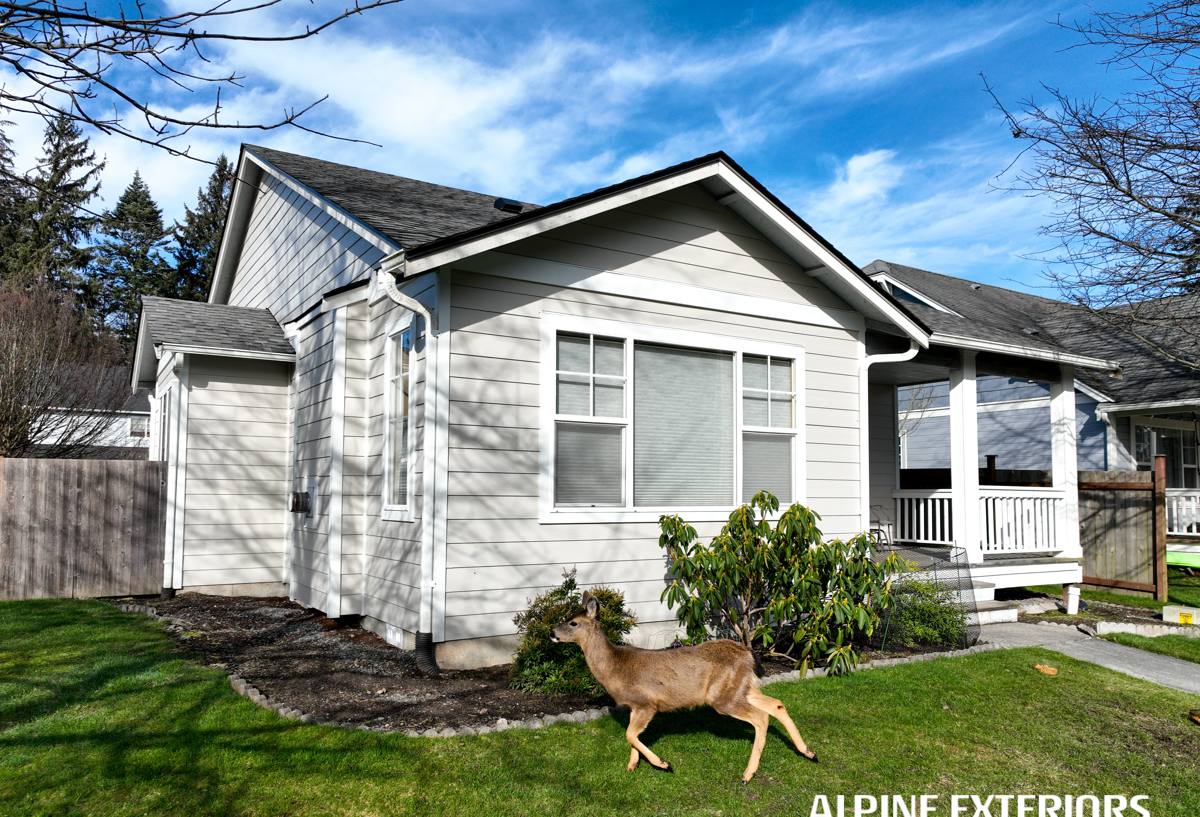
What Local Homes Are Actually Up Against
Every siding material reacts differently to sustained moisture exposure, and the failures we see on service calls in this region tend to follow a pattern.
- Moss and algae growth on shaded elevations that never fully dry out between rain events
- Paint and finish breakdown from repeated wet-dry cycling, especially on south and west-facing walls that also take direct sun
- Swelling and soft spots where wood-based or wood-adjacent products absorb moisture at cut edges, seams, or fastener penetrations
- Caulk failure at trim and joints, which opens the door for water intrusion behind the siding plane
- Wind-driven rain infiltration at poorly flashed windows, doors, and butt joints, worse in exposed or elevated lots
None of these are exotic problems. They're the predictable result of this region's climate acting on siding materials over years and decades. The products that hold up here are the ones engineered for exactly this kind of exposure, and installed by a crew that understands where water actually gets in.
Why We Install James Hardie Fiber Cement — and Nothing Else
Birch Bay Siding installs James Hardie fiber cement siding exclusively. We don't install vinyl, LP SmartSide, Cemplank, Allura, primed spruce, or cedar. That's not a marketing position — it's a standard we hold because of what we've seen play out on homes in this exact climate over time.
Fiber cement is a mix of cement, sand, and cellulose fibers, which makes it non-combustible and dimensionally stable in a way wood-based and wood-fiber siding products simply aren't. It doesn't absorb water the way engineered wood does, so it doesn't swell, delaminate, or develop soft spots at cut edges the way products with a wood-fiber core can when moisture gets past a seam or fastener. In a climate with this much sustained dampness, that difference matters more than it does in a drier region.
James Hardie's ColorPlus factory finish is baked on under controlled conditions rather than field-applied, which means better adhesion and color consistency than job-site painting, and a finish that's engineered to resist the fade and peel we see from UV and moisture cycling here. Hardie also builds region-specific HZ product lines engineered for climate zones like ours — wetter, cooler, more moss-prone — rather than a single one-size-fits-all formulation. That's a meaningful distinction from generic fiber cement competitors, and part of why we standardized on this specific manufacturer rather than fiber cement in general.
We're not going to tell you vinyl or engineered wood siding is garbage — plenty of it is installed correctly and performs adequately for years. But when we weigh installation sensitivity, long-term moisture behavior, and warranty structure against what we've watched happen on homes in Whatcom County's climate specifically, Hardie is the product we're willing to put our name behind. It's the only one we install.
How Fiber Cement Compares to the Alternatives
| Factor | James Hardie Fiber Cement | Vinyl | Engineered Wood (LP SmartSide) |
|---|---|---|---|
| Moisture absorption | Minimal; cement-based core | None, but seams and channels trap water | Wood-fiber core can swell if moisture reaches it |
| Fire resistance | Non-combustible | Melts/deforms under heat | Combustible wood-based product |
| Finish durability | Factory-baked ColorPlus finish | Color molded in; can fade | Field or factory paint; needs reapplication over time |
| Impact/pest resistance | High; resists woodpeckers and impact | Can crack in cold, dent easily | Vulnerable to pests and impact at damaged spots |
| Typical expected lifespan | 30+ years with proper install | 20-30 years | Manufacturer-dependent, moisture-sensitive |
Every one of these products has a legitimate use case somewhere. Our position is narrower than "fiber cement is always right" — it's that for this specific climate, on the homes we're asked to work on, Hardie is the product that holds up best against what Whatcom County weather actually does to a wall over 20 or 30 years.
A Note on Cost
Fiber cement generally costs more upfront than vinyl and is often comparable to or slightly above engineered wood siding, depending on the specific product line, trim package, and the condition of what's being removed. We won't quote a number here because every home is different — square footage, number of stories, existing siding condition, and trim complexity all move the price. What we can tell you honestly is that the upfront difference tends to look smaller once you factor in repainting cycles, moisture repair, and earlier replacement that lower-cost materials often require in this climate.
Roofing, Windows, and Decks — The Rest of the Exterior Envelope
Siding doesn't work in isolation. Water that gets past a roof edge, a window flashing detail, or a deck ledger connection ends up in the same wall assembly siding is supposed to protect. Because we handle roofing, windows, and decks in addition to siding, we look at a home's exterior as one connected system rather than a series of separate trades that don't talk to each other.
That matters in a place like Sumas, where wind-driven rain and cold snaps put real stress on flashing details, window seals, and any exposed fastener. A siding job that ignores a failing roof edge or a poorly flashed window is just delaying the next repair call. We'd rather flag that upfront during an estimate than have a homeowner deal with a surprise a few years down the road.
What a Siding Project Looks Like With a Local Crew
Sumas isn't a large market, and it's not the kind of place where a crew from out of the region shows up once and disappears. We work here regularly, which means we know how this area's exposure — wind, cold snaps, sustained damp — tends to affect a wall assembly, and we plan the install accordingly rather than applying a generic approach.
What a Typical Project Involves
- An on-site assessment of existing siding, trim, and any moisture damage already present
- A written estimate that accounts for the specific home — square footage, story count, trim detail, and any rot or sheathing repair needed
- Removal of old siding and inspection of the sheathing and weather barrier underneath before anything new goes up
- Correct water-resistive barrier and flashing detail at every window, door, and penetration — this is where most long-term failures actually start
- Installation of James Hardie panels or lap siding per manufacturer fastening and clearance specifications
- Final walkthrough covering caulking, trim, and touch-up before the job is called done
Questions Worth Asking Before You Hire Anyone
Whether you end up working with us or another contractor, these are the questions worth asking before signing anything for siding, roofing, window, or deck work in this region.
- Are you licensed and insured to work in Washington, and can you provide proof?
- Who is actually on the crew doing the install — subcontracted labor or your own employees?
- What manufacturer specifications are you following for fastening, clearance, and flashing?
- What does the warranty actually cover, and is it transferable if the home sells?
- Will you put the full scope of work, materials, and timeline in writing before starting?
- How do you handle water-resistive barrier and flashing detail around windows and doors?
A contractor who answers these clearly and without hesitation is usually one who does the work correctly. Vague answers, especially around flashing and warranty terms, are worth treating as a red flag.
Maintenance Realities for This Climate
No siding product is maintenance-free, and it's worth being honest about what ongoing care looks like even with a durable material like James Hardie. In a region with this much sustained moisture and shade, expect to periodically rinse off moss and algae growth on north-facing or heavily shaded walls, inspect caulking at trim and window joints every year or two, and keep gutters and downspouts clear so water isn't dumping directly against a wall section. These are simple tasks, but skipping them for years at a stretch is how small issues turn into bigger ones, regardless of what siding material is on the wall.
Get a Straightforward Estimate
If you're weighing a siding, roofing, window, or deck project on a home in Sumas or elsewhere in the Birch Bay Siding service area, we're happy to walk the property, look at what's actually going on, and give you a straightforward assessment — no pressure, no inflated scope. Reach out for a free estimate using the form below.