 Birch Bay
 Exterior Work Built for the Point Whitehorn Coastline
Point Whitehorn sits on one of the more exposed stretches of Whatcom County shoreline, and homes here take a different kind of beating than houses just a few miles inland. The combination of salt-laden air off the Strait of Georgia, driving rain that comes in sideways during winter storms, and a moss season that can stretch from October well into spring puts real, cumulative stress on siding, roofing, trim, and anything painted or unprotected. We've worked on homes throughout this stretch of Whatcom County, and the pattern is consistent: it's rarely one dramatic failure that gets a homeowner calling us. It's years of small compromises — a paint film that's chalked and thinned, caulk joints that opened up, moss holding moisture against a roofline — that finally add up to a real problem.
This page walks through what that climate actually does to a house near Point Whitehorn, how our siding, roofing, window, and deck services address it, and why we standardized on one siding product instead of offering the usual menu of options.
What the Local Climate Does to a House
Salt Air and Airborne Moisture
Homes closer to the water deal with salt-laden air that settles on every exterior surface. Over time, that salt film holds moisture against paint, wood, and metal fasteners longer than it would sit on a dry surface. Painted wood trim chalks and fades faster near the shoreline. Uncoated or poorly coated metal — flashing, fasteners, gutter hardware — corrodes at a noticeably faster rate than the same materials would a few miles inland. It's not that salt air destroys a house quickly; it's that it shortens the interval between maintenance cycles if the materials and coatings aren't up to the exposure.
Driving Rain and Wind-Driven Water
Whatcom County's winter storms don't just drop rain straight down — wind pushes it sideways into wall assemblies, under trim, and into any gap in flashing or caulking. Point Whitehorn's relatively open exposure means less windbreak from trees or terrain than a lot of infill lots elsewhere in Birch Bay. That makes water management — flashing details, house wrap, proper siding overlaps, deck ledger connections — more important here than it would be on a sheltered inland lot. A siding job that's fine in a protected neighborhood can fail early on an exposed coastal lot if the water-management details weren't done right.
The Long Moss Season
Cool, damp, and shaded conditions for much of the year make moss and algae growth a near-constant issue on north-facing walls, roof valleys, and anywhere sunlight doesn't reach for long stretches. Moss on a roof holds moisture against shingles and can work into laps and fastener penetrations over time. Moss and green staining on siding isn't just cosmetic — on porous or absorbent siding materials, it can indicate the surface is holding moisture longer than it should.
Siding: Why We Only Install James Hardie
We get asked fairly often why we don't offer vinyl, LP SmartSide, or other fiber-cement brands alongside Hardie. The honest answer is that we made a standardization decision based on what holds up in this exact climate, and we'd rather do one product exceptionally well than spread our crews thin across several.
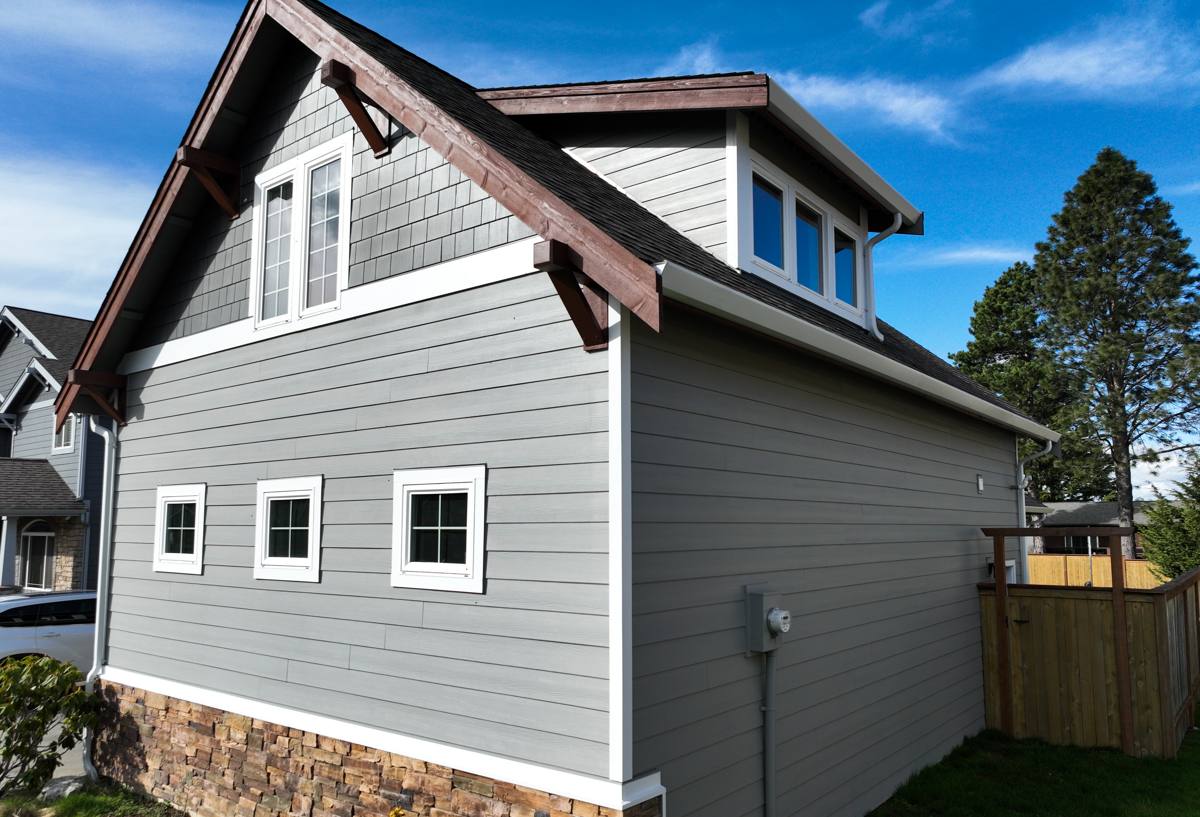
James Hardie fiber cement is non-combustible, dimensionally stable in wet-dry cycling, and its ColorPlus factory-applied finish is baked on under controlled conditions rather than field-applied on a jobsite in variable weather. In a climate with this much sustained moisture exposure, a factory finish matters — it isn't relying on a painter getting perfect conditions and perfect coverage on a coastal install day. Hardie also engineers regional product lines (HZ5 for our climate zone) specifically for wet, moderate-freeze conditions like ours, which is a level of climate-specific engineering that generic fiber cement or vinyl products don't offer.
What We're Not Installing, and Why
- Vinyl siding: lightweight and inexpensive, but it expands and contracts significantly with temperature swings, can warp or crack in high wind exposure, and its seams and J-channels give wind-driven rain more opportunities to get behind the cladding on an exposed lot.
- LP SmartSide (engineered wood): a legitimate product with real strengths, but it's a wood-based composite, and wood-based sidings are more sensitive to sustained moisture exposure than fiber cement — cut edges and fastener penetrations need meticulous sealing, which is a harder standard to hold consistently on every job in a wet coastal climate.
- Cemplank, Allura, and other fiber cement brands: chemically similar to Hardie in composition, but we don't have the regional engineering data, factory-finish track record, or warranty structure on those brands that we have confidence standing behind long-term.
- Primed spruce or cedar: beautiful materials, but they require a maintenance commitment — regular refinishing, vigilant caulking — that most homeowners underestimate, especially with this area's moss and moisture exposure working against any lapse in upkeep.
None of these are bad products in the abstract. They're just trade-offs we don't think are worth making on homes exposed to this much salt air and driving rain, when a better-suited alternative exists.
Roofing: Managing Moss and Wind-Driven Water
Roofing near Point Whitehorn has to account for both the moss problem and the wind-driven rain problem at once. That means proper underlayment, careful attention to valley and flashing details (especially around any roof penetrations), and ventilation that keeps the roof deck from staying damp longer than it needs to. We look at moss growth patterns during an inspection as a diagnostic tool, not just a cosmetic complaint — heavy moss concentrated in one area often points to a spot that's staying wetter than the rest of the roof, which is worth investigating before it becomes a leak.
Windows: Sealing Out Wind-Driven Rain
Window replacement on an exposed coastal lot is as much about the installation as it is about the window unit itself. Flashing that integrates correctly with the wall's water-resistive barrier, proper sill pans, and sealant details that account for wind-driven rain rather than just vertical rainfall are what actually keep water out over the long run. We see plenty of older single-pane and early dual-pane windows in this area with failed seals and fogged glass — often a sign the original installation didn't fully account for how much lateral water pressure a storm off the Strait can put on a window assembly.
Decks: Built for Wet-Dry Cycling
Decks near Point Whitehorn spend a lot of the year damp, then get intermittent sun exposure that dries surfaces unevenly — a cycle that's hard on fasteners, ledger connections, and any wood component that isn't properly flashed away from the house. Ledger board flashing is one of the most common failure points we find on older decks in this area, since trapped moisture there can lead to rot that isn't visible until it's advanced. Composite decking surfaces reduce some of the maintenance burden compared to wood, but the structural framing and ledger connection still need to be built and flashed correctly regardless of what decking material sits on top.
Comparing Siding Options for This Climate
| Material | Moisture Behavior in Coastal Climate | Maintenance Burden | Factory Finish |
|---|---|---|---|
| James Hardie Fiber Cement | Dimensionally stable, non-combustible, engineered for wet climates (HZ5) | Low — periodic cleaning, no refinishing needed | Yes — ColorPlus baked-on finish |
| Vinyl | Doesn't absorb moisture, but seams/joints allow water intrusion behind panels; expands/contracts with temperature | Low, but prone to warping/cracking in wind | Color molded in, fades over time, not repaintable easily |
| LP SmartSide | Wood-based; sensitive to sustained moisture at cut edges and fasteners | Moderate — requires diligent sealing and monitoring | Factory primer, field-applied topcoat typical |
| Cedar / Primed Wood | Absorbs moisture readily; needs consistent protective coating | High — regular refinishing and caulk maintenance | No — field-applied and reapplied over time |
What to Look For When Hiring a Contractor Here
Whatcom County has a lot of general contractors who'll take on siding, roofing, or window work as one line item among many. For a coastal-exposure property, that's not necessarily enough. Ask specifically about their experience with wind-driven rain detailing, moss-prone roofing, and salt-air corrosion on fasteners and flashing — those are the failure points that separate a job that lasts from one that doesn't in this specific environment.
- Ask how they detail flashing and water-resistive barriers around windows and wall penetrations, not just what siding brand they install.
- Confirm they're using stainless or coated fasteners rated for coastal/salt-air exposure, not standard interior-grade hardware.
- Ask how they'll manage moss and algae exposure on north-facing and shaded elevations.
- Get manufacturer certification confirmation if they claim to install James Hardie products — proper installation is what keeps the warranty valid.
- Ask for a written scope that specifies underlayment, flashing details, and fastener schedule, not just "reside the house."
Working With a Local Crew
A crew that works this stretch of Birch Bay and Whatcom County regularly knows which elevations on a given lot take the worst of the weather, how local moss patterns tend to develop, and which flashing and fastening details actually hold up here versus what's fine in a drier or more sheltered market. That local pattern recognition is hard to replicate with a crew that mostly works inland or in a different climate zone — it shows up in the small decisions made on-site, not just the materials list.
If you're weighing a siding, roofing, window, or deck project for a home near Point Whitehorn, we're happy to walk the property, look at how the weather has treated it so far, and put together a straightforward, no-pressure estimate — just fill out the form below.