 Birch Bay
 Why California Creek's Exposure Is Tougher on Siding Than It Looks
California Creek sits close enough to the water that homes here take a steady diet of salt-laden air, wind-driven rain, and long stretches of damp, shaded moisture that never fully dries out between storms. Whatcom County's marine climate means mild temperatures, but mild doesn't mean easy on a building envelope. The combination of salt exposure, near-constant humidity, and heavy tree cover in parts of the neighborhood creates conditions that most siding products were never engineered to handle for the long haul.
Salt air accelerates corrosion on fasteners, trim, and any exposed metal. Driving rain off the water finds every gap, seam, and poorly caulked joint and pushes moisture behind the cladding rather than letting it run off the surface. And the moss season that stretches through much of the fall, winter, and spring keeps north-facing and shaded walls wet for weeks at a time, feeding the kind of organic growth that traps moisture against a wall and slowly breaks down anything not built to resist it.
None of this is unique to one house on one street — it's the baseline condition for this stretch of Birch Bay, and it's the starting point for every siding decision we make here.
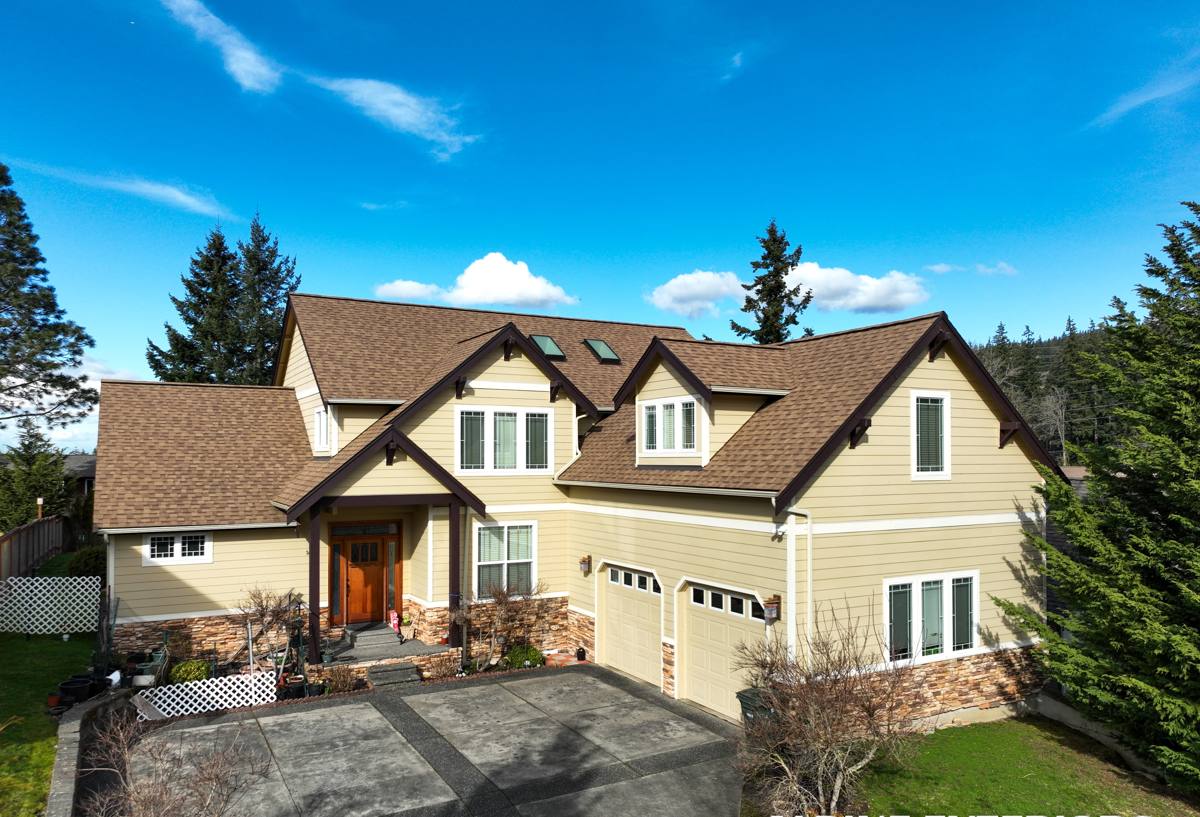
What James Hardie Siding Is Built to Handle
James Hardie fiber cement siding is a cement, sand, and cellulose fiber composite, factory-cured and engineered specifically to resist the failure modes that show up in exposures like this one. It's non-combustible, dimensionally stable across wet and dry cycles, and finished with Hardie's ColorPlus factory coating — a baked-on finish that holds color and resists fading, chipping, and cracking far better than field-applied paint.
James Hardie also builds its products in climate-specific engineering lines, marketed as HZ5 and HZ10 depending on the region. The Pacific Northwest falls into the HZ5 category, which is formulated for the freeze-thaw cycling, sustained moisture, and moderate winters typical of this coastal zone. That's not marketing language — it affects how the product is manufactured to resist moisture absorption and hold up to the specific weather pattern a house in California Creek actually experiences, rather than a generic national spec.
Why We Standardized on One Product
We install James Hardie exclusively. We don't install vinyl, LP SmartSide, Cemplank, Allura, or unfinished wood siding like primed spruce or cedar. That's not a marketing position — it's a decision built on what we've seen hold up in this climate over time versus what struggles. Vinyl can warp and crack in temperature swings and doesn't offer the same fire resistance. Engineered wood products carry moisture-sensitivity concerns at cut edges and seams. Bare wood siding demands a maintenance schedule most homeowners don't realize they're signing up for, especially in a climate that barely gives a wall time to dry out. Hardie isn't perfect either — it's heavier to install, requires correct fastening and flashing to perform as designed, and costs more upfront than vinyl. We think that trade-off is worth it for a house that's going to sit exposed to Birch Bay weather for decades.
What a Correct Installation Actually Involves
Fiber cement siding is only as good as the installation behind it. A huge share of the siding problems we get called out to inspect in this area aren't product failures — they're installation shortcuts that let water in behind a system that was designed to keep it out. In a climate with this much driving rain and salt exposure, the details matter more than they would somewhere drier.
- A correctly lapped, sealed weather-resistant barrier (house wrap) behind the siding, not just stapled on and left
- Proper flashing at every window, door, and roofline transition, integrated with the wrap so water sheds outward rather than pooling behind trim
- Rain screen or drainage gap detailing where the wall assembly calls for it, so any moisture that does get behind the cladding has somewhere to go
- Fasteners installed at Hardie's specified pattern and depth — not overdriven, not underdriven, and corrosion-resistant given the salt air here
- Correct board-to-board and butt joint spacing, caulked and painted per Hardie's published installation instructions
- Clearance between the bottom of the siding and grade, decks, or roofing to avoid wicking moisture up from below
Skip any one of these and you can end up with a wall that looks fine for a year or two and then starts showing swelling, staining, or paint failure at the joints — problems that trace back to installation, not the material itself.
How We Approach a California Creek Job
Every property in this neighborhood has its own mix of sun exposure, wind direction, and tree cover, so we don't run a one-size-fits-all process. What stays consistent is the sequence.
| Step | What Happens |
|---|---|
| Site walk and assessment | We look at existing siding condition, moisture staining, trim and flashing details, and exposure direction (which walls take the worst weather) |
| Removal and substrate check | Old siding comes off and we inspect sheathing for hidden rot or moisture damage before anything new goes up |
| Weather barrier and flashing | House wrap, window and door flashing, and drainage detailing installed to current best practice, not just what was there before |
| Hardie installation | Panels or lap siding installed to manufacturer fastening and clearance specs, with attention to joint sealing |
| Trim, caulking, and touch-up | Final trim work, factory-finish touch-up paint at cut edges, and a walk-through before we call it done |
Problems We Commonly See on Older Siding in This Area
When we're called out to look at existing siding in Birch Bay and the surrounding waterfront neighborhoods, a handful of issues show up repeatedly:
- Moss and algae buildup on north- and east-facing walls that stay shaded and damp longer through the year
- Corroded or rust-streaking fasteners on older installs where standard fasteners were used instead of corrosion-resistant ones
- Caulk failure at butt joints and trim, letting wind-driven rain track behind the siding
- Paint failure and swelling on wood or engineered wood products where moisture got into cut edges
- Bowing or buckling panels where siding was installed too tight to the ground or adjoining hardscape with no clearance
Almost all of these are preventable with correct product selection and installation detail — which is the whole reason we've narrowed our focus to one system we can install consistently well.
What Affects the Cost of a Job Like This
Every home is different, so we don't quote sight unseen, but a few factors tend to move the number the most on a California Creek project.
| Factor | Why It Matters |
|---|---|
| Existing siding removal | Tear-off and disposal of old material adds labor, especially if there's hidden damage underneath |
| Sheathing repair | Rot or moisture damage found during removal has to be fixed before new siding goes up |
| Home size and complexity | Roofline transitions, dormers, and multiple stories add cutting, flashing, and staging time |
| Siding profile and trim package | Lap siding, panel systems, and trim details (shakes, board-and-batten) carry different material and labor costs |
| ColorPlus finish selection | Factory-finished color options avoid future field painting but are chosen upfront during ordering |
Maintaining Hardie Siding in a Salt Air, Moss-Prone Climate
Fiber cement is low-maintenance compared to wood, but "low-maintenance" isn't "no-maintenance," especially this close to the water. A little seasonal attention goes a long way toward getting the full lifespan out of the system.
- Rinse siding periodically to clear salt residue and organic buildup, especially on shaded or wind-exposed walls
- Keep gutters clear so overflow isn't running down the face of the siding during heavy rain
- Trim back vegetation and tree cover that keeps a wall section shaded and damp longer than the rest of the house
- Inspect caulking at trim and joints every year or two and re-caulk before gaps open up
- Watch for moss starting on north-facing walls and address it early rather than letting it establish
Why It Matters That We Already Work This Neighborhood
A crew that already knows Birch Bay's exposure patterns isn't guessing at flashing details or fastener choices — we've seen what holds up on this stretch of Whatcom County coastline and what doesn't. That familiarity shows up in small decisions during installation: where to add extra flashing attention, which walls need more clearance, how to detail a joint knowing it's going to take direct salt spray in a winter storm. It's the difference between a generic install and one built for the specific conditions a California Creek home actually faces.
If you're weighing a siding replacement or want a second opinion on an existing installation, we're happy to take a look. Reach out for a free, no-pressure estimate — we'll walk the property, answer your questions honestly, and give you a straight assessment of what your home needs.