 Birch Bay
 Siding Built for Marietta's Weather, Not Just Installed Here
Marietta sits low and close to the water in Whatcom County, and that location shapes everything about how a house exterior ages here. Homes in this part of the county deal with a longer wet season than most of the country, salt-tinged air rolling in off the bay, and enough shade and moisture in the fall and winter to keep moss and algae established on roofs, siding, and trim for months at a time. None of that is unusual for anyone who has lived here a while — but it does mean the exterior products and installation methods that work fine in a drier climate often don't hold up the same way in Marietta.
We're a local crew, not a call center that dispatches whoever's available. When we bid a job in Marietta, we're accounting for the same salt air, driving rain, and moss pressure we see on our own jobs up and down this stretch of Whatcom County. That local knowledge changes decisions on flashing details, product selection, and maintenance recommendations — not just the sales pitch.
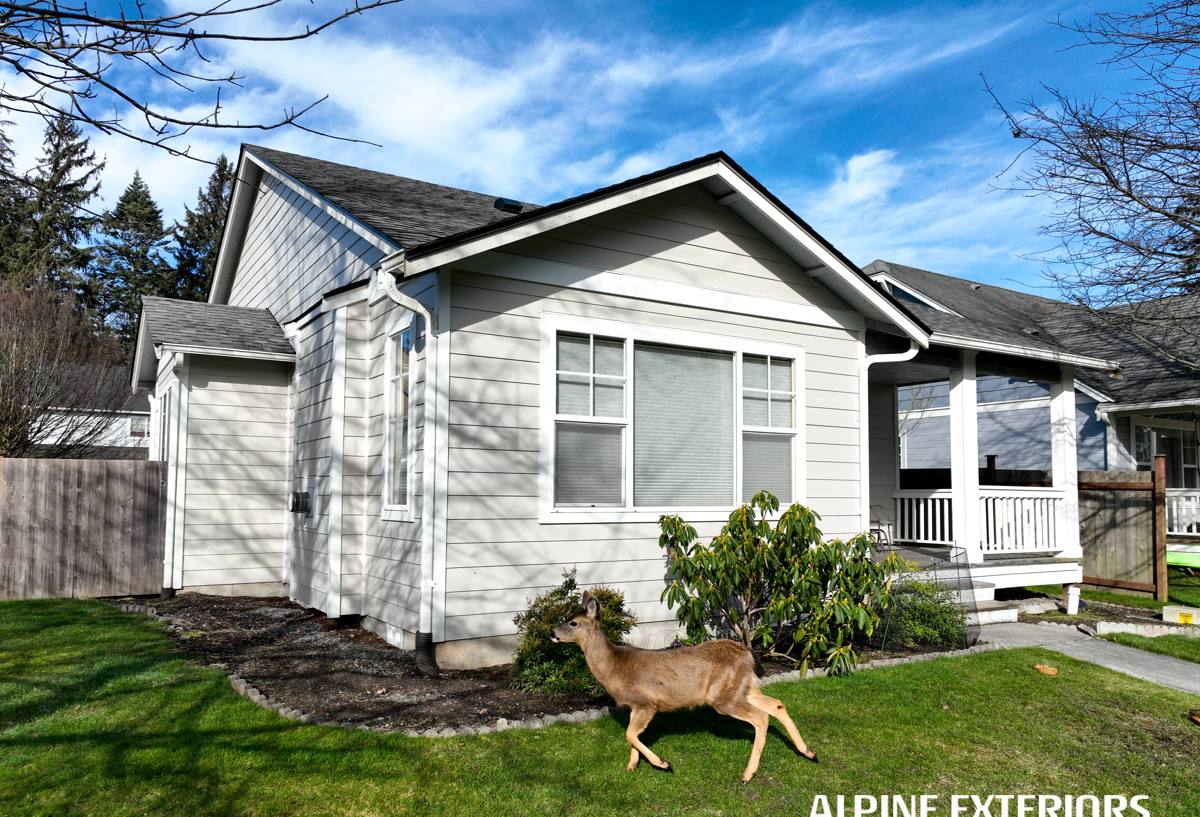
What the Climate Actually Does to a House Exterior
Salt Air and Moisture Intrusion
Proximity to Birch Bay and the Strait of Georgia means airborne salt is a real factor here, more than most homeowners realize until they see it in the corrosion on fasteners, hardware, and lower-quality trim. Salt air accelerates the breakdown of untreated or poorly sealed wood, and it's tough on paint films that aren't engineered for coastal exposure. Combined with driving rain that comes in sideways during winter storms, any gap in the water-resistive barrier, any poorly lapped joint, or any caulk seam that was never meant to be a primary water seal becomes a path for moisture to get behind the cladding.
The Long Moss and Algae Season
Whatcom County's wet, mild winters and shaded lots — common on wooded parcels around Marietta — create ideal conditions for moss and algae to take hold on north-facing walls, roof valleys, and anywhere siding stays damp longer than it should. Moss doesn't just look bad. It holds moisture against the surface it's growing on, which is exactly the kind of sustained dampness that rots wood-based siding and degrades paint and caulk faster than dry-climate exposure ever would.
Freeze-Thaw and Seasonal Swings
It doesn't get brutally cold here most winters, but Whatcom County does see enough freeze-thaw cycling that any siding product prone to swelling and shrinking with moisture content — or any product where water has already gotten behind the surface — will show that stress over time, usually as cracking, cupping, or paint failure at the joints first.
Why We Install Only James Hardie Fiber Cement
We made a decision as a company to install James Hardie fiber cement siding exclusively — not LP SmartSide, not vinyl, not Cemplank or Allura, not primed spruce or cedar. That's not a marketing angle; it's a standard we hold to because of what we've seen happen to exteriors in exactly this kind of climate.
Fiber cement is non-combustible and dimensionally stable, meaning it doesn't swell and shrink with moisture the way wood-based products do. That matters enormously in a climate with a long wet season — a product that stays dimensionally consistent holds its paint line and caulk joints far longer than one that's constantly expanding and contracting with humidity. James Hardie's ColorPlus factory-applied finish is baked on under controlled conditions, which gives it better adhesion and UV resistance than field-applied paint, and Hardie's HZ5 product line is specifically engineered for the kind of wet, freeze-prone Pacific Northwest exposure that Whatcom County sees.
We're not going to tell you every other siding product is junk — that's not honest, and it's not our call to make about someone else's manufacturing. What we will say is that after years of doing exterior work in this specific climate, we stopped installing products that require more maintenance, that are more sensitive to installation error around moisture management, or that carry warranty structures we felt didn't hold up to what coastal Whatcom County actually throws at a house. James Hardie is what we're willing to put our name behind.
How Fiber Cement Compares to the Alternatives
| Factor | James Hardie Fiber Cement | Vinyl Siding | Wood/Engineered Wood (LP, Cedar) |
|---|---|---|---|
| Moisture response | Dimensionally stable, resists warping | Can warp/buckle with heat, doesn't rot but traps moisture behind it | Prone to swelling, cupping, rot if moisture gets in |
| Fire rating | Non-combustible | Combustible, can melt/deform | Combustible |
| Finish durability | Factory-baked ColorPlus finish, long fade resistance | Color molded in but can fade/chalk over time | Field-applied paint/stain needs recoating every few years |
| Moss/algae resistance | Doesn't feed organic growth; surface sheds it more easily | Resists rot but moss/algae still adhere to surface | Organic material, more susceptible to moss and fungal growth |
| Typical warranty structure | Long, transferable limited warranty on material | Varies widely by manufacturer and gauge | Shorter, often excludes moisture damage |
What a Full Exterior Job Involves
Siding rarely fails in isolation. On coastal Whatcom County homes, we regularly find that a siding problem traces back to a roofing issue — a failed valley, undersized gutters, or moss buildup holding water against the roofline longer than it should. That's part of why we handle siding, roofing, windows, and decks as one exterior practice instead of treating each as a separate trade with separate crews who never talk to each other.
Siding
Full tear-off and Hardie replacement, or targeted repair and repainting sections where the underlying structure is sound. Every job includes attention to flashing, house wrap, and water-resistive barrier details — the parts of the job that don't show but determine whether the siding actually performs in driving rain.
Roofing
Roof condition directly affects how much water your siding and trim have to deal with. We assess roof drainage, valley condition, and moss/moisture issues as part of any full exterior evaluation, since a compromised roof edge is one of the most common hidden causes of siding rot we find during tear-off.
Windows
Window flashing and integration with the siding plane is one of the most common failure points on older Whatcom County homes. When we replace siding around existing windows, we check and correct flashing details rather than just cutting siding to fit around a problem that's already there.
Decks
Decks in this climate face the same driving rain and moss exposure as siding, plus standing water and ground contact. We build and repair decks with the same moisture-management mindset we apply to siding — proper drainage, ledger flashing, and material choices suited to a wet climate.
Signs Your Marietta Home May Need Exterior Attention
- Soft or spongy spots when you press on siding, especially near the bottom courses or window and door trim
- Persistent moss or dark algae streaking on north- or shade-facing walls that keeps coming back after cleaning
- Paint that's peeling, bubbling, or chalking heavily rather than just fading evenly
- Visible gaps, cracking, or separation at siding joints and corners
- Rust staining below fasteners or trim, a common sign of corrosion in coastal air
- Interior signs like musty smells, peeling interior paint, or discoloration on walls that share an exterior wall
- Roof moss buildup or clogged gutters that keep water sitting against the roofline or fascia longer than it should
How We Approach a Job in Marietta
Every exterior job starts with an honest look at what's actually going on, not just an estimate written from the driveway. For siding specifically, that means checking for hidden moisture damage under the existing cladding, evaluating the condition of the house wrap and flashing, and being straightforward about what's cosmetic versus what's structural.
Installation Details That Matter Here
Correct James Hardie installation isn't just nailing panels to a wall — it's a system, and it's sensitive to getting the details right, which is part of why we insist on doing it ourselves rather than subbing it out to whoever's cheapest that month. Proper clearance from grade and roof lines, correct fastener pattern and spacing, properly lapped and sealed joints, and integration with flashing at windows, doors, and roof intersections all matter more in a climate that gets this much sustained rain. A Hardie installation done to spec in a dry climate can tolerate more sloppiness than the same installation would get away with here.
Working Around Existing Conditions
Older homes in this area sometimes have layers of siding history — original wood siding under a later re-side, for example. We evaluate what's actually on the wall before quoting, since tear-off scope and any necessary sheathing repair affect both cost and timeline.
Cost Factors for Siding Projects in This Area
| Factor | How It Affects Scope/Cost |
|---|---|
| Tear-off vs. re-side over existing | Full tear-off costs more but allows inspection and repair of sheathing/framing underneath |
| Hidden moisture damage | Rot found during tear-off adds repair scope; more likely on older or long-neglected homes |
| Home size and wall complexity | More corners, dormers, and trim details increase labor time |
| Trim and accent work | Hardie trim boards, soffit, and fascia add cost but improve long-term durability and appearance |
| Window/flashing correction | Fixing improperly flashed windows during a re-side adds labor but prevents recurring leaks |
| Access and site conditions | Steep lots, limited driveway access, or heavy landscaping can affect staging and labor time |
Why a Local Crew Matters More Than It Sounds Like It Should
A crew that works Whatcom County regularly knows what a coastal Marietta lot demands versus a drier inland property, even one twenty minutes away. That shows up in small decisions — how much clearance to leave at grade, which side of the house needs extra attention to moss and shade, how aggressive to be about flashing at roof-to-wall transitions — that a crew unfamiliar with this specific stretch of coastline might not think twice about. It also means someone local is available if a warranty question or a maintenance question comes up years down the road, not a name on an invoice from a company that moved on to the next region.
Maintenance in a Wet, Salt-Air Climate
Even a well-installed exterior benefits from basic upkeep in this climate. Rinsing siding periodically to keep salt residue and organic buildup from accumulating, keeping gutters clear so water isn't sheeting down the wall, and trimming back vegetation that keeps a wall shaded and damp all extend the life of any siding product — Hardie included. The difference is that Hardie's factory finish and non-organic composition mean it doesn't demand the recoating and rot-prevention maintenance that wood-based products do just to stay even with where it started.
If you're seeing any of these signs on your Marietta home, or you're just planning ahead for a siding, roofing, window, or deck project, we're happy to take a look and give you a straightforward, no-pressure estimate. There's no cost and no obligation to get our read on your home's condition — just fill out the form below.