 Birch Bay
 Cherry Point Sits Right in the Path of the Weather That Wears Out Siding
Cherry Point is a shoreline community along the Salish Sea just north of Birch Bay, in Whatcom County — close enough to the water that homes here take on a different kind of weather load than houses even a few miles inland. It's not just rain totals. It's salt-laden air coming off the water, driving rain that hits walls at an angle instead of falling straight down, and long stretches of overcast, damp weather that give moss and algae months at a time to take hold on north-facing walls and anything shaded by trees.
None of that is unusual for northwest Whatcom County. But it does mean siding decisions that work fine in a drier, more sheltered part of the state don't hold up the same way out here. Salt air accelerates corrosion on fasteners and trim hardware. Wind-driven rain finds gaps and seams that would stay dry in a calmer climate. And moss doesn't just look bad — sustained moisture trapped under it is exactly the kind of slow, patient damage that rots wood-based siding and delaminates weaker composite products from the inside out.
What Fiber Cement Actually Solves for a Cherry Point Home
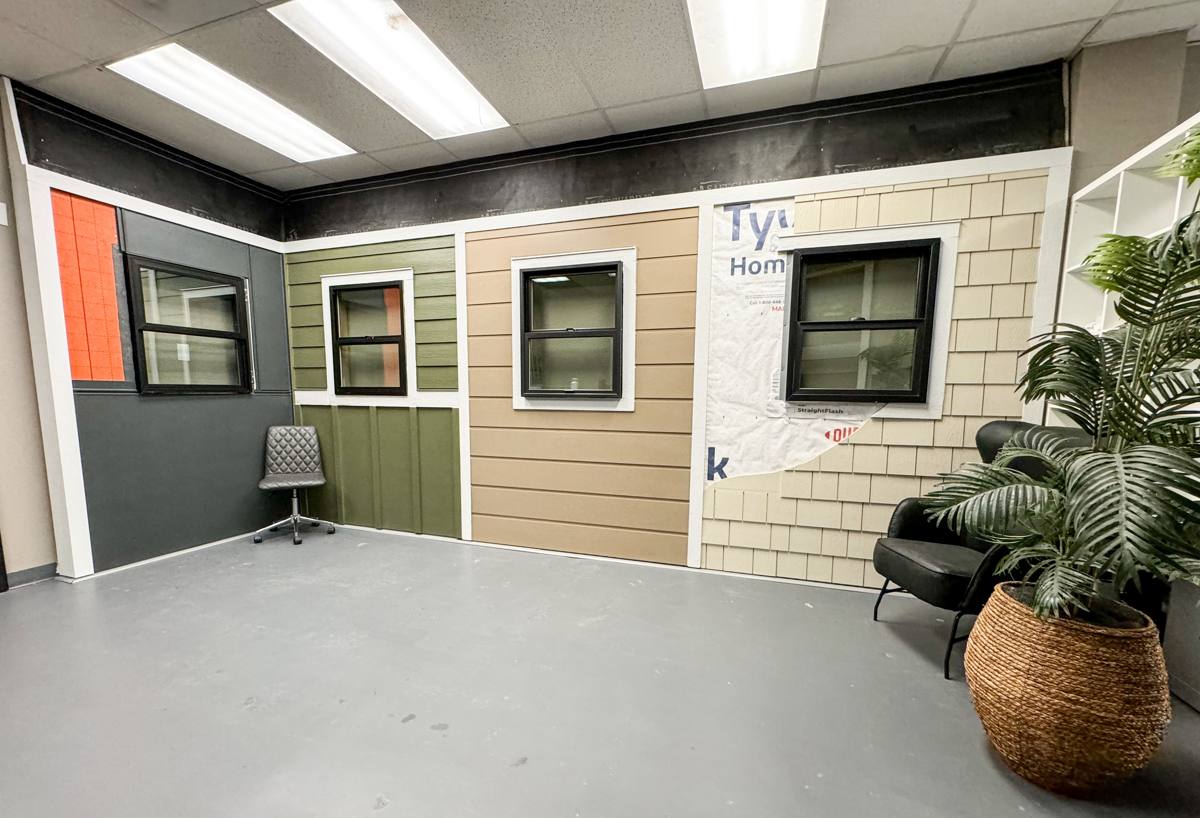
Fiber cement siding is cement, sand, and cellulose fiber pressed into planks and cured — there's no wood pulp core to absorb water, swell, and rot, and nothing organic on the surface for moss to feed off the way it can with untreated wood or some engineered wood products. That matters directly here: a material that doesn't take on water at the plank level removes one of the biggest long-term failure points in a marine climate.
It's also non-combustible, which matters less for moss and rain and more as a baseline safety upgrade over wood-based sidings — worth mentioning because it's part of why we standardized on it in the first place, not just a coastal-specific benefit.
The factory-applied ColorPlus finish is the other piece that matters here. It's baked on in a controlled factory environment rather than brushed on in the field, and it's formulated to hold color and resist fading through UV exposure and salt exposure alike. A field-painted product — primed wood, primed spruce trim, some engineered wood sidings — depends on the paint job holding up against exactly the conditions Cherry Point throws at it hardest: driving rain finding hairline cracks in the paint film, salt residue breaking down the finish faster than inland homes ever see.
Why We Only Install James Hardie
We install James Hardie fiber cement and nothing else — not vinyl, not LP SmartSide or other engineered wood, not primed spruce or cedar. That's a standard we hold across every job, not something specific to this area, but it's worth explaining briefly here because it shapes every recommendation on this page. Hardie's ColorPlus finish, its non-combustible composition, and its transferable warranty are the reasons we settled on one product line rather than offering several tiers at different price points. We'd rather do one thing right than install several products we can't fully stand behind in this climate.
HZ Engineering: Why the Climate Rating on the Box Isn't Marketing
James Hardie manufactures its siding in different formulations rated for different climate zones — engineered for the moisture, temperature swings, and freeze exposure a given region actually sees rather than a one-size-fits-all product. Western Washington's mix of sustained damp weather with occasional hard freezes puts it in the colder-climate HZ category rather than the hot-humid formulation used in Gulf Coast or Southeast installs. The point isn't the label — it's that the product going on a Cherry Point wall is formulated for a climate that includes both freeze-thaw cycles and months of sustained moisture, not a generic siding board.
What a Correct Installation Involves Out Here
The siding itself only performs as well as what's behind it. In a wind-driven-rain environment like this, the installation details matter more than they would in a calmer climate:
- A drainable housewrap or rainscreen gap behind the siding, so any moisture that does get past the cladding has somewhere to drain and dry rather than sitting against the sheathing
- Correct flashing at every window, door, and roofline penetration — the places wind-driven rain actually finds its way in
- Manufacturer-specified gaps and sealant at butt joints and trim, sized for the expansion and contraction the product actually experiences here
- Corrosion-resistant fasteners, given the salt content in the air this close to the water
- Factory-cut edges properly sealed or field-painted per spec, since a raw cut edge is the one place on the board that isn't factory-finished
Skip any one of these and you can still end up with moisture problems behind fiber cement siding that's otherwise doing its job — the board isn't the whole system, the installation is.
Our Process on a Cherry Point Job
We start with an inspection of the existing wall assembly, not just the siding surface. On a re-side, that means checking sheathing and framing for moisture damage before anything new goes up — it's far cheaper to find and fix rot now than to bury it under new siding and deal with it in five years. From there:
- Remove existing siding and inspect/repair sheathing as needed
- Install a drainable weather-resistive barrier and rainscreen furring
- Install trim, corner boards, and flashing at all penetrations before the field siding goes up
- Install Hardie planks or panels per manufacturer fastening and gapping specifications
- Caulk and seal per spec, touch up any factory-cut edges
- Final walk-through and cleanup
None of that is unique to us — it's simply what a correct Hardie installation requires. What we'd add is that we don't shortcut the rainscreen or flashing steps to save time, because in a climate that sends wind-driven rain at these walls for months at a stretch, those are the steps that actually determine whether the job holds up.
Living With It After Installation: Salt Air and Moss Season
Fiber cement doesn't need repainting and won't rot, but it isn't entirely maintenance-free in this environment. A few things are worth building into a regular routine for a home this close to the water:
Rinsing the siding down once or twice a year removes salt residue and general grime before it has a chance to sit against the finish long-term. Keeping gutters and downspouts clear matters more here than in a drier climate, since overflow running down a wall keeps that section wetter than the rest of the house and gives moss a head start. Trimming back trees and shrubs that shade a wall improves airflow and sun exposure, which is the single biggest factor in how much moss and algae actually take hold. And it's worth checking caulking at trim and penetrations annually — not because Hardie fails, but because sealant is the one component in the whole system with a shorter service life than the siding itself.
What Drives the Cost on a Job Like This
| Cost Factor | Why It Affects the Price |
|---|---|
| Home size and number of stories | More square footage and taller walls mean more material and more labor, plus added scaffolding or lift costs on multi-story homes |
| Condition of existing sheathing | Rot or moisture damage found during tear-off has to be repaired before new siding goes up — this is the most common source of a cost adjustment mid-project |
| Trim and architectural detail | Homes with more corners, dormers, and trim work take more time to flash and finish correctly than a simple rectangular footprint |
| Siding profile chosen | Lap width, panel style, and shake-style accents vary in material cost and installation time |
| Site access | Waterfront lots, steep driveways, or limited staging space can add time for material handling and equipment |
| Re-side vs. full tear-off | Installing over existing siding (where code and conditions allow) versus a full tear-off changes both material and labor scope |
Anyone quoting a job in Cherry Point without at least discussing sheathing condition, site access, and the rainscreen/flashing approach is giving a rough guess, not a real estimate.
Why It Matters Who You Hire
Fiber cement siding is forgiving of a lot of things, but it isn't forgiving of a skipped rainscreen, a missed flashing detail, or fasteners driven wrong — and in a climate that sends sustained wind-driven rain at these walls for a good part of the year, those mistakes surface faster here than they would in a drier region. A crew that already works Whatcom County's shoreline communities has already run into the common problems specific to homes out here — moss buildup on north walls, salt-air corrosion on old fasteners and flashing, sheathing that's been slowly taking on moisture behind aging siding — and knows what to check for before it becomes a bigger repair.
Before hiring anyone for a job like this, it's worth asking a few direct questions:
- Are you a James Hardie-certified or preferred installer, and can you explain the fastening and gapping spec you'll follow?
- What weather-resistive barrier and rainscreen approach do you use, and why?
- Will you inspect and document sheathing condition before installing new siding?
- What does your workmanship warranty cover, separate from the manufacturer's material warranty?
- Can you walk me through how you'll handle flashing at windows, doors, and the roofline?
A contractor who answers those questions specifically, rather than in generalities, is the one who understands what this climate actually demands from a siding job.
If you're weighing siding options for a home in Cherry Point or elsewhere around Birch Bay, we're happy to take a look and walk you through what we'd recommend and why — no pressure, no obligation. Use the form below to request a free estimate.