 Birch Bay
 Cottonwood Beach Roofs Work Harder Than Most
Homes along Cottonwood Beach sit close enough to the water that the roof over them deals with a different set of stresses than a roof twenty miles inland. Salt-laden air corrodes exposed metal faster, wind off the water drives rain sideways under poorly lapped flashing, and the shaded, damp tree cover common in this part of Whatcom County keeps roof surfaces wet long after a storm has passed. That combination is exactly what accelerates moss growth, granule loss, and fastener corrosion on a roof that wasn't built with this specific coastline in mind.
A new roof installation here isn't just "put shingles on a house." It's a chance to correct whatever the last roof got wrong — usually ventilation, flashing detail, or underlayment choice — and build something that's actually suited to a marine environment. That's the lens we bring to every Cottonwood Beach roof: not the generic Birch Bay job, but the one that accounts for wind exposure, tree cover, and salt air on that specific lot.
What Makes This Stretch of Coastline Different
Birch Bay generally sees a wet, mild climate typical of the Pacific Northwest, but homes directly along the beach get more direct exposure to wind-driven rain and salt spray than homes set back a few blocks. Metal components — flashing, vents, fasteners — take more corrosion stress here. Roofs shaded by mature trees hold moisture longer, which is the single biggest driver of moss and algae growth. Any honest new roof plan for this area starts by acknowledging both of those realities rather than defaulting to a one-size-fits-all spec.
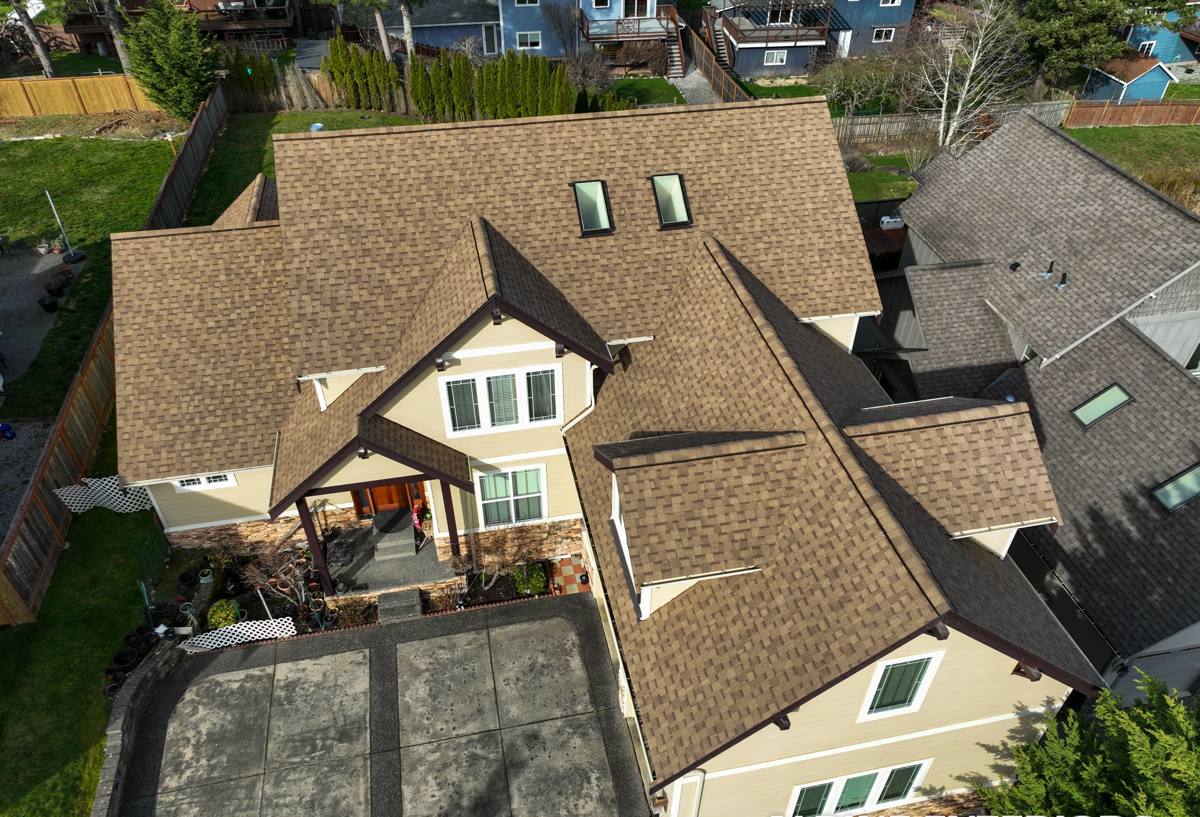
Signs Your Cottonwood Beach Roof Needs Replacing, Not Patching
Not every roof problem here calls for a full tear-off. But there's a point where repeated repairs stop making financial sense and a new roof becomes the honest recommendation. Here's what usually tips that decision:
- Granule loss heavy enough that you can see bare or shiny patches on multiple slopes, not just one isolated spot
- Moss that keeps returning within a season or two of cleaning, especially on north-facing or tree-shaded slopes
- Soft or spongy decking found during a repair — a sign water has already gotten past the roofing system
- Flashing around chimneys, skylights, or wall intersections that's rusted, cracked, or was never properly stepped and counter-flashed
- Roof age past 20–25 years for asphalt shingle, especially if the attic has a history of poor ventilation
- Multiple past repairs in different spots — a pattern that usually means the underlying roofing system is failing, not just one shingle
What a Correct New Roof Installation Actually Involves
A new roof is only as good as what's underneath the visible layer. On a Cottonwood Beach home, we pay particular attention to the parts that don't show once the job is done, because those are the parts that determine whether the roof handles driving rain and salt air for its full service life.
Tear-Off and Deck Inspection
We remove the old roofing down to the deck rather than layering over it. That lets us actually see the plywood or plank decking underneath, replace any sections that are soft, delaminated, or water-stained, and confirm nailing patterns meet current code before anything new goes down. Skipping this step is how hidden rot gets sealed under a brand-new roof.
Underlayment Suited to a Marine Climate
In a wet, wind-exposed area, the underlayment matters as much as the shingle on top of it. We use synthetic underlayment across the field for its tear resistance and water shedding, with self-adhered ice-and-water membrane at eaves, valleys, and any low-slope transitions where wind-driven rain is most likely to find a weak point. This is one of the details a rushed re-roof often shortcuts, and it's one of the first things that shows up as a leak years later.
Flashing Done Right
Flashing failure is the number one cause of "new roof, still leaking" calls we see. Around chimneys, skylights, sidewalls, and any roof-to-wall intersection, flashing needs to be step-flashed and counter-flashed correctly, not caulked as a shortcut. In a salt-air environment we also pay attention to flashing material — some metals corrode faster than others near the water, and we'll talk through that trade-off honestly rather than defaulting to whatever's cheapest.
Ventilation That Actually Balances
Attic ventilation is intake at the eaves balanced against exhaust at the ridge or roof vents. Get this wrong and moisture builds up in the attic, which shortens the life of the decking from underneath and can accelerate moss growth on the surface from above by keeping the roof deck cold and damp. We calculate intake and exhaust together rather than just adding vents wherever there's room.
Material Choices for a Beach-Adjacent Roof
There's no single "best" roofing material for Cottonwood Beach — it depends on budget, how the home is shaded, and how long you plan to own it. Here's how the common options compare for this specific setting:
| Material | Moss/moisture resistance | Salt air durability | Typical lifespan | Relative cost |
|---|---|---|---|---|
| Architectural asphalt shingle | Good with proper ventilation; algae-resistant granules help | Good — minimal exposed metal | 25–30 years | $ (baseline) |
| Standing seam metal | Excellent — sheds moisture fast, little surface for moss to grip | Depends on coating/finish; needs a coastal-rated finish | 40–60 years | $$$ |
| Synthetic/composite shingle | Very good — dense material resists moss anchoring | Good | 30–50 years | $$ |
| Wood shake | Poor without diligent maintenance — moss and rot risk are high here | Fair — needs regular treatment | 20–30 years with upkeep | $$–$$$ |
We generally steer beach-adjacent homeowners away from untreated wood shake, not because it's a bad-looking roof, but because the maintenance burden in a shaded, wet, salt-air environment is genuinely higher than most people expect going in — that's a fair trade-off to know before you commit, not a knock on the material itself.
Our Installation Process
We keep the process straightforward so there are no surprises mid-job:
- On-site assessment — we walk the roof and attic, check ventilation, note tree exposure and any existing moss or moisture damage specific to the property
- Written estimate — material options, scope, and timeline laid out clearly, with the trade-offs explained, not just a price
- Permitting — we handle the permit application through the applicable local jurisdiction before work starts
- Tear-off and deck repair — full removal of old roofing, decking inspected and repaired as needed
- Underlayment and flashing — ice-and-water membrane at vulnerable points, synthetic underlayment across the field, new flashing at every penetration and transition
- Roofing installation — installed to manufacturer spec and local code, including proper nailing patterns and exposure
- Ventilation check — intake and exhaust balanced and verified before we call the job done
- Final walkthrough — we go over the finished roof with you before wrapping up
Permits and Local Code Considerations
Re-roofing in Whatcom County generally requires a permit, and requirements can vary depending on where a property sits relative to the shoreline and any applicable critical areas or setback rules near the water. We pull the necessary permits as part of the job so you're not left navigating that process alone, and we build the roof to current code rather than just matching whatever was there before — sometimes that means updated ventilation or ice-and-water membrane requirements that didn't exist when the original roof went on.
Moss Season: What Homeowners Can Do Between Roofs
Even a well-built new roof benefits from some seasonal attention in a moss-prone area like this. A few habits go a long way toward protecting the investment:
- Keep overhanging branches trimmed back where reasonably possible to reduce shade and debris on the roof
- Clear gutters and valleys of needles and leaf litter before the fall rains set in, since clogged drainage is a major contributor to moss and rot
- Have moss physically removed rather than just chemically treated when it does appear — chemical treatments alone don't address the moisture retention causing it
- Watch for granule buildup in gutters, which signals accelerated shingle wear
- Schedule a roof check after any major windstorm, since driving rain can find small flashing gaps quickly
Why a Crew That Already Works Cottonwood Beach Matters
Roofing crews that mostly work inland don't always think about wind-driven rain, salt exposure, or the specific moss pressure that comes with heavy tree shade near the water. A crew that regularly works Cottonwood Beach and the surrounding Birch Bay area has already seen how roofs age in this exact microclimate — which flashing details fail first, which slopes hold moss longest, and where ventilation tends to be shortchanged in older construction. That local pattern recognition shows up in fewer callbacks and a roof that's actually built for the conditions it will face, not a generic spec pulled off a shelf.
It also means straightforward answers when you ask why we're recommending one material or detail over another. We'd rather explain the honest trade-offs of each option for your specific roof than oversell a product that isn't the right fit for a beach-adjacent home.
Ready for an Honest Look at Your Roof?
If your Cottonwood Beach home is showing signs of an aging roof — recurring moss, granule loss, or a repair history that's starting to add up — it's worth getting a straightforward, no-pressure estimate before deciding what's next. Fill out the form below and we'll take a look and give you a clear picture of your options.