 Birch Bay
 Deck Building in Semiahmoo: A Different Job Than Building Inland
A deck built for a neighborhood a few miles inland and a deck built for Semiahmoo are not the same project, even if the plans look identical on paper. Semiahmoo sits close to the water in Whatcom County, and that changes what the structure is up against every single day: salt-laden air moving off the Strait, driving rain that comes in sideways during fall and winter storms, and a moss and algae season that can run most of the year on shaded or north-facing surfaces. A deck built to a generic inland spec will show it within a few seasons — soft spots, rust streaks at the fasteners, slick decking, and rot starting where water sits instead of running off.
Building correctly for this stretch of coast isn't about upgrading everything to "marine grade" and calling it done. It's about knowing which parts of a deck actually take the abuse out here and being deliberate about material, hardware, and drainage in those specific spots.
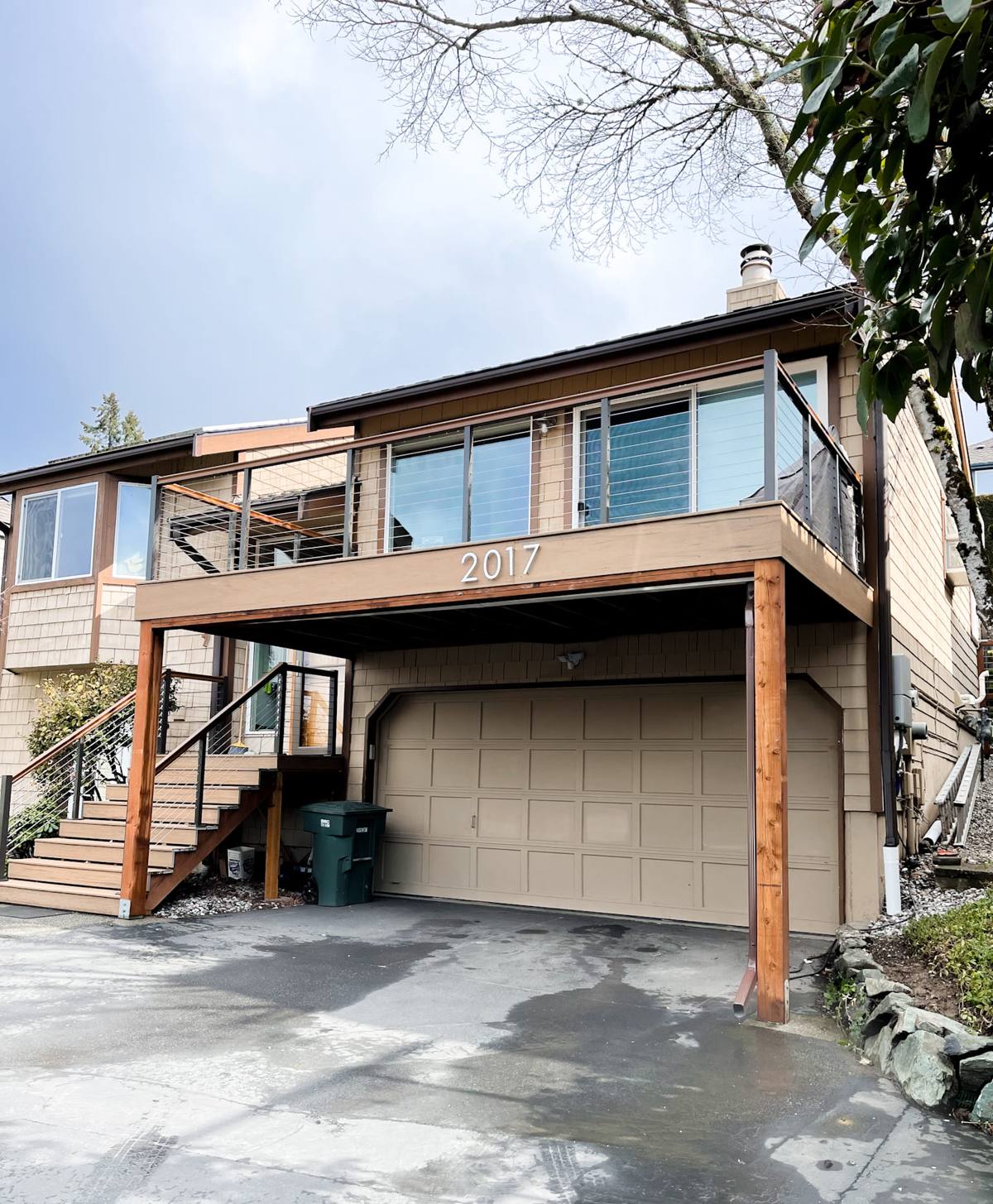
What Salt Air, Rain, and Moss Actually Do to a Deck
Salt Air and Metal Fasteners
Airborne salt accelerates corrosion on any exposed metal — nails, screws, joist hangers, post bases, and bolts. On a coastal lot, standard electro-galvanized fasteners can start showing rust bleed through the decking within a few years, long before the wood or composite itself has a problem. Once a fastener corrodes, it loses holding strength, and a deck is only as strong as the connections holding it together.
Driving Rain and Ledger/Flashing Details
Wind-driven rain off the water doesn't just fall straight down — it gets pushed sideways and upward under railings, around post connections, and behind ledger boards where a deck attaches to the house. That's the single most common place we find hidden rot on older coastal decks: water working its way behind flashing that was installed for a calmer climate, not one that regularly throws rain at the wall.
Moss, Algae, and Shaded Surfaces
Whatcom County's long wet season, combined with mature trees and shade common on Semiahmoo properties, gives moss and algae plenty of time to establish on decking that doesn't dry out quickly. Beyond looking neglected, a mossy deck surface is a real slip hazard on wet mornings, and moss holds moisture against the board surface, which speeds up wood decay underneath it.
Foundation and Framing Choices That Hold Up Here
Everything above the framing depends on what's underneath it. For Semiahmoo lots, that means paying attention to a few things a lot of decks skip:
- Footings sized and set to reach stable soil, not just poured to minimum depth
- Post bases that hold the post above the concrete rather than embedding wood directly into it, so water can't wick up into the post end grain
- Joist hangers and structural connectors rated for the fastener corrosion resistance the site needs, not whatever came in the standard box
- Proper joist spacing and sizing for the actual decking material chosen — composite and hardwood often have different span requirements than standard lumber
None of this is exotic. It's standard deck-building practice done without shortcuts, which matters more here because the climate punishes shortcuts faster than it would a few miles inland.
Choosing Decking Material for a Coastal Property
There's no single "right" decking material for every Semiahmoo home — it depends on budget, how much upkeep you want to do, and how exposed the deck is to weather. Here's how the common options compare for this specific environment:
| Material | Typical Cost | Maintenance | Coastal Performance |
|---|---|---|---|
| Pressure-treated wood | Lowest upfront cost | Needs periodic cleaning and re-sealing | Good if sealed regularly; end grain and fastener points are the weak spots |
| Cedar | Mid-range | Regular cleaning, occasional refinishing | Naturally moisture- and insect-resistant, but still needs care in shaded, damp areas |
| Composite decking | Higher upfront cost | Occasional washing, no sealing or staining | Very stable in wet climates; still needs airflow underneath to resist mildew and algae |
| PVC decking | Highest upfront cost | Low — mostly rinsing | Excellent moisture resistance; can get slick with algae in shaded, low-airflow spots without occasional cleaning |
We'll walk through these trade-offs honestly during an estimate — the goal is matching the material to how the deck will actually be used and how much shade or salt exposure the specific lot gets, not upselling the most expensive option by default.
Hardware and Fasteners: The Part Most Decks Get Wrong
This is where we differ most from a generic build. On a Semiahmoo project, we treat fastener and connector selection as part of the structural plan, not an afterthought:
- Stainless or coated fasteners matched to the decking manufacturer's requirements — mixing the wrong metal types can accelerate corrosion on both
- Corrosion-resistant structural connectors at the ledger, posts, and stair stringers
- Proper ledger flashing and a gap or drainage plane behind it so any water that does get in has somewhere to go besides the house sheathing
- Post bases and hardware kept off standing water, with concrete sloped to shed rather than pool
It costs more in materials than defaulting to whatever's cheapest at the yard. It's also the difference between a deck that's still solid in fifteen years and one that starts needing board and hardware replacement in five.
Drainage and Airflow: Designing Out the Moss Problem
Since moss and algae need shade, moisture, and still air to establish, the way to fight them starts at the design stage, not with a pressure washer every spring:
- Decking gapped correctly so water drains through rather than pooling on the surface
- Adequate clearance and airflow underneath the deck so the underside can dry out between rains
- Grading and drainage around the footings so water isn't sitting against the structure after a storm
- Board orientation and layout that accounts for which parts of the deck actually get sun during the year
A deck designed this way still needs occasional cleaning in a marine climate like Birch Bay's — nothing eliminates that entirely — but it needs far less of it, and what does grow rinses off instead of taking hold.
Our Deck Building Process
The process is straightforward, and we don't skip steps to move faster:
- On-site assessment — we look at sun exposure, wind and rain exposure, existing drainage, and how the deck will connect to the house before recommending materials
- Design and material selection — sized and specified for the actual site conditions, with honest trade-offs explained, not just the highest-margin option pushed
- Permitting — deck permits and any setback requirements are handled through Whatcom County or the local jurisdiction as required before work starts
- Foundation and framing — footings, posts, and structural connections built to hold up under coastal exposure, not just to pass a quick inspection
- Decking, railing, and stairs — installed with the fastening and flashing details this climate requires
- Final walkthrough — we go over basic maintenance for the specific material installed so it lasts as long as it's built to
Maintenance in a Marine Climate
Whatever material is chosen, a deck near Birch Bay needs a little more attention than one built farther inland — that's just the reality of building this close to salt water. A realistic maintenance rhythm looks like:
- Annual inspection of fasteners, connectors, and ledger flashing for corrosion or gaps
- Periodic cleaning to keep moss and algae from establishing, especially on shaded sections
- Re-sealing or refinishing wood decking on the schedule the product actually needs, not just when it looks bad
- Keeping gutters and downspouts near the deck clear so runoff isn't dumping directly onto or under the structure
Why It Matters to Hire a Crew That Already Works Semiahmoo
A contractor who mostly builds decks inland can still build a structurally sound deck — but they're often working from a generic spec that doesn't account for what this stretch of Whatcom County coastline actually does to fasteners, wood, and finishes over time. Working regularly in Birch Bay and the surrounding coastal communities means we've seen how decks age out here, not just how they look on installation day. That shows up in the hardware we spec, the flashing details we don't skip, and the material recommendations we're willing to make even when they're not the cheapest option on the shelf.
If you're planning a new deck or replacing one that's showing its age in Semiahmoo, we're glad to take a look and give you a straight assessment. Fill out the form below for a free, no-pressure estimate — we'll walk the site, talk through material options for your specific exposure, and give you honest numbers before any work begins.