 Birch Bay
 Deck Repair Built for the Nooksack Climate
Decks in the Nooksack area take a different kind of beating than decks farther inland. You're close enough to Birch Bay to get salt-laden air on windy days, you get the same driving rain that soaks every exposed structure in Whatcom County, and you get long stretches of overcast, damp weather that keep wood surfaces wet far longer than they should be. None of that is dramatic on its own. It's the accumulation — season after season — that turns a solid deck into one with soft boards, rusted fasteners, and a green film that never quite goes away.
We repair decks in this area regularly enough to recognize the patterns fast: which boards fail first, which connections rust out early, and which repairs are quick fixes versus which ones point to a bigger structural issue. This page walks through what actually causes deck damage here, what a proper repair looks like, and how to tell a legitimate fix from a cosmetic patch that won't hold up through another wet season.
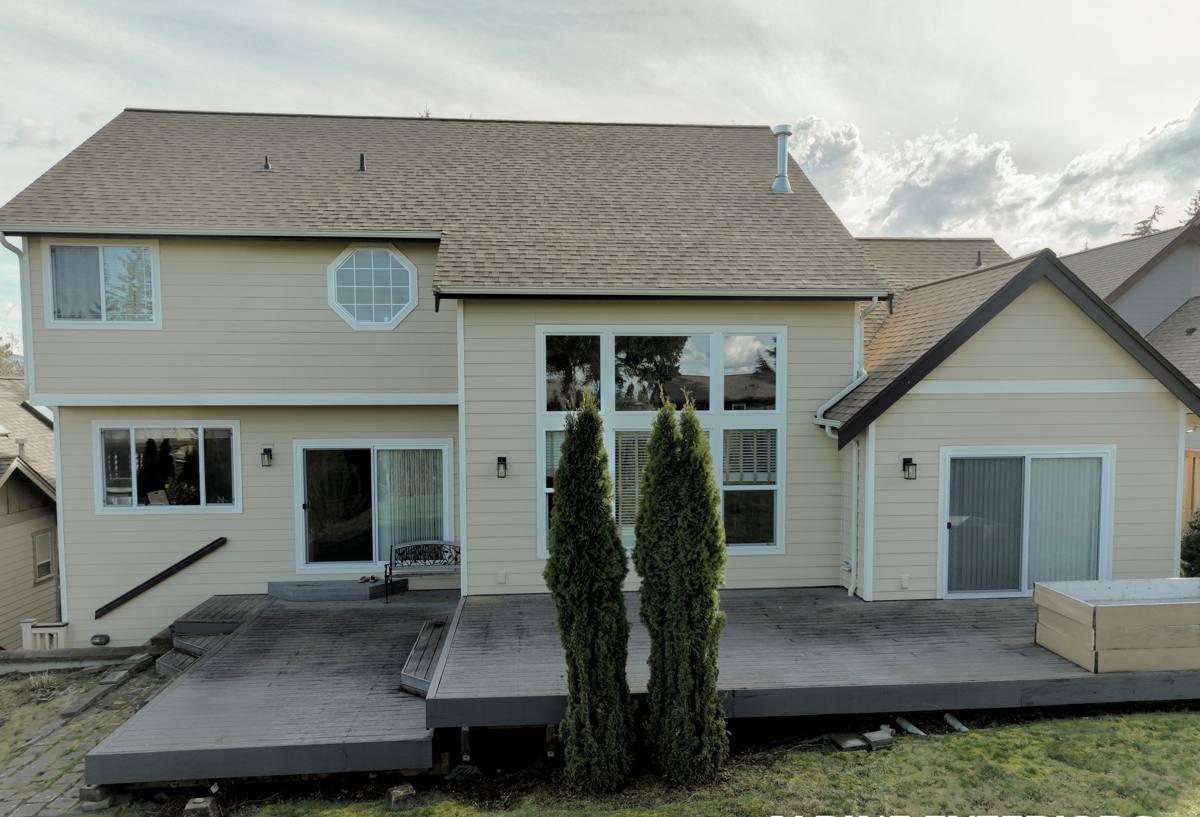
Why Decks Wear Out Faster Here Than the Manufacturer's Warranty Suggests
Moisture That Never Fully Leaves
Most decking and framing lumber is rated assuming it gets a real chance to dry out between rain events. In Whatcom County, especially on shaded lots or decks tucked under overhangs, that drying window can shrink to almost nothing for months at a time. Wood that stays damp promotes rot in the end grain, around fastener holes, and anywhere two boards sit tight against each other and trap moisture.
Salt Air and Metal Fatigue
Proximity to Birch Bay means airborne salt reaches structures more than most inland Whatcom County towns realize. Salt accelerates corrosion on anything metal — screws, joist hangers, bolts, and flashing. A fastener that would last decades in a dry inland climate can start showing rust bleed and weakening within several years here if it wasn't rated for coastal exposure to begin with.
The Long Moss Season
Moss and algae aren't just a cosmetic nuisance. On decking surfaces, moss holds moisture directly against the wood fibers, keeps the surface perpetually damp, and makes boards slicker and more slippery underfoot. Left unaddressed, the wood beneath a moss mat softens well before the surrounding boards show any visible sign of trouble.
Signs Your Deck Needs Repair — Not Just a Cleaning
A pressure wash or a coat of stain can hide a lot of problems temporarily. Here's what tells us the deck needs actual repair work:
- Boards that feel spongy, springy, or noticeably softer than the boards around them
- Visible gaps opening up between decking boards or where the deck meets the house
- Rust streaking below screw heads or around joist hanger hardware
- Railings or posts that wiggle more than a firm push should allow
- Persistent moss or black staining that returns within weeks of cleaning
- Any separation, cracking, or daylight visible at the ledger board where the deck attaches to the house
- Stairs that feel uneven, bouncy, or have visibly sagging stringers
The ledger board connection deserves special attention. It's the single most common source of serious deck failure, because it's bolted to the house and sits behind the siding where moisture problems can develop unseen for years. If we see any sign of moisture intrusion at that connection, we treat it as a priority, not a cosmetic item.
What a Correct Deck Repair Actually Involves
A repair that only replaces what's visible from the top often misses what's happening underneath. Our approach starts below the decking, not on top of it.
Structural Inspection First
Before we touch a single board, we check the framing: joists, beams, posts, footings, and the ledger connection. A deck can look fine on the surface while sitting on a joist that's rotted through at a hidden contact point. Skipping this step is how "repairs" end up needing to be redone within a year or two.
Fastener and Hardware Upgrades
If the original build used fasteners or joist hangers that weren't rated for wet, coastal-adjacent exposure, we don't just match what's there — we upgrade to hardware suited to this environment as part of the repair. Reusing corroding hardware just because it's already in place is a false economy.
Proper Flashing at the Ledger
Where the deck meets the house, correct flashing is what keeps rain from working its way behind the siding and into the wall framing. If we find missing or failed flashing during a repair, we address it, because a beautifully repaired deck attached with poor flashing just moves the water problem into your house.
Matching or Replacing Decking Boards
Depending on the extent of damage, we either replace individual failed boards or resurface larger sections. We're upfront about when patch repairs make sense versus when the better long-term answer is broader board replacement — we won't stretch a small fix over damage that's more widespread than it looks.
Repair vs. Rebuild: How We Help You Decide
Not every deck problem calls for a full rebuild, and not every deck is worth patching indefinitely. Here's the general framework we use when evaluating a Nooksack-area deck:
| Condition Found | Typical Recommendation | Why |
|---|---|---|
| A few soft or damaged boards, sound framing underneath | Targeted board replacement | Framing is doing its job; isolated surface damage doesn't require rebuilding it |
| Rusted hardware, framing otherwise solid | Hardware upgrade during a standard repair | Correcting the fastener spec stops the corrosion cycle from repeating |
| Rot at the ledger board or house connection | Ledger repair with new flashing, priority scheduling | This connection affects both deck safety and the house's moisture protection |
| Widespread soft framing across multiple joists | Partial or full rebuild | Patching individual joists in a failing structure rarely holds up long-term |
| Deck is 20+ years old with recurring repair needs | Rebuild evaluation | At some point, repeated repairs cost more than starting with a correctly built deck |
We'll always tell you honestly which category your deck falls into. If a repair is the right call, we won't upsell a rebuild — and if the framing is genuinely compromised, we won't paper over it with a surface-level fix that won't last.
Our Deck Repair Process
- On-site assessment — we walk the full deck, check the framing from below where accessible, and test suspect boards and connections by hand
- Written scope and estimate — you get a clear breakdown of what needs repair, what we recommend upgrading, and what it costs before any work starts
- Demo of damaged material — we remove only what needs to come out, protecting sound material and surrounding landscaping
- Structural repair — framing, hardware, and flashing corrections happen before any new decking goes down
- Decking and finish work — new boards are installed, fastened, and finished to match or complement the existing deck
- Final walkthrough — we go over the completed repair with you and flag any maintenance items worth watching
Decking Material Choices and Trade-Offs
Part of a repair is deciding what to rebuild damaged sections with. We're straightforward about the trade-offs rather than pushing one option for every situation.
| Material | Strengths | Trade-Offs in This Climate |
|---|---|---|
| Pressure-treated lumber | Lower upfront cost, widely available, easy to repair further down the road | Needs regular sealing/staining to resist moisture and moss; will eventually need refinishing |
| Cedar | Natural rot resistance, attractive grain, ages well when maintained | Softer surface, requires consistent upkeep to prevent graying and moisture absorption |
| Composite decking | Low maintenance, resists rot and moss buildup better than wood | Higher upfront cost; installation details around fastening and spacing matter more, since mistakes are harder to correct later |
Whichever material fits your budget and goals, the framing underneath matters more than the surface material. A composite deck on a compromised structure is still a compromised deck — the surface only lasts as long as what's holding it up.
Maintaining Your Deck After Repair
A repaired deck stays repaired longer with a little seasonal attention. This is the maintenance rhythm we recommend to homeowners in the Nooksack and greater Birch Bay area:
- Sweep debris and standing leaves off the deck surface regularly, especially in fall
- Rinse or gently clean moss and algae buildup before it has a chance to establish, rather than after it's spread
- Check railings and stair connections for looseness once or twice a year
- Reapply sealant or stain on wood decking on the manufacturer's recommended schedule — don't stretch it just because the surface still looks okay
- Keep an eye on the ledger board area for staining, gaps, or paint bubbling on the adjacent siding
- Trim back vegetation that keeps sections of the deck shaded and damp longer than the rest
Why Hire a Crew That Already Works in This Area
Deck repair looks straightforward from the outside, but the failure patterns specific to Whatcom County's salt-air, high-rain, moss-prone conditions aren't always obvious to a crew that mostly works drier inland regions. We've repaired enough decks around Birch Bay and the surrounding Nooksack area to know where problems typically start — which is usually below the surface, not on top of it. That local pattern recognition is what keeps us from missing the ledger rot hiding behind good-looking decking, or the joist hanger that's two seasons from failing even though the boards above it still look fine.
If your deck has soft spots, rust stains, persistent moss, or just doesn't feel as solid as it used to, we're happy to take a look and give you an honest read on what it needs. Reach out for a free, no-pressure estimate using the form below — there's no obligation, just a clear picture of what's going on and what it would take to fix it right.