 Birch Bay
 Why Decks Wear Out Faster in Birch Bay Village
Birch Bay Village sits close enough to the water that every deck in the neighborhood is doing double duty: holding up your family cookouts and fighting off a marine climate at the same time. Whatcom County's shoreline weather isn't dramatic in any single storm, but it's relentless over years — salt-laden air, long stretches of driving rain off the Strait of Georgia, and short, low-angle winter sun that lets moss and algae take hold almost everywhere shade lingers. A deck built to a generic national standard, without those three factors in mind, tends to show real trouble by year twelve or fifteen. One built correctly for this specific area can go much longer.
Salt Air and Metal Fasteners
Airborne salt doesn't need direct ocean spray to do damage — it travels on the wind and settles on any exposed metal, where it speeds up corrosion far beyond what you'd see a few miles inland. On older or budget-built decks, this shows up as rust streaks bleeding out of screw heads, corroded joist hangers, and bolts that have seized or weakened inside the framing where you can't see them until something moves underfoot.
Moss, Shade, and Trapped Moisture
Birch Bay Village has plenty of mature trees and homes close enough together to keep parts of most decks shaded for a good part of the day. Combine that with our wet fall-through-spring stretch and you get ideal conditions for moss and algae, which hold moisture against the wood and hardware far longer than direct sun and open air would allow. That trapped moisture is what quietly rots ledger boards, joists, and post bases from the inside while the top surface still looks fine.
Driving Rain and Ledger Board Failure
Wind-driven rain off the water doesn't just fall straight down — it gets pushed sideways into the gap where a deck ledger meets the house, and into any joint that wasn't properly flashed. This is the single most common structural failure point we find on aging decks in this area, and it's rarely visible without pulling boards or checking behind the rim joist.
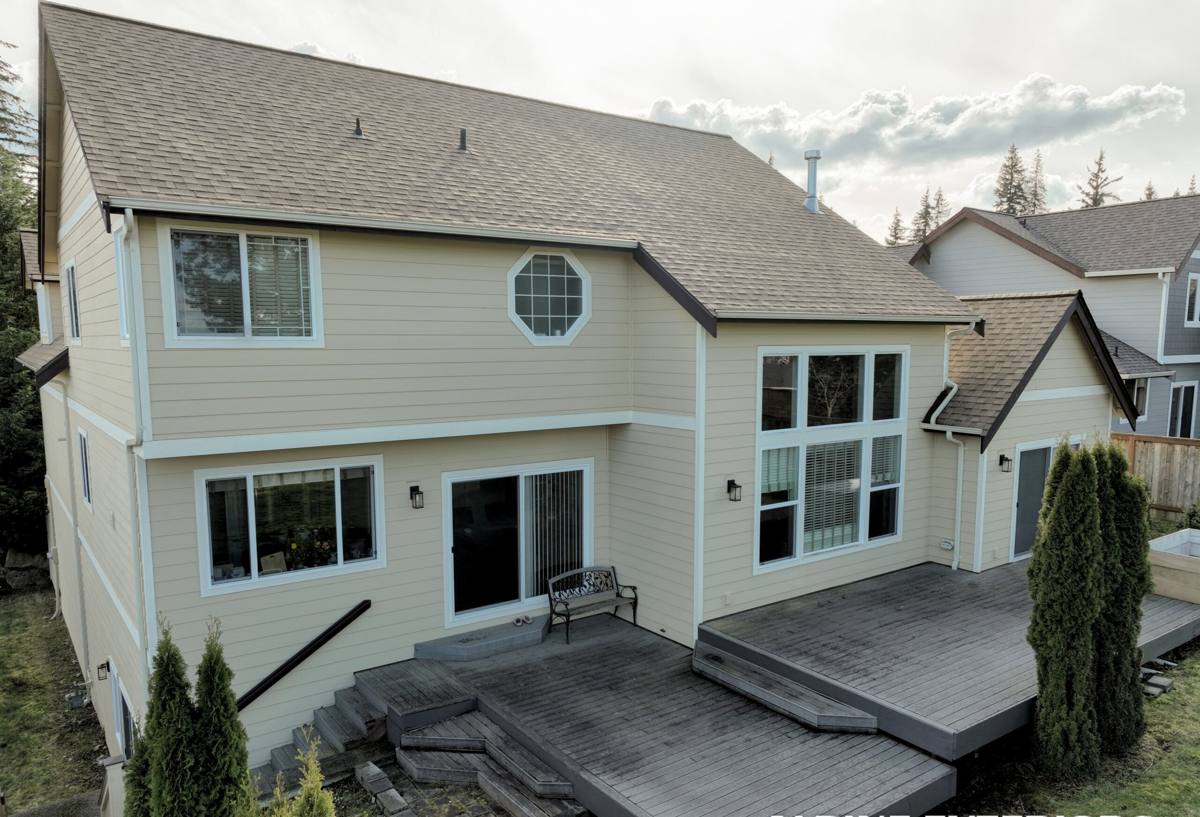
Signs Your Deck Needs Replacing, Not Just Repairing
Repair makes sense when the framing is sound and the problems are cosmetic or isolated. Replacement makes sense once the structure itself is compromised, or once repair costs start approaching what a new deck would run. Watch for:
- Soft, spongy, or springy spots when you walk across the deck, especially near the house
- Visible rust bleeding from fastener heads or joist hangers
- Wood that's gone gray, splintery, or punky (a screwdriver sinks in with light pressure)
- Persistent moss or black staining that comes back within weeks of cleaning
- Railings or posts that wobble at the base
- Gaps opening up where the ledger meets the house siding
- A deck that's more than 15-20 years old and has never had the framing inspected
What a Correct Deck Replacement Involves
A deck is only as good as what's underneath the decking boards. Most of the failures we're called out to inspect in Birch Bay Village trace back to shortcuts taken in framing, flashing, or hardware — not the visible surface material.
Structural Framing and Ledger Attachment
The ledger board — where the deck bolts to the house — is the highest-stakes connection on the whole structure and the one most exposed to wind-driven rain in this area. It needs proper flashing that sheds water away from the house framing, not just caulk, and lag bolts or through-bolts sized and spaced to current code, not whatever was on hand. Joists, beams, and posts need to be sized for the actual span and load, with post bases set to keep wood off standing water.
Fasteners and Hardware Rated for Coastal Exposure
Given the salt air, we don't treat hardware as a place to save money. Stainless steel or heavy hot-dip-galvanized fasteners and connectors cost more up front than standard coated hardware, but they're the difference between a deck that's still solid at year twenty and one that's showing rust streaks and loosening connections by year eight. This is one of the clearest local-climate decisions in the whole project.
Decking Material Choices
Once the frame is right, the decking surface itself comes down to how much upkeep you want to take on versus what you want to spend up front. There's no single correct answer — it depends on your budget, how much shade the deck sits in, and how hands-on you want to be with maintenance.
Comparing Decking Materials for a Birch Bay Village Climate
| Material | Moisture & Moss Behavior | Maintenance | Typical Lifespan Here |
|---|---|---|---|
| Pressure-treated wood | Absorbs moisture; needs sealing to resist moss and rot in shaded areas | Annual cleaning, re-sealing every 1-2 years | 10-15 years |
| Cedar | Naturally rot-resistant but still needs sealing against constant damp and salt exposure | Cleaning and re-sealing every 1-2 years | 15-20 years |
| Composite decking | Resists rot and moisture absorption; can still grow surface algae/moss in deep shade if not cleaned | Periodic washing, no sealing or staining | 25-30+ years |
| PVC/capped polymer | Essentially non-absorbent; best resistance to moss and moisture staining | Occasional washing | 25-30+ years |
We install all of these depending on what the homeowner wants, but for shaded, moisture-heavy lots in Birch Bay Village we usually steer people toward composite or capped polymer boards. It's not that wood is a bad product — it's that wood decking asks for a maintenance commitment (sealing, cleaning, spot-treating moss) that a lot of busy homeowners underestimate, and in a climate this wet, falling behind on that schedule shortens the deck's life fast.
Permits and Whatcom County Considerations
Deck replacement projects typically require a building permit, and requirements can shift depending on the deck's height, size, and proximity to property lines or, for some Birch Bay Village lots, shoreline setback rules. We handle the permit process as part of the job so you're not left figuring out county requirements on your own, and we build to current code rather than just matching whatever was there before — which matters most on older decks that predate current fastener and railing standards.
Our Deck Replacement Process
- On-site inspection: We check the framing, ledger connection, and post footings, not just the surface boards, so you know exactly what's driving the replacement.
- Honest scope and estimate: You get a clear breakdown of what's structural, what's material choice, and what it costs — no surprise add-ons mid-project.
- Tear-out: Full removal of the old deck, including any hidden rot in ledger or framing we find once boards come off.
- Framing and flashing: New joists, beams, and posts sized to code, with proper ledger flashing to keep wind-driven rain out of the house framing.
- Decking and railing installation: Installed to manufacturer spec if composite or PVC, with coastal-rated fasteners throughout.
- Final walk-through: We go over the finished deck with you, including basic care guidance for whatever material you chose.
Why Hire a Crew That Already Works Birch Bay Village
A contractor who's worked this specific stretch of Whatcom County knows which framing details actually matter here versus what a generic build guide assumes. We're not guessing at how much shade a lot gets, how exposed a deck is to wind off the water, or how fast moss comes back on a north-facing rail post — we've seen it on other decks nearby. That local pattern recognition is what separates a deck that gets re-inspected for rot in eight years from one that doesn't need a second look for two decades.
Maintaining Your New Deck Through the Moss Season
Whatever material you choose, a little seasonal attention goes a long way in this climate. Keep gutters and downspouts clear so runoff isn't sheeting onto the deck surface. Sweep off wet leaves and debris regularly through fall, since trapped organic matter is what feeds moss growth. Rinse shaded areas periodically, even on low-maintenance composite or PVC decking, and check railing posts and stair connections once a year for any looseness. For wood decks, staying on top of the sealing schedule is the single biggest factor in how long the deck lasts.
If your deck is showing rust, soft spots, or moss that keeps coming back, we're happy to take a look and give you a straight assessment of what it needs — repair or full replacement — with no pressure either way. Use the form below to request a free estimate for your Birch Bay Village property.