 Birch Bay
 Why Ferndale Windows Take More Punishment Than Most
Ferndale sits close enough to the water that homes here deal with a different set of problems than windows twenty or thirty miles inland. Salt-laden air moves in off the bay and settles on everything, including window frames, hardware, and the caulk lines that are supposed to keep water out. Add wind-driven rain that comes in sideways during a Whatcom County winter storm, and a long, damp moss season that keeps roof and siding surfaces wet for weeks at a stretch, and you have a climate that finds every weak point in a window installation within a few years, not a few decades.
None of that means Ferndale homeowners need to over-build or panic about their windows. It means the details that get skipped on an easy inland job — flashing sequence, sealant choice, drainage paths — cannot be skipped here. A window that would perform fine in a dry climate for fifteen years can start failing in five if it was installed without accounting for this kind of weather.
What "Custom" Actually Means on a Window Job
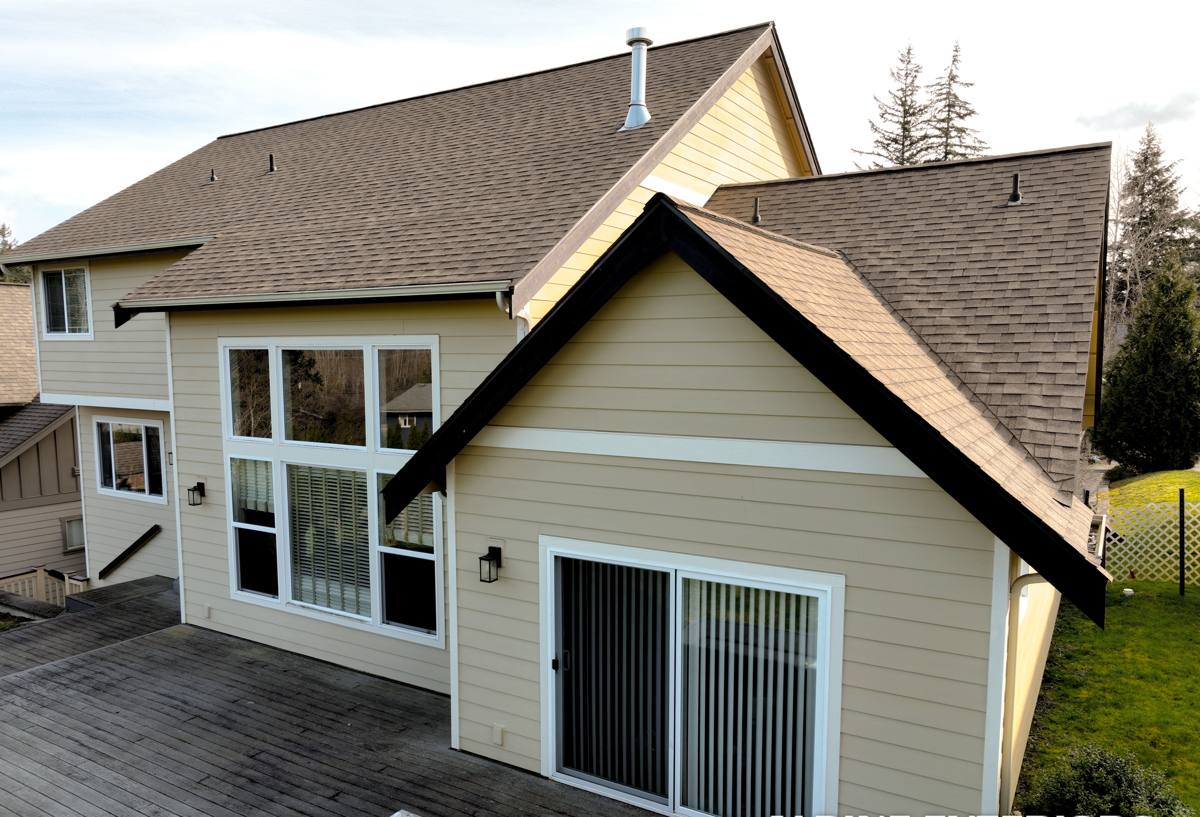
"Custom" doesn't mean upgraded or fancy — it means the window is built and fitted to the actual opening in your house, rather than forcing a stock size to work. Most homes in this area, especially older ones, have openings that have shifted slightly over the decades. Framing settles, siding gets replaced more than once, and original construction wasn't always perfectly square to begin with.
A correct custom job starts with precise measurement of each opening individually — width, height, and diagonal, checked at multiple points, not just one. Windows are then ordered or built to those exact dimensions so the final unit doesn't need to be forced, shimmed excessively, or packed with extra sealant to make up for a poor fit. A window that's forced into an opening it doesn't quite match will fail at the gaps first, and in this climate, that failure shows up as leaks and drafts faster than you'd expect.
Common Window Types We Fit
| Frame Material | How It Handles Salt Air & Moisture | Maintenance Burden |
|---|---|---|
| Vinyl | Doesn't corrode; seams and welds are the main watch point over time | Low — occasional cleaning, no repainting |
| Fiberglass | Very stable dimensionally, resists warping in wet-dry cycles | Low — durable finish, minor cleaning |
| Wood-clad | Cladding protects the exterior face, but any breach exposes wood beneath | Higher — interior wood and any cladding seams need periodic checks |
| Aluminum | Strong but conducts cold and can show pitting near salt air over years | Moderate — finish and hardware need attention |
We don't push one material on every homeowner. The right choice depends on your home's style, your budget, and how much upkeep you actually want to do. What we won't do is install a product in a way that ignores how it behaves in this specific climate — that's a decision we make as professionals, not a shortcut we take to save time on the job.
Signs Your Current Windows Are Already Losing the Fight
Whatcom County's wet season makes window problems easier to catch if you know what to look for. Most failures don't happen all at once — they show up gradually, and by the time you notice them, moisture has usually been getting in for a while.
- Fogging or a permanent haze between the panes of a double-pane window (the seal has failed)
- Soft, spongy, or discolored wood at the sill or the interior trim around the frame
- A noticeable draft when standing near the window on a windy day, even with it fully closed
- Paint or caulk that's cracked, peeling, or pulling away from the frame edge
- Difficulty opening, closing, or locking a window that used to operate smoothly
- Visible mold or mildew staining on the interior sill, especially in rooms that don't get much airflow
- Condensation forming on the interior glass regularly, even when the room isn't especially humid
Any one of these on its own might be minor. Several of them together, especially on a window facing the prevailing wind and weather, usually means the frame or the seal around it has been compromised.
What a Correct Installation Actually Involves
The window unit itself is only part of the job. In a climate with this much driving rain, how the window is integrated into the wall is just as important as the window's quality.
Flashing and Drainage
Water that reaches the wall behind a window needs a path back out, not a place to collect. That means flashing installed in the correct shingle-lap order — each layer overlapping the one below it — so water sheds downward and outward rather than pooling behind the trim or sitting against the framing. Skipping or reversing this sequence is one of the most common causes of hidden rot behind a window that looks fine from the outside.
Sealant and Gap Management
Sealant is a backup, not the primary defense. A window relying entirely on a bead of caulk to keep water out will fail eventually — caulk degrades, especially with UV exposure and constant wet-dry cycling. The frame, flashing, and house wrap need to do the structural work of keeping water out; sealant fills the small remaining gaps.
Integration With Siding
Window trim needs to tie cleanly into the surrounding siding so there's no gap or ledge where water can sit. This is one area where it genuinely helps to have a crew that does siding and windows together — the transition between the two is where a lot of leaks originate, and it's easy for a window-only installer or a siding-only installer to leave that seam as someone else's problem.
Our Process, Start to Finish
- On-site assessment — we look at each opening, check the current condition of the framing and any water damage, and talk through what you actually need versus what's optional.
- Precise measurement — every opening is measured individually; nothing is assumed to match "standard" sizing.
- Material and style selection — we walk through frame material, glass options, and style trade-offs in plain terms, including what each choice means for long-term maintenance in this climate.
- Removal and prep — old units are removed carefully, and we inspect the framing underneath before anything new goes in. If there's rot or damage, we address it before installing the new window, not after.
- Installation — proper flashing sequence, air-sealing, insulation around the frame, and correct shimming so the window operates smoothly and seals correctly.
- Exterior integration — trim and siding tie-in finished so water sheds away from the opening.
- Walkthrough — we go over the finished work with you, operate each window, and answer questions before we consider the job done.
Cost Factors Worth Understanding
We don't post fixed prices because every home and every opening is different, but the main factors that drive cost are consistent from job to job:
| Factor | Why It Matters |
|---|---|
| Number and size of openings | More and larger windows mean more material and labor time |
| Frame material | Vinyl and fiberglass generally cost less upfront than wood-clad options |
| Glass package | Double-pane vs. triple-pane and any low-E or gas-fill upgrades affect price and performance |
| Condition of existing framing | Rot or water damage found during removal adds repair work before the new window goes in |
| Access and second-story work | Harder-to-reach windows take longer and may need additional equipment |
A written, itemized estimate that accounts for your specific home is more useful than any general price range we could quote here.
Why a Crew That Already Works Ferndale Matters
Wind and rain don't hit every part of Whatcom County the same way. Homes closer to the water tend to catch more direct, wind-driven weather than those further inland, and that affects which sides of a house need the most attention, how quickly moss and mildew build up on north-facing surfaces, and how much salt exposure the exterior hardware actually deals with over a year. A crew that regularly works in and around Ferndale and the Birch Bay area has already seen how local homes age in this specific climate — which materials hold up, which installation shortcuts cause problems two winters later, and which parts of a house tend to need extra attention.
That local pattern recognition doesn't replace careful work on any individual job, but it does mean fewer surprises and better judgment calls when something about your home's framing or exposure isn't textbook standard.
Maintaining Custom Windows in a Wet, Salt-Air Climate
New windows installed correctly will still need some ongoing attention in this environment. Rinsing frames and tracks periodically helps clear salt residue before it has a chance to sit against hardware and seals. Keeping weep holes (the small drainage openings at the base of the frame) clear of debris and moss growth lets water drain the way it's designed to. It's also worth doing a quick visual check each fall, before the wet season really sets in, looking for any new cracking in exterior caulk lines or trim.
None of this is heavy maintenance — it's the kind of occasional check that catches small issues while they're still small, which matters more here than in a drier climate where problems develop more slowly.
If you're dealing with drafty, foggy, or failing windows, or you're planning ahead for a home in Ferndale or the surrounding Birch Bay area, we're happy to take a look and give you an honest read on what your home actually needs. Reach out for a free, no-pressure estimate using the form below.