 Birch Bay
 Fiber Cement Siding Built for Island Exposure
Lummi Island sits out in the water on its own, reached only by ferry, and that changes the calculus on exterior work in ways a lot of mainland Whatcom County homes don't have to think about. Being surrounded by water means Lummi Island homes take on a steadier, more direct dose of salt-laden marine air than most inland properties, along with wind-driven rain that comes off open water with little to break it up, and a moss season that can stay active most of the year on shaded, north-facing walls. It's a demanding climate for any exterior material, and it's the exact kind of exposure that separates siding built to last thirty years from siding that starts showing problems in five.
We install James Hardie fiber cement siding exclusively, and on Lummi Island specifically, that standard matters more than almost anywhere else we work. A material that only sort of holds up to salt air and driving rain is a bigger problem on an island where getting a crew back out for repairs means coordinating around a ferry schedule, not just a drive across town.
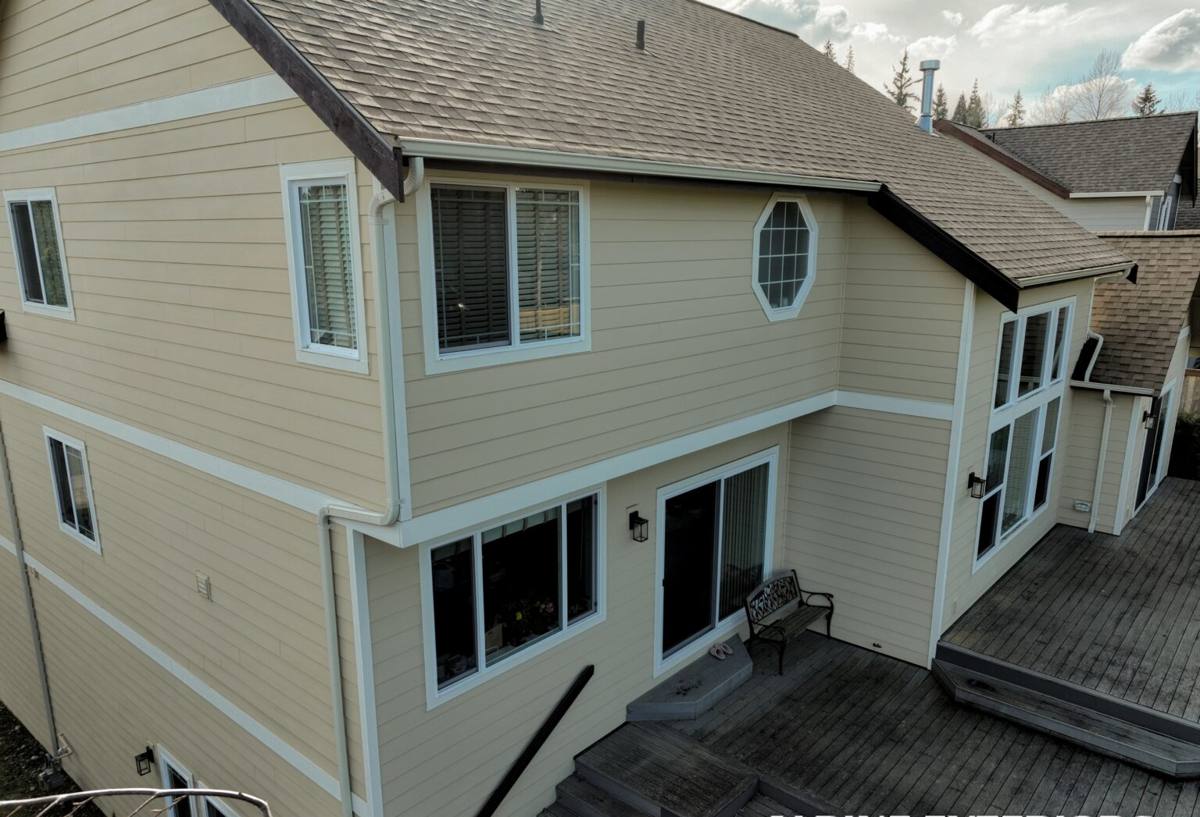
What Island Exposure Does to a Home's Siding
Salt Air From Every Direction
Mainland homes usually face salt exposure from one direction — whichever way the water is. An island home can pick up salt-laden air from multiple sides depending on wind direction, which means there's often no "sheltered" elevation the way there is on a typical inland lot. Salt accelerates corrosion in fasteners, flashing, and hardware, and it breaks down lower-grade paints and finishes faster than a drier climate would. On Lummi Island, every material and every piece of trim hardware needs to be chosen with that corrosion risk in mind from the start, not picked based on how it looks going up.
Driving Rain With Nothing to Block It
Open water exposure means wind moves across the island with fewer windbreaks than a sheltered mainland lot would have, and wind is what turns rain into a sideways problem instead of a straight-down one. That wind-driven rain gets pushed into lap joints, trim seams, and any spot where flashing isn't doing its job. A siding system that performs fine in a calmer, more protected location can still fail here, specifically because the water is finding its way in from the side, not falling straight down onto a roof plane.
A Long Moss and Mildew Season
Shade, mild temperatures, and near-constant moisture add up to a moss and mildew season on Lummi Island that runs longer than what drier parts of Whatcom County see. It typically shows up first on north-facing and tree-shaded walls, and it's not just a cosmetic issue — sustained organic growth holds moisture against the wall assembly, which is exactly the condition that leads to rot behind the siding if it isn't addressed. Any material that's even slightly porous, or that traps moisture against the substrate, becomes a growth surface over time in this kind of climate.
Why We Only Install James Hardie Fiber Cement
We used to offer a broader range of siding products. We don't anymore, and that change came from what we kept seeing on service calls and tear-offs in exactly this kind of salt-heavy, wet, moss-prone environment — not from a supplier relationship or a sales pitch.
- Non-combustible core: Fiber cement doesn't feed a fire the way wood-based siding can, which matters for safety and can matter for insurance considerations as well.
- Factory-applied ColorPlus finish: The color is baked on under controlled factory conditions rather than brushed on in the field, which holds up far longer against salt exposure, fading, and chalking than site-applied paint.
- Climate-engineered HZ product lines: Hardie's HZ5 formulation is built for regions with heavy moisture exposure and freeze-thaw cycling, which describes island Whatcom County well.
- Dimensional stability: Fiber cement doesn't swell, warp, or cup the way engineered wood products can when they take on repeated moisture over a wet season.
- Strong transferable warranty: Hardie backs the product with one of the more robust warranty structures in the industry, provided installation follows their spec.
We don't install LP SmartSide, vinyl siding, Cemplank, Allura, primed spruce, or cedar. Those are legitimate products, and other contractors install them competently elsewhere. But on an island where salt exposure is heavier and a return trip for maintenance is a bigger logistical lift, we've made a professional call that we'd rather stand fully behind one system than offer something cheaper that shifts more long-term maintenance risk onto the homeowner.
What Correct Fiber Cement Installation Requires Here
Fiber cement only performs the way it's designed to when it's installed to Hardie's published specifications, and on an island climate that margin for error is thinner than it is inland. A correct install includes:
- House wrap or weather-resistive barrier installed and properly lapped before any siding goes up
- A drainage gap or rainscreen detail behind the siding so moisture that does get past the surface can dry out instead of sitting against the wall
- Corrosion-resistant fasteners, correctly sized and spaced per Hardie's specification for this exposure category
- Proper clearance from grade, roof lines, and decking so water sheds away from the bottom edge of the siding
- Factory-mitered or correctly caulked joints at corners, windows, and trim transitions
- Field-cut edges primed before installation to protect the one place the factory ColorPlus finish doesn't already cover
Skip any one of these and the wall can still look fine for a year or two. On Lummi Island, the problems that show up when corners get cut — staining at seams, soft trim, paint failure at the fastener line — tend to surface after a wet season or two, which is exactly why a loose installation is easy to get away with until the homeowner is the one dealing with it.
What Correct Hardie Installation Looks Like
Beyond the checklist above, the details that matter most on this island are the ones a generic install guide doesn't spell out for local conditions: how tight to run the rainscreen gap given how long walls stay damp here, which fastener grade actually holds up to island-strength salt exposure over decades rather than years, and where extra flashing attention is worth the added labor because a callback means a ferry trip, not a quick drive back.
The Ferry Factor: Why Logistics Matter for Island Projects
Every material delivery, every crew trip, and every walk-through on a Lummi Island project has to work around ferry scheduling. That's not a minor detail — it changes how a project needs to be planned from day one. Material orders have to be right the first time, because a missing piece of trim or the wrong fastener box means waiting on the next available crossing, not a quick run to a supply house. Crews benefit from staging as much of the job as possible before work starts, so days on the island are spent installing rather than waiting on something that should have already been on site.
This is also where hiring a crew that already works Lummi Island pays off in ways that are easy to underestimate. A contractor who's planned island projects before already builds ferry timing into the schedule, already knows how much material to bring per trip, and isn't learning those lessons on your project. A crew unfamiliar with the logistics can turn a straightforward siding job into a drawn-out one simply because nobody accounted for the schedule the island runs on.
Comparing Siding Materials for a Lummi Island Home
| Material | Behavior in Island Salt Air | Maintenance Given Ferry Access | Realistic Lifespan Here |
|---|---|---|---|
| James Hardie fiber cement | Dimensionally stable, resists swelling and salt-driven finish breakdown | Low; factory finish means fewer return trips needed | 30+ years with correct install |
| Vinyl siding | Can warp or distort under sustained wind and heat cycling | Low upfront, but seams and fasteners are exposure points that may need attention | Variable; shorter in high-wind, high-salt spots |
| LP SmartSide / engineered wood | Wood-based core is moisture-sensitive at cut edges and joints | Moderate; edge sealing and caulk upkeep matter, meaning more trips | Depends heavily on installation quality and upkeep |
| Cedar / primed wood | Absorbs and releases moisture readily in salt air | High; regular refinishing needed, each one a scheduled trip | Shorter without consistent, ongoing maintenance |
The maintenance column matters more here than it would on a mainland home. Every touch-up trip on Lummi Island means coordinating a crew around a ferry crossing, so a material that needs less ongoing attention isn't just a convenience — it's a real cost difference over the life of the siding.
Our Process for a Lummi Island Fiber Cement Project
Walkthrough and Assessment
We start with an on-site look at the home's existing siding, paying close attention to which elevations take the most direct salt and wind exposure and which stay shaded and slower to dry. On an island property, we're also assessing what that means for material staging and crew scheduling around ferry availability.
Planning the Job Before Crews Cross Over
We finalize material quantities, fastener specs, and flashing details before the first ferry crossing for the project, not after. Working out those details ahead of time avoids the kind of field improvisation that costs an extra trip — and on this island, an extra trip costs real time.
Installation to Manufacturer Spec
Every fastener, drainage gap, and flashing lap follows James Hardie's published installation requirements for this climate zone. That's what keeps the manufacturer's warranty intact and what determines whether the siding performs for decades rather than years.
Final Walkthrough
We walk the finished job with you, cover what little ongoing maintenance fiber cement actually needs, and make sure you know what to look for if you ever want to check the siding yourself between visits.
Cost Factors for Fiber Cement Siding on Lummi Island
| Factor | Why It Matters |
|---|---|
| Ferry scheduling and material logistics | Coordinating crossings for crews and materials affects project timeline and planning |
| Wall height and complexity | More corners, dormers, and transitions mean more cuts and flashing details |
| Existing wall condition | Rot or moisture damage found during tear-off needs repair before new siding goes up |
| Exposure direction | Elevations facing open water may need additional fastening or flashing attention |
| Site access on the island | Driveway grade, staging space, and access to the property affect labor time |
We'll walk your specific property and give you real numbers rather than a rough estimate based on square footage alone. Two homes on the island with similar footprints can have very different costs depending on exposure, existing wall condition, and how straightforward material staging is for that particular lot.
Why Hire a Crew That Already Works Lummi Island
Siding work on an island rewards local, specific experience in a way mainland projects don't always require. A crew that's worked Lummi Island through multiple wet seasons already knows which exposures need extra fastening attention, how much clearance a rainscreen gap actually needs in a climate this consistently damp, and how to plan a project around the ferry rather than fighting it. That judgment doesn't show up on a spec sheet, and it's the difference between a project that runs smoothly on the schedule it was quoted and one that drags out because logistics got underestimated.
If you're weighing fiber cement siding for a home on Lummi Island, we're happy to come take a look, walk the property with you, and talk through what your specific exposure and site conditions call for. There's a form below — reach out and we'll set up a free, no-pressure estimate.