 Birch Bay
 Marietta's Exposure Is Different From an Inland Whatcom County Lot
Homes in Marietta sit close enough to the water that siding takes a beating most inland Whatcom County properties never see. Salt-laden air off the Salish Sea works into seams and fastener heads year-round. Wind-driven rain hits gable ends and window trim at angles that a standard rain screen barely accounts for. And the long, wet moss season here means anything organic or slow-drying on your exterior walls becomes a growing surface, not just a stain. If you've owned a home in this stretch of Whatcom County for more than a few years, you've probably already watched paint chalk out early, trim rot from the bottom up, or green streaking creep across a north-facing wall that never gets direct sun. That's not bad luck. It's what this climate does to siding that isn't built or installed for it.
This page is about one job done right: fiber cement siding on Marietta homes, installed by a crew that already knows what this specific stretch of coastline does to a wall assembly.
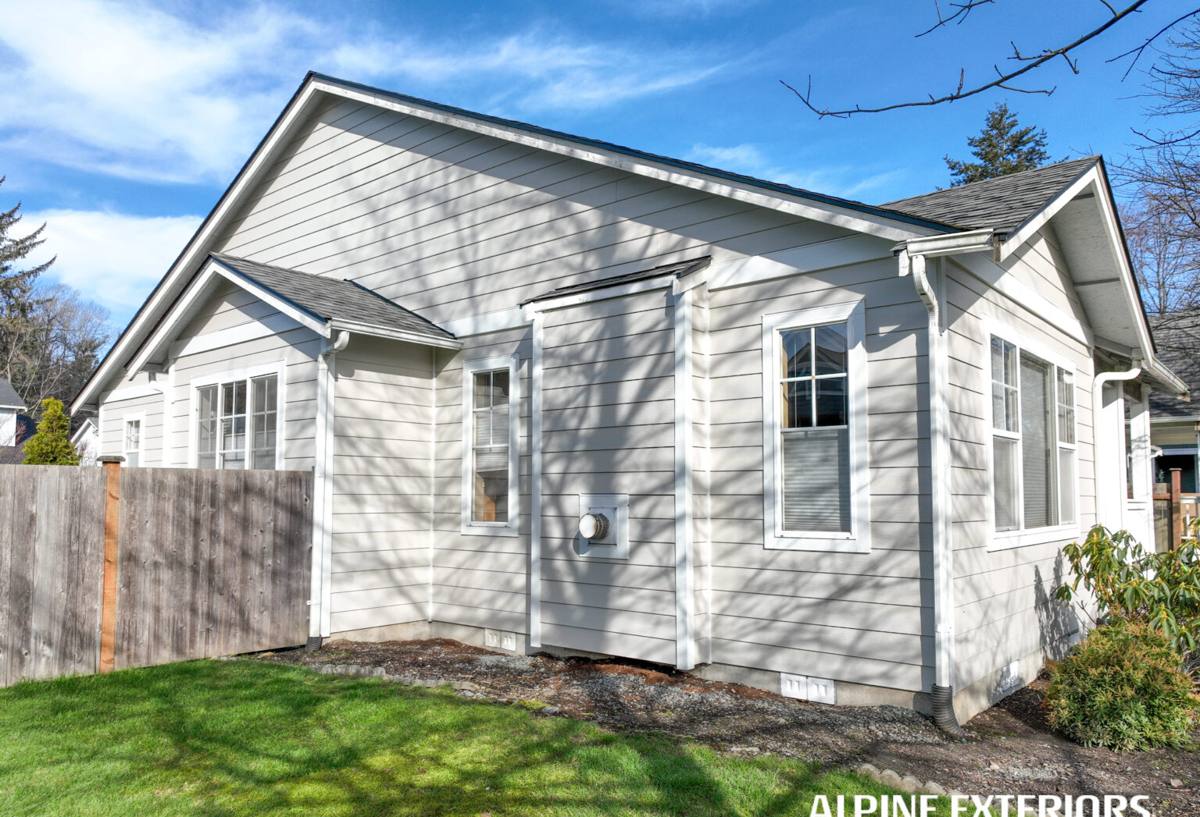
Why Fiber Cement Is the Right Material Here
Fiber cement is cement, sand, and cellulose fiber pressed and cured into a dense, dimensionally stable board. Unlike wood-based siding, it doesn't absorb moisture into its core and swell, and unlike vinyl, it doesn't soften, warp, or become brittle as coastal temperatures swing through the seasons. That density matters most in a place like Marietta, where the siding is dealing with salt air, standing humidity, and moss spores at the same time, sometimes for weeks without a real drying window.
What It Resists That Matters Locally
- Moisture swelling: fiber cement won't puff up at butt joints the way engineered wood products can when water finds a gap.
- Moss and algae growth: a factory-cured, non-organic surface gives moss less to hold onto than raw wood or primed spruce, though nothing stops moss from settling on top of paint.
- Salt exposure: the material itself doesn't corrode; the fasteners and flashing detailing around it are what determine long-term performance near the water, which is why installation quality matters as much as the product.
- Fire exposure: fiber cement is non-combustible, a real advantage during the dry summer stretches Whatcom County has seen in recent years.
We install James Hardie exclusively. Hardie's HZ5 product line is engineered for cold, wet climate zones like this one, with a factory-applied ColorPlus finish that's baked on rather than field-painted, which matters a great deal when the material has to hold color and seal integrity through a genuinely wet nine months of the year.
What a Correct Installation Actually Involves
Fiber cement is only as good as the assembly behind it. Most of the siding failures we get called out to inspect in coastal Whatcom County aren't the siding material failing — they're a flashing detail, a fastener pattern, or a clearance gap that let water get in behind a perfectly good board.
Weather-Resistive Barrier and Flashing
Everything starts with a continuous weather-resistive barrier and correctly lapped flashing at every window, door, and horizontal trim transition. In a driving-rain environment, water doesn't just run down a wall — it gets pushed sideways and upward under pressure. Flashing has to be sequenced so every layer sheds onto the one below it, with no reverse laps that trap water against the sheathing.
Fastening and Clearances
Hardie specifies exact nailing patterns, fastener types, and minimum clearances from grade, roofing, decks, and other transitions — usually a minimum of 6 inches off grade and 2 inches off roofing. Skipping these clearances is one of the most common shortcuts we see on homes that weren't installed by a Hardie-focused crew, and it's one of the fastest ways to void a warranty and invite rot at the bottom plate.
Caulking, Joints, and Trim
Butt joints, corner boards, and trim intersections all need to be treated as moisture management points, not just cosmetic seams. In a salt-air environment we lean toward detailing that sheds water rather than relying purely on sealant, because caulk is a maintenance item, not a permanent barrier.
James Hardie Compared to Other Siding Options
Homeowners in Marietta usually come to us already comparing a few materials. Here's an honest look at how they hold up against the conditions this location actually presents.
| Material | Moisture Behavior | Moss/Algae Resistance | Fire Rating | Long-Term Upkeep |
|---|---|---|---|---|
| James Hardie fiber cement | Dimensionally stable, resists swelling | Non-organic surface, holds paint well | Non-combustible | Low — repaint cycle only, no rot risk |
| Vinyl | Doesn't absorb water, but can warp/buckle with heat and cold cycling | Moderate; can trap moisture behind panels | Combustible, can melt or deform | Low cost but limited lifespan near salt air |
| LP SmartSide (engineered wood) | Treated, but wood-based core can swell at cut edges and joints | Vulnerable if the factory seal is compromised | Combustible | Moderate — edge sealing and joint maintenance matter |
| Primed spruce / cedar | Absorbs moisture, prone to cupping and checking | High — organic surface feeds moss readily | Combustible | High — regular repainting and moss treatment |
We don't install vinyl, LP SmartSide, primed spruce, or cedar, and we won't pretend that's just preference. Each of those products has real strengths, but in a climate that combines salt air, sustained humidity, and heavy moss pressure, they ask homeowners to take on maintenance or replacement risk that a correctly installed Hardie system doesn't carry.
Our Process, Start to Finish
A siding job is only as good as the sequence it follows. Here's what a Marietta project looks like with our crew, from first call to final walkthrough.
- On-site assessment: we look at existing siding, sheathing condition, trim, flashing, and any water staining or soft spots before quoting anything.
- Written estimate: a clear scope covering material, tear-off (if needed), flashing and moisture barrier work, and finish details — no surprise change orders for things we should have caught up front.
- Sheathing repair: any rot or soft sheathing found during tear-off gets replaced before a single new board goes up.
- Weather-resistive barrier and flashing installation: the part of the job nobody sees but that determines whether the siding lasts.
- Hardie siding installation: installed to manufacturer fastening and clearance specs, not shortcuts.
- Trim, caulking, and final details: corner boards, window and door trim, and touch-up work.
- Walkthrough: we go over the finished job with you before calling it done.
Maintenance in a Marine, Moss-Heavy Climate
Fiber cement lowers the maintenance burden, it doesn't eliminate it. A few habits keep a Marietta home's siding performing the way it should:
- Rinse siding annually, especially north-facing and shaded walls where moss and mildew settle fastest.
- Keep gutters clear so overflow doesn't run down and pool behind trim boards.
- Trim back vegetation and tree cover that keeps siding damp longer than it needs to be.
- Check caulking at trim joints and penetrations every couple of years and re-seal as needed.
- Watch for hairline cracking or chalking at the paint film — with ColorPlus finish this is rare, but it's worth a look after major storms.
None of this is heavy labor. It's the difference between siding that looks the way it did on installation day fifteen years later and siding that's fighting a losing battle against moss and moisture the whole time.
Why a Crew That Already Works Marietta Matters
Siding installation isn't one-size-fits-all across Whatcom County. A crew that mostly works drier, inland jobs can still do competent work, but they haven't necessarily built the habits that matter here — treating every flashing detail as a water-management decision, sequencing tear-off around the wet-weather windows this area actually gets, or knowing which wall orientations on a Marietta lot are going to take the worst of the driving rain and need extra attention at the seams. Familiarity with a specific coastal microclimate shows up in the small decisions on a job site, and those small decisions are what separate siding that holds up for decades from siding that needs attention again in five years.
What This Costs
Every home is different, and the honest answer is that final pricing depends on square footage, existing siding removal, sheathing condition, and trim complexity. Broadly, fiber cement siding sits above vinyl and below full masonry or high-end wood siding systems in upfront cost, but it carries a lower long-term cost of ownership than materials that need repainting, moss treatment, or early replacement in this climate. We provide a written, itemized estimate before any work starts, so you know exactly what you're paying for and why.
If your Marietta home's siding is showing moss staining, soft trim, chalking paint, or you're just planning ahead for a replacement, we'd be glad to take a look and put together a free, no-pressure estimate. There's no obligation, and you'll get a straight answer about what your home actually needs.