 Birch Bay
 Point Roberts' Uncommon Exposure
Point Roberts sits in a category of its own within Whatcom County. It's a peninsula that hangs south off the Canadian mainland, bordered by Boundary Bay and the Strait of Georgia on multiple sides, and reachable from the rest of the United States only by driving through Canada. That geography does more than make it a curiosity on a map — it means almost every home on the point is exposed to open water on more than one side, with fewer trees, hills, or neighboring structures to break up wind and salt spray before they reach a wall.
For siding, that translates into a heavier workload than a similar house would face a few miles inland in Birch Bay or Blaine. Salt-laden air, driving rain that comes in sideways off the water, and a moss season that runs longer than it does on more sheltered lots all combine to test a wall system in ways a generic install doesn't plan for.
Why This Matters More Here Than Elsewhere in Whatcom County
Salt air accelerates corrosion on anything metal — fasteners, flashing, trim edges — faster than it would on a home set back from the water. Persistent humidity keeps surfaces wet longer between rain events, which matters most for any siding material that can absorb moisture or support rot. And wind off open water pushes rain into laps, seams, and trim joints with more force than a calm, tree-sheltered site ever will. None of this means Point Roberts homes need something exotic. It means the material and the installation both need to be matched to the exposure, not just to a regional average.
Why Fiber Cement Is the Right Call for This Climate
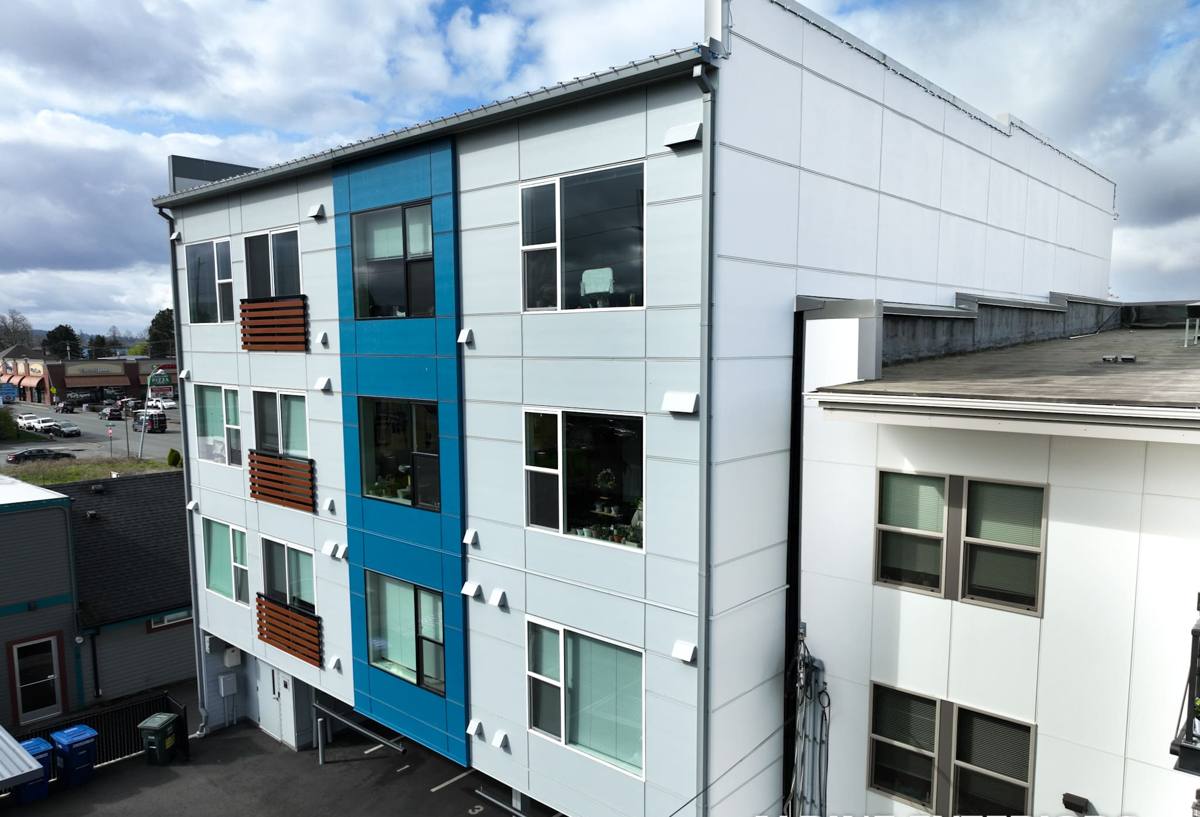
James Hardie fiber cement siding is made from cement, sand, and cellulose fiber, pressed and cured into a dense, dimensionally stable board. It doesn't rot, it doesn't feed insects, and it doesn't swell and shrink with moisture the way wood-based products can. In a marine environment where a wall can go through repeated wet-dry cycles without ever fully drying out between storms, that stability is the difference between siding that holds its shape and finish for decades and siding that needs attention every few years.
This is also why we install James Hardie fiber cement exclusively and don't offer vinyl, LP SmartSide, or primed wood siding. Each of those products has real strengths in the right setting, but none of them is what we'd choose to put on a home that sits this close to open salt water — the maintenance burden and moisture sensitivity work against a homeowner in exactly the conditions Point Roberts sees most.
Non-Combustible Is Still Worth Having
Fiber cement is non-combustible, which matters for insurance and peace of mind even on a coastal lot that isn't in a wildfire corridor. It's not the main reason to choose it here, but it's a real advantage that comes standard with the material rather than something you have to pay extra to get.
What Salt Air, Driving Rain, and Moss Actually Do to a House
Salt Air and Metal Corrosion
Airborne salt settles on every exterior surface, including the fasteners and flashing hidden behind the siding. Standard fasteners can corrode faster in this environment, which is why corrosion-resistant fasteners and flashing — rated for coastal exposure rather than generic interior-grade hardware — matter more here than on an inland job. It's a detail that's invisible once the wall is closed up, but it's the difference between trim that stays tight for decades and trim that starts to streak and loosen years early.
Wind-Driven Rain and Water Intrusion
Rain that falls straight down is easy for any siding to shed. Rain that's being pushed sideways or even slightly upward by wind off the water is a different problem — it looks for any gap at a lap, a butt joint, or a penetration and tries to work its way behind the siding. Correct lap reveal, sequenced flashing at every horizontal transition, and a properly installed weather-resistant barrier underneath the siding are what actually stop that water, not the siding material alone.
A Longer Moss and Algae Season
Shaded and north-facing walls on the point stay damp longer into the year than similar walls further inland, which extends the window for moss and algae growth. Moss holds moisture directly against whatever it's growing on, and over time that constant dampness undermines paint and caulk faster than intermittent rain would on its own. A factory-applied, moisture-resistant finish and proper standoff and airflow behind the siding both help slow this down; letting growth sit untreated year after year does not.
How James Hardie's Climate Engineering Addresses This
Engineered by Climate Zone
James Hardie doesn't make one universal siding formulation — it engineers its HardieZone products differently depending on the climate they're going into. Whatcom County falls into the wetter, temperate HZ5 zone, and the products we install are formulated with that specific combination of moisture and freeze-thaw cycling in mind rather than for a generic national average.
ColorPlus Factory Finish
Most of what we install uses Hardie's ColorPlus factory-applied finish rather than field-applied paint. It's baked on under controlled conditions, resists fading and moisture penetration better than a job-site paint job, and comes with its own finish warranty separate from the substrate warranty. In a climate that keeps siding damp more often than it dries, a finish that was engineered specifically to resist that cycle is worth more than it would be in a drier region.
Product Lines We Use
Most Point Roberts homes use HardiePlank lap siding as the main field material, with HardiePanel or shingle-profile siding for accent areas and HardieTrim for corners, fascia, and window and door surrounds. These are manufactured to work together as a system — matched expansion characteristics, matched fastening requirements — rather than mixed with trim or accent material from a different product line.
What a Correct Installation Involves
Flashing and Water Management First
The siding itself is the last thing that goes up. Before any board is hung, the wall needs a properly lapped weather-resistant barrier, correct flashing at every window, door, and roof-to-wall intersection, and kick-out flashing wherever a roofline meets a sidewall. Get this sequence wrong and no amount of quality siding on top will keep water out.
Fastening, Gapping, and Clearances to Spec
James Hardie publishes specific fastener types, spacing, and placement requirements, along with minimum gaps at butt joints and trim, and minimum clearance from grade, decks, and roofing. Those numbers aren't arbitrary — they're what allows the material to move slightly with temperature and humidity without cracking the finish or trapping water, and skipping them is one of the most common ways an otherwise good product ends up performing poorly.
Caulking and Finish Practices
Sealant at trim joints needs to be compatible with the ColorPlus finish and applied only where the manufacturer calls for it — over-caulking joints that are designed to allow drainage can trap moisture instead of shedding it. Any touch-up paint should be matched to the factory finish rather than a generic exterior paint pulled off a shelf.
| Cost Factor | Why It Affects Your Estimate |
|---|---|
| Home size and wall complexity | More corners, dormers, and trim details mean more cutting, flashing, and labor time |
| Existing siding removal and sheathing condition | Rot or moisture damage found once old siding comes off needs repair before new siding goes on |
| Trim and accent detailing | Board-and-batten accents, shingle-style gables, and custom trim add material and labor beyond a plain lap-siding wall |
| Color selection | Factory ColorPlus finishes come in a set palette; custom colors typically mean field painting and a different warranty structure |
| Access and logistics | Point Roberts' location affects how material deliveries and crew scheduling are planned around the border crossing |
Our Process for a Point Roberts Project
We start with an on-site assessment and measurement, checking existing siding, trim, and sheathing for moisture damage or rot before we ever price the job. Once the scope is set, materials are ordered and staged so the crew arrives with everything needed rather than making repeat trips mid-project. Installation follows the sequence above — water management first, then siding, trim, and finish — with inspection points along the way rather than only at the end.
Scheduling Around the Point Roberts Commute
Getting a crew and a full load of material onto the point means planning around the drive through Canada rather than treating it as an afterthought. We schedule Point Roberts jobs in continuous blocks and stage deliveries in advance, which keeps the project moving instead of losing days to logistics that a crew unfamiliar with the area might not plan for. That planning is also why we can work efficiently with seasonal and part-time residents whose availability windows are tighter than a full-time occupant's.
Maintenance Point Roberts Homeowners Should Expect
- Rinse salt residue off siding a couple of times a year, especially on walls facing open water
- Keep gutters and downspouts clear so roof runoff doesn't sheet directly across siding
- Trim back vegetation touching or shading walls to cut down on trapped moisture and moss growth
- Inspect caulking at trim, windows, and penetrations annually and re-seal joints that have opened up
- Address moss and algae growth with a gentle, manufacturer-appropriate cleaning method rather than aggressive pressure washing, which can damage the factory finish
Why Hiring a Crew That Already Works in Point Roberts Matters
A crew that regularly works this area knows how the exposure here differs from a job in Birch Bay, Blaine, or Ferndale, and installs accordingly — corrosion-resistant fasteners as a default, flashing details sized for wind-driven rain, and finish choices that hold up through a longer damp season. They also already know how to plan around the logistics of reaching the point, so a project doesn't stall out on delivery timing or crew scheduling. That local experience shows up less in what the finished wall looks like on day one and more in how it's still performing ten and twenty years later.
If you're weighing a siding project on Point Roberts, we're happy to walk the property, look at what your home is currently dealing with, and put together a straightforward, no-pressure estimate using the form below.