 Birch Bay
 Point Roberts' Marine Climate Is Harder on Siding Than Most Homeowners Realize
Point Roberts sits at the very tip of a small peninsula that pokes into the Strait of Georgia, surrounded on three sides by water and cut off from the rest of Whatcom County by the U.S.–Canada border. That geography is part of what makes it a beautiful place to own a home — and part of what makes siding here take a beating that inland Whatcom County homes never see. Salt-laden air blows off the water almost constantly, wind-driven rain hits walls at angles siding on a sheltered lot never has to deal with, and the same marine humidity that keeps lawns green year-round also keeps north- and west-facing walls damp long enough for moss and algae to take hold.
None of this is unique to Point Roberts in the abstract — it's the same Pacific Northwest coastal pattern we see across Birch Bay and the rest of the Whatcom County shoreline. But Point Roberts gets a more concentrated dose of it because there's open water on nearly every side. A siding product or installation detail that holds up fine two miles inland can fail years early right on the water, which is exactly why this page focuses on this one job in this one place rather than treating siding installation as generic anywhere in the county.
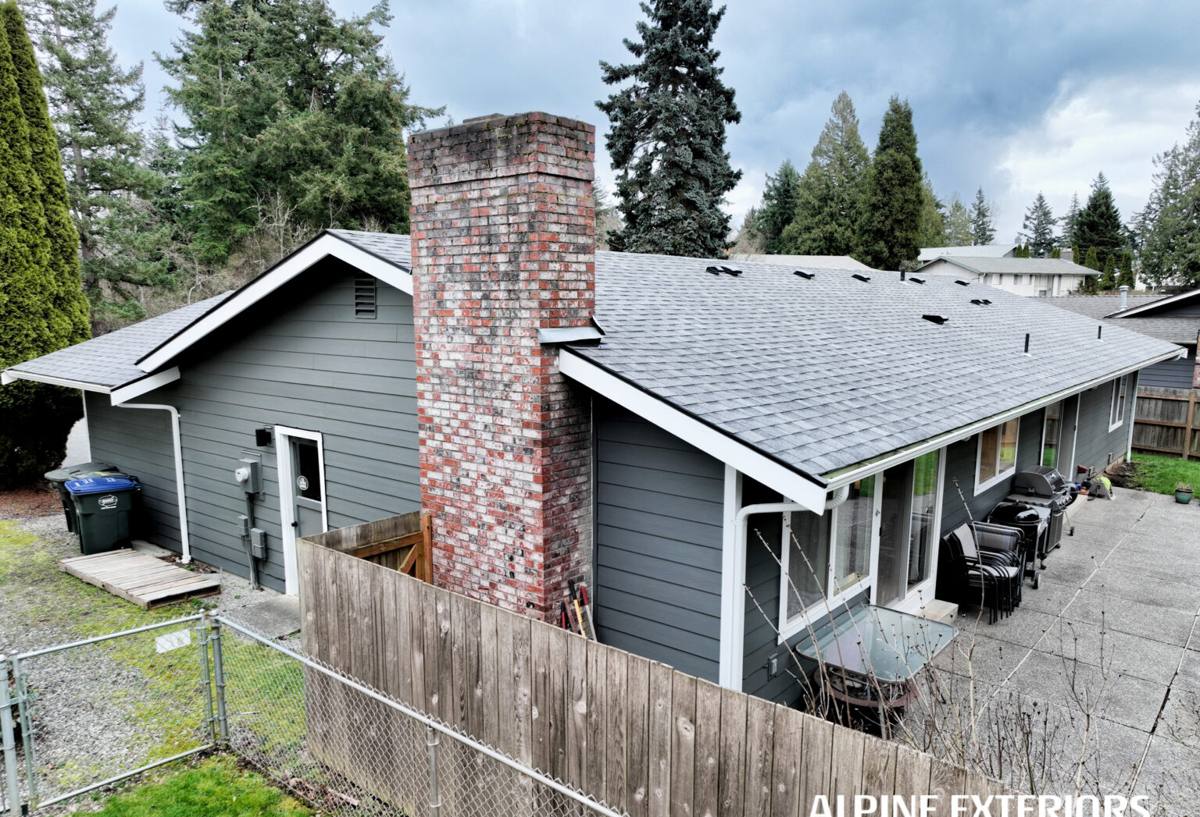
What Point Roberts Homes Actually Need From Their Siding
Salt Air
Airborne salt is corrosive to fasteners, trim, and finish coatings, and it accelerates the breakdown of anything that relies on paint film alone for protection. Siding here needs a finish and a fastening system built to shrug off salt exposure, not just cope with normal weather.
Driving Rain
Wind off the water pushes rain sideways into wall assemblies, which means water management — flashing, house wrap, proper laps, and sealed penetrations — matters more here than on a calm inland wall. Siding that's merely water-resistant on a still day isn't enough when rain is being driven horizontally into the wall.
A Long Moss Season
Shaded, north-facing walls in this climate stay damp for months at a stretch. Moss and algae don't just look bad — sustained moisture at the surface of the siding is what eventually finds its way into seams, fastener holes, and butt joints if the material and the installation aren't built to resist it.
Why We Install James Hardie Fiber Cement Here — and Not the Alternatives
We install James Hardie fiber cement exclusively, on every job, including every project we do in Point Roberts. That's not a marketing position — it's a standard we hold because of what this specific coastline does to a wall over ten or twenty years.
Fiber cement is non-combustible and dimensionally stable, meaning it doesn't swell, cup, or warp the way wood-based products can when they take on repeated moisture. Hardie's ColorPlus factory finish is baked on under controlled conditions rather than field-applied, which gives it better adhesion and more consistent UV and salt resistance than a coat of paint applied on site. Hardie also engineers its HZ product lines for specific climate zones — the versions we install are matched to Pacific Northwest moisture exposure, not a one-size-fits-all national spec.
We get asked why we don't offer vinyl, LP SmartSide, cedar, or primed spruce as options. The honest answer is trade-offs, not defects: vinyl can warp and fade under UV and doesn't offer the same fire performance; wood-based products, including engineered wood like LP SmartSide, rely on edge sealing and maintenance discipline to keep moisture out, which is a harder standard to hold on a wall that's wet as often as ours are here; cedar and primed spruce need more frequent refinishing to keep ahead of moss and rot in this climate. Every one of those products has a place — we just don't think a Point Roberts wall is the place for them, and we'd rather install one product well than several products with caveats.
Siding Material Comparison for This Climate
| Material | Moisture/salt behavior | Maintenance in this climate | Typical field performance here |
|---|---|---|---|
| James Hardie fiber cement | Non-combustible, dimensionally stable, factory finish resists salt and UV | Periodic rinse; repaint only if desired, not required for protection | Decades before a repaint decision is even needed |
| Vinyl | Won't rot, but can warp or fade with UV and coastal temperature swings | Low, but panels can loosen near constant wind exposure | Visible fading and warping well before Hardie's finish shows wear |
| Engineered wood (e.g., LP SmartSide) | Resin-treated, but cut edges and fastener penetrations need consistent sealing | Regular caulk and paint upkeep to keep moisture out of seams | Performs well only with disciplined, ongoing maintenance |
| Cedar / primed spruce | Natural material, absorbs moisture, prone to moss and rot without upkeep | Frequent refinishing and moss treatment | Requires the most maintenance of the group in this climate |
These are general climate-performance patterns, not claims about any specific product failing — every material on that list can perform reasonably well with diligent upkeep. What we're pointing out is how much maintenance discipline each one demands on a wall that faces open water, and Hardie is the one that asks the least of the homeowner over time.
What a Correct Siding Installation Involves Here
The product is only half the equation. A Hardie installation that isn't detailed correctly for a driving-rain, high-salt environment can still leak or fail early. On every Point Roberts job we pay particular attention to:
Water Management Behind the Siding
Proper house wrap or weather-resistive barrier, correctly lapped and taped, with flashing at every window, door, and horizontal trim transition. This is the layer that actually keeps a wall dry — the siding is the first line of defense, not the only one.
Drainage and Airflow at the Wall
Where the wall assembly calls for it, a drainage gap behind the siding lets any moisture that does get past the outer layer drain and dry out instead of sitting against the sheathing. In a climate with this much sustained dampness, giving the wall a way to dry is as important as keeping water out in the first place.
Fastening and Clearances
Corrosion-resistant fasteners driven to Hardie's specification — not overdriven, not underdriven — with correct nailing patterns and proper clearance at the ground, roofline, and any deck or patio surface so moisture and debris can't wick into the bottom edge of the siding.
Joints, Caulking, and Trim
Butt joints and trim transitions sealed with a flexible, paintable sealant rated for exterior use — done consistently on every elevation, not just where it's visible from the ground.
Field-Cut Edges
Every field cut needs to be sealed per manufacturer spec before it goes on the wall. Skipping this step is one of the most common corner-cutting mistakes we see on redo jobs, and it's exactly the kind of detail that matters more here than on a sheltered inland wall.
Our Process for a Point Roberts Siding Project
- On-site assessment — we walk the exterior, check for existing moisture or moss damage, and note which elevations take the worst of the wind and rain.
- Material and color selection — Hardie plank, panel, or shingle profiles and ColorPlus finish options, chosen with this climate in mind.
- Tear-off and substrate check — removing existing siding lets us inspect sheathing for hidden moisture damage before anything new goes up.
- Weather barrier and flashing — the water-management layer goes in correctly before a single piece of siding is installed.
- Installation to Hardie spec — proper fastening, clearances, and sealed joints, elevation by elevation.
- Trim, caulk, and final finish — details finished to the same standard on every wall, not just the street-facing side.
- Walkthrough and cleanup — we review the completed work with the homeowner before we consider the job done.
Why a Crew That Already Works Point Roberts Matters
Point Roberts is geographically separate from the rest of Whatcom County — it's connected to the mainland U.S. only by driving through Canada. That's a real logistical detail, not a footnote: it affects how contractors plan material deliveries, schedule crews, and coordinate multi-day projects. A crew that hasn't worked here before has to solve that logistics puzzle for the first time on your job. A crew that already works this area — like ours, based just up the coast in Birch Bay — has already worked out the routing, timing, and delivery coordination it takes to keep a project moving without unnecessary delays.
There's also a practical-experience side to it. A crew that's installed Hardie siding on multiple Point Roberts homes has a feel for which elevations on a typical lot take the worst wind-driven rain, how much moss buildup to expect on shaded walls, and what local permitting requires. That familiarity doesn't replace doing the installation correctly — it just means fewer surprises along the way, and fewer delays caused by logistics nobody planned for.
Maintenance After Installation
One advantage of fiber cement in a salt-air, high-moss climate is how little ongoing maintenance it actually demands compared to wood-based alternatives. Still, a few habits keep any siding performing well here:
- Rinse siding periodically to clear salt residue and organic buildup, especially on shaded or north-facing walls
- Keep gutters clean and downspouts directed away from the foundation so runoff isn't sheeting down the wall
- Trim back vegetation and tree cover that keeps a wall shaded and damp longer than it needs to be
- Watch caulked joints and trim transitions for cracking or gaps and have them resealed before water gets behind the siding
- Address any moss or algae growth early rather than letting it establish itself over a full season
Cost Factors for a Point Roberts Siding Project
| Factor | Why it affects cost |
|---|---|
| Home size and wall complexity | More elevations, corners, and trim details mean more labor and material |
| Extent of tear-off and substrate repair | Hidden moisture damage found during tear-off adds repair scope |
| Siding profile and finish selection | Plank, panel, and shingle profiles and premium ColorPlus colors vary in material cost |
| Site access and delivery logistics | Point Roberts' location affects scheduling and material staging |
| Trim and detail work | Corner boards, window and door trim, and fascia detailing add labor time |
We won't quote a number without seeing the home — every one of these factors moves the estimate — but we're always straightforward about what's driving the cost and where a homeowner has real choices to make.
If you're planning a siding project in Point Roberts, we'd be glad to come take a look and walk the property with you. There's no pressure and no obligation — just a straight assessment of what your home needs and an honest estimate, from a crew that already knows this stretch of coastline. Use the form below to get started.