 Birch Bay
 Siding Repair Built for Point Roberts' Odd Geography and Rough Weather
Point Roberts sits in a strange spot on the map — a small American peninsula hanging off the bottom of the Tsawwassen headland, cut off from the rest of Whatcom County by water and by the Canadian border. That isolation matters for siding repair. It's not a place where a contractor swings by on the way to another job. It takes planning, a border crossing, and a crew that treats the trip as routine rather than a hassle. We work Point Roberts alongside our regular routes through Birch Bay and the rest of Whatcom County, so we're not learning the drive or the local conditions for the first time when your call comes in.
The weather is the other half of the story. Point Roberts catches wind and salt spray off Boundary Bay and the Strait of Georgia from multiple directions, gets pounded by the same driving winter rain that hits the rest of the county, and sits under enough tree cover and marine moisture in places to grow moss on siding for a good chunk of the year. Siding here works harder than siding fifty miles inland, and repairs need to account for that, not just patch the visible damage and move on.
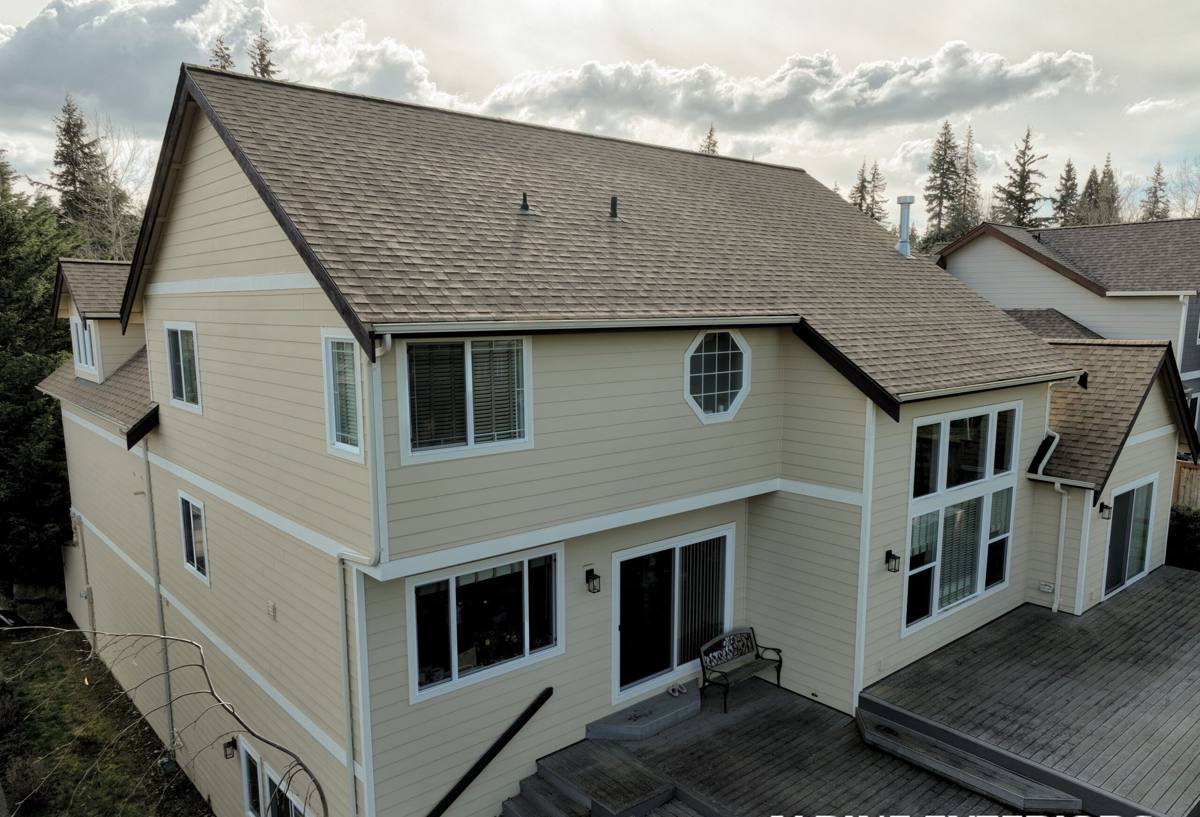
What Point Roberts' Climate Does to Siding Over Time
Salt Air and Corrosion
Being surrounded by water on three sides means salt-laden air is a constant, not an occasional event. Salt accelerates corrosion on fasteners, flashing, and any exposed metal trim. When we open up a siding repair here, we're checking not just the siding material itself but the nails, screws, and flashing behind it — because corroded fasteners are often the real reason a section of siding failed in the first place.
Driving Rain and Wind-Driven Moisture
Point Roberts gets the same wet Pacific Northwest winters as Birch Bay, and its exposed, low-elevation position means wind-driven rain can push moisture into joints, laps, and penetrations that would stay dry on a more sheltered lot. Repeated wetting and drying cycles are what eventually cause siding to swell, delaminate, or let water track behind the cladding into the wall assembly.
Moss, Mildew, and a Long Damp Season
Shaded sides of homes, north-facing walls, and anywhere airflow is limited are prone to moss and mildew growth for much of the year. Moss holds moisture against the siding surface far longer than open air would, which speeds up rot in wood-based products and can stain or degrade paint finishes on almost anything it colonizes.
How to Tell If Your Point Roberts Home Needs Siding Repair
- Soft or spongy spots when you press on the siding, especially near the bottom courses or around windows
- Visible gaps, cracks, or buckling at seams and corners
- Paint that's peeling, bubbling, or won't hold in specific spots (often a sign of trapped moisture)
- Moss or dark streaking that keeps coming back even after cleaning
- Rust streaks below nail heads or trim fasteners
- Soft trim boards, especially at the base of walls and around doors and windows
- Interior signs — musty smell, discoloration on interior walls near exterior corners, or a slight give in nearby drywall
Any one of these can be minor. Several together, especially in the same area of the house, usually mean water has been getting behind the siding for a while and the damage goes deeper than the surface.
What a Correct Siding Repair Actually Involves
A lot of siding "repair" in wet coastal areas is really just cosmetic — caulk over a crack, a fresh coat of paint over a stain, a patch nailed on top of a soft spot. That approach might look fine for a season, but it doesn't address why the siding failed, and on a site as exposed as Point Roberts, the underlying problem tends to come back worse.
Our approach starts with removal, not covering
We pull the damaged siding rather than working around it. That's the only way to actually see the condition of the water-resistive barrier, the flashing, and the framing underneath. If there's rot in the sheathing or framing, patching over it just traps the problem behind new material.
Then we address the water path, not just the hole
Almost every siding failure has a water entry point somewhere — a gap in flashing, a caulk joint that failed, a penetration that was never properly sealed, or a butt joint that wasn't backed correctly. Replacing the siding without fixing that entry point means you're paying for the same repair again in a few years.
Finally, we match and finish correctly
Repairs get tied into the existing siding with proper overlaps, fastening patterns, and — where the repair involves painted material — a finish that matches as closely as reasonably possible. We don't leave mismatched patches as a "good enough" outcome.
Repair Scope: What to Expect Depending on Damage Level
| Damage Level | Typical Cause | What the Repair Involves |
|---|---|---|
| Isolated crack or gap | Impact damage, settling, or a failed caulk joint | Localized removal, inspection of the area behind it, re-siding the section, resealing |
| Soft or delaminating boards | Long-term moisture exposure, often from a nearby flashing or sealant failure | Removal of affected boards, check sheathing condition, repair or replace framing if needed, re-side and re-flash |
| Recurring moss/mildew staining | Shade, poor airflow, marine humidity | Cleaning, addressing airflow or vegetation clearance where possible, evaluating whether the siding surface itself is degrading underneath the growth |
| Multiple failure points across one wall | Systemic issue — original installation, aging material, or long-term water intrusion | Broader assessment of whether targeted repair is still cost-effective versus replacing that wall's siding |
That last row matters. Part of an honest repair estimate is telling you when patch repair no longer makes sense — when the labor to keep chasing individual failures costs more over a few years than replacing the affected section once, correctly.
Why We Only Repair and Replace With James Hardie Fiber Cement
When a repair calls for new siding material — whether it's a small patch or a full wall section — we use James Hardie fiber cement, and we don't install alternatives. That's a deliberate standard, not a default.
Fiber cement doesn't absorb water the way wood-based or wood-adjacent products can, which matters directly in a place like Point Roberts where siding stays damp for extended stretches. It's non-combustible, holds its shape and fastening in salt-exposed marine air better than many alternatives over the long run, and James Hardie's ColorPlus factory finish is engineered to resist the fading and moisture-related finish failure that plain field-painted products are more prone to in this climate. Their HZ5 product line is specifically engineered for the kind of freeze-thaw and moisture cycling the Pacific Northwest sees.
We've made the call not to install vinyl, LP SmartSide, primed wood, or other fiber cement alternatives on the homes we work on. Each of those products has legitimate uses elsewhere, but for the moisture load, salt exposure, and long damp season that Whatcom County's coastline — Point Roberts included — puts siding through, we don't think they hold up as well over a 20-30 year window as correctly installed Hardie does. When a repair is significant enough that we're replacing more than a patch, we'll walk you through why we recommend Hardie for that specific section rather than matching a failing product with more of the same.
Our Process for Point Roberts Jobs
- Initial assessment: We look at the visible damage and check adjacent areas, trim, and flashing for related issues, not just the spot you called about
- Scope and estimate: A clear, written explanation of what needs to happen and why — including if we think patch repair isn't the right long-term answer for a given area
- Scheduling: Because Point Roberts requires crossing the border to reach, we batch materials and plan the trip so the work isn't held up mid-project waiting on a supply run
- The repair itself: Removal, inspection of what's underneath, structural or moisture-barrier correction if needed, and proper re-siding with correct fastening and flashing
- Final check: Confirming water paths are sealed correctly and the finished repair is tied cleanly into the surrounding siding
Why Hiring a Crew That Already Works Point Roberts Matters
Point Roberts homeowners have told us, in different words, the same frustration: contractors quote the job, then the logistics of the crossing and the isolation make it a low priority once something easier comes along on the mainland. A repair gets delayed, rescheduled, or the crew shows up without the right materials because the trip wasn't planned for.
We treat Point Roberts as a regular part of our Whatcom County service area, not a special case. That means realistic scheduling, materials packed correctly the first time, and a crew that isn't guessing about how the local exposure — salt air, wind-driven rain, extended damp periods — affects the repair decisions we're making on your home.
Get a Free, No-Pressure Estimate
If you're seeing early signs of siding damage on a Point Roberts home — or you already know a section needs real repair — we're glad to take a look. Fill out the form below for a free estimate; there's no pressure and no obligation, just a straight assessment of what's going on and what it would take to fix it right.