 Birch Bay
 New-Construction Windows Are a Different Job Than Replacement
When a homeowner or builder in the Sumas area calls us about new-construction windows, they're usually mid-build: framing is up, the rough openings are cut, and the weather-resistive barrier is either on or about to go on. That's a very different job from swapping out an old window in an existing wall. New-construction windows install with a nailing fin that gets integrated directly into the wall's water management system — the housewrap, the flashing tape, the sill pan — before siding ever goes on. Get that sequence wrong and you won't see the problem for a year or two, until moisture starts showing up somewhere it shouldn't.
We treat new-construction window installs as part of the building envelope, not a standalone product swap. That mindset matters everywhere in Whatcom County, but it matters especially here, where the combination of long wet seasons and, closer to the water, salt-laden air puts real stress on anything that isn't sealed correctly from day one.
Why This Matters More in This Part of Whatcom County
Homes in and around Birch Bay and the surrounding Whatcom County communities deal with a wet season that runs long — driving rain off the Strait, saturated ground for months at a stretch, and a moss season that tells you exactly how much moisture is sitting on every north-facing surface. A window that's only "mostly" sealed will find that out. Sumas-area builds add their own wrinkle: being more inland, homes here can see sharper temperature swings and more frost/fog cycling than waterfront Birch Bay properties, which puts extra demand on the window's air seal and the quality of the frame material, not just the flashing.
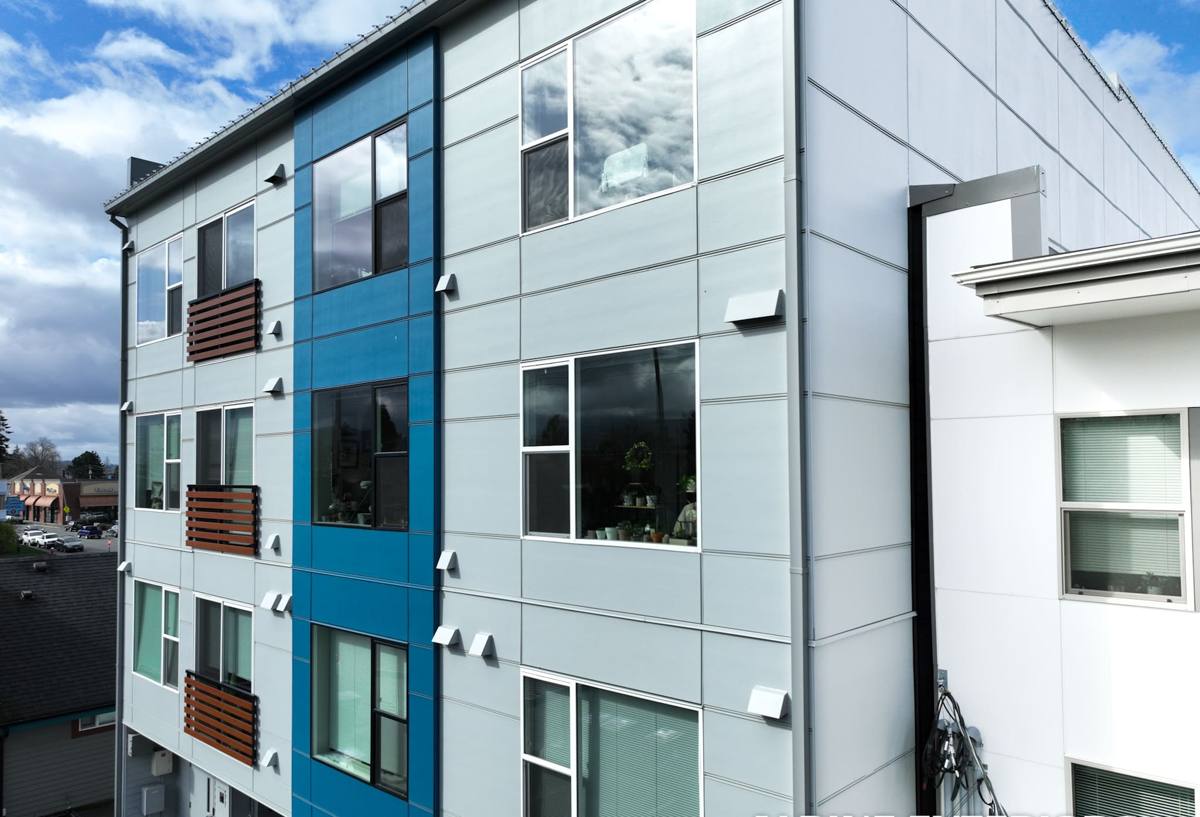
What a Correct New-Construction Window Install Actually Involves
There's a sequence to this, and skipping steps is the single biggest cause of window-related water damage we get called out to fix later. On a proper install, every layer overlaps the one below it like shingles, so water is always directed outward and down, never behind the housewrap.
- Sill pan flashing — a sloped, sealed pan under the rough opening so any water that gets past the window has somewhere to go besides the framing.
- Housewrap integration — the WRB is cut and folded into the opening correctly, not just taped over.
- Flashing tape at jambs and head — applied in the right order (sides before top) so laps shed water correctly.
- Nailing fin fastening — fastened per the manufacturer's schedule, not "close enough," because under-fastening is a warranty-voiding shortcut we won't take.
- Shimming and squaring — the window has to be plumb, level, and square in the opening or it won't operate correctly and the seal will be uneven.
- Insulation and air sealing around the frame — low-expansion foam or backer rod, not stuffed fiberglass that leaves gaps.
- Interior and exterior trim/sealant — finished so the whole assembly is weathertight before siding closes it in.
Every one of those steps has to be inspectable before the wall gets closed up. On new construction, that's actually an advantage over replacement work — we can verify the flashing is right while it's still visible, instead of taking it on faith behind finished siding.
Choosing Windows for a Sumas-Area New Build
Material and glazing choice matters as much as installation. We steer new-construction clients toward products that hold up to sustained wet weather without high maintenance demands, and we're upfront about the trade-offs of each option rather than pushing whatever's easiest to install.
| Frame Material | Moisture Behavior | Maintenance | Typical Fit |
|---|---|---|---|
| Vinyl | Won't rot; handles wet climates well | Low — occasional cleaning | Most cost-effective, good all-around choice for new builds |
| Fiberglass | Very stable in wet/temperature swings; won't warp | Low | Higher upfront cost, longer expected service life |
| Wood-clad | Good if the exterior cladding stays intact; interior wood needs a dry, sealed exterior shell | Higher — cladding seams need periodic inspection | Best for buyers prioritizing interior wood look and willing to maintain it |
| Aluminum | Conducts cold and can condense in our wet, cooler months | Moderate | We generally don't recommend it for this climate unless thermally broken |
Glass Packages Worth Asking About
For this region, we typically talk new-construction clients through low-E, argon-filled double-pane units as the baseline, with triple-pane as an upgrade for north- or west-facing rooms that take the brunt of the weather. The NFRC label on any window you're considering will show U-factor (insulation value) and air leakage — both matter more here than in a drier, milder climate, because the window is working against sustained moisture and wind exposure for a large part of the year.
How We Approach the Job
- Plan review — we look at the rough opening sizes and window schedule before anything ships, so there are no surprise fit issues mid-build.
- Coordination with the builder or GC — new-construction windows go in on a schedule set by framing and WRB installation, not on our own timeline, so we work with whoever's running the site.
- Flashing and install — done to manufacturer spec, documented as we go so it can be checked before siding closes the wall.
- Operation check — every window gets opened, closed, and locked before we call the job done. A window that doesn't operate smoothly on day one won't get better with age.
- Final walkthrough — we go over what was installed, what the warranty covers, and what basic upkeep looks like.
Mistakes We See on New Builds — and Why We Avoid Them
Most window failures we're called to diagnose on newer homes trace back to a handful of repeatable problems: flashing installed in the wrong order so laps direct water inward instead of outward, sill pans skipped entirely, fasteners driven through trim instead of the nailing fin, or spray foam used as the only "seal" with no mechanical flashing behind it. None of these show up at final walkthrough. They show up during the first hard winter storm, or a few years later as soft trim and interior staining. We flag this not to criticize any one product or crew, but because it's the honest reason a rushed install costs more in the long run than a correct one.
What New-Construction Windows Typically Run
Costs vary by opening size, material, glazing package, and how many units are on the job, so we'd rather give you a real number after seeing the plans than a page full of guesses. As a general guide:
| Factor | Effect on Cost |
|---|---|
| Frame material (vinyl vs. fiberglass vs. wood-clad) | Fiberglass and wood-clad run higher than vinyl |
| Glazing (double vs. triple-pane) | Triple-pane adds cost but improves comfort on exposed elevations |
| Number and size of openings | Larger and more numerous openings raise both material and labor cost |
| Opening complexity (bays, corners, large sliders) | Custom shapes and multi-unit assemblies take more install time |
| Site access and build stage | Coordinating around other trades can affect scheduling but not usually unit cost |
Why a Crew That Already Works This Area Is Worth Choosing
A crew that installs windows across Birch Bay, Sumas, and the rest of Whatcom County sees how these homes actually perform a few years out — which flashing details hold up to a wet, salt-influenced coastal exposure and which details matter more on an inland lot with sharper temperature swings. That's not something you get from a general install manual. It shapes small decisions on-site: how much lap to give flashing tape on a west-facing wall, where to spend extra time on the seal, which glazing package is worth the upgrade for a given elevation. It also means we're not guessing at how local building department expectations or typical framing practices in this area line up with manufacturer install instructions.
Before You Hire — A Quick Checklist
- Ask to see the sill pan and flashing detail they plan to use, not just the window brand.
- Confirm they'll install to the window manufacturer's written instructions (this is what keeps the warranty valid).
- Check they're licensed and insured to work in Washington, and ask for proof.
- Ask how they coordinate scheduling with your framer or GC if this is a build in progress.
- Get the glazing spec (U-factor, air leakage) in writing, not just "energy efficient" as a description.
- Ask what happens if an opening is out of square — a real answer beats a vague one.
If you're planning new-construction windows for a build in the Sumas or Birch Bay area, we're glad to walk the plans with you and put together a straightforward, no-pressure estimate. Use the form below to get started.