 Birch Bay
 Terrell Creek's Climate Puts Real Stress on a Roof
Terrell Creek sits inside the Birch Bay area of Whatcom County, close enough to the water that salt air is a daily fact of life for anything metal on a house. Add in the long stretch of wet months typical of northwest Washington, driving rain that comes off the water at an angle rather than falling straight down, and a shaded, moisture-heavy landscape that keeps moss growing for most of the year, and you've got three separate forces working against a roof at the same time. None of this is unique to this one neighborhood, but it's more pronounced here than in the drier, more open parts of inland Whatcom County, and a roof detailed for a generic Pacific Northwest climate isn't always detailed for this particular combination.
That's the case for metal roofing specifically. Metal handles wind and rain better than most materials when it's installed correctly, but it's also less forgiving of shortcuts than people expect. The mistakes that don't show up for years in a drier climate show up in a couple of wet seasons here.
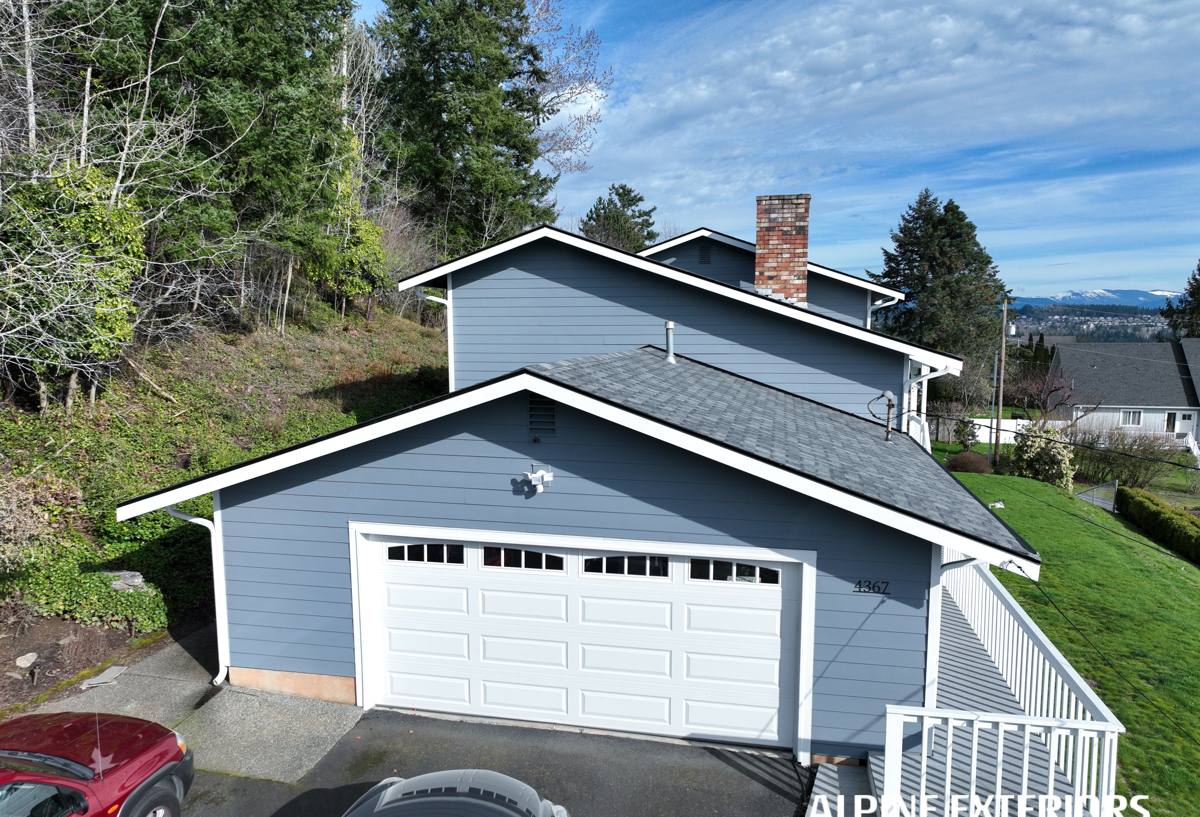
What This Climate Actually Does to a Metal Roof
Salt Air and Corrosion
Airborne salt accelerates corrosion on metal, especially at fasteners, cut edges, and anywhere two dissimilar metals touch. A steel screw against an aluminum panel, or the wrong flashing metal paired with the wrong panel metal, sets up galvanic corrosion that eats away at the contact point over years. It's rarely dramatic — it's a slow staining and pitting that shows up first at fastener heads and panel edges, exactly the spots that are hardest to see from the ground.
Moss and Standing Moisture
Moss doesn't just sit on top of a roof. Once it takes hold in a shaded valley or a north-facing slope — both common under the tree cover around Terrell Creek — it holds moisture directly against seams, fasteners, and panel laps. That constant dampness is what actually causes problems, not the moss itself. A roof that sheds moss easily and dries out quickly between rains will outlast one that traps it.
Driving Rain and Wind-Driven Water
Rain that comes in sideways behaves differently than rain that falls straight down. It gets pushed up under laps, around fastener heads, and into the transition points where a roof meets a wall, a chimney, or a dormer. Those are exactly the spots where flashing and sealant quality matter most, and they're the first places a marginal installation fails once storm season sets in.
Standing Seam vs. Exposed-Fastener Panels
Both systems are legitimate metal roofing options, and both can perform well in this climate — but they behave differently, and that difference matters more here than in a drier region.
| Factor | Standing Seam | Exposed-Fastener |
|---|---|---|
| How panels attach | Hidden clips under the seam, no exposed screws in the field of the panel | Screws driven directly through the panel, gasketed washers seal each one |
| Long-term weak point | Seam quality at install; very few penetration points to fail later | Every fastener is a potential leak point as gaskets age and shrink |
| Maintenance over time | Minimal — no fasteners to re-check or replace | Fastener gaskets typically need inspection and occasional replacement |
| Upfront cost | Higher | Lower |
| Best fit | Homes wanting the longest maintenance-free stretch, especially in salt air | Budget-conscious projects, secondary structures, shorter ownership horizons |
For a home in a salt-air, high-rain environment like Terrell Creek, standing seam generally gives you fewer long-term weak points simply because there are fewer places for water and corrosion to get started. Exposed-fastener systems aren't wrong for this climate — they're a legitimate, lower-cost option — but they ask more of ongoing maintenance to perform as long.
What a Correct Installation Involves
Metal roofing is unforgiving of skipped steps in a wet climate. A correct job in Terrell Creek includes, at minimum:
- A synthetic or self-adhered underlayment rated for high-moisture exposure, not just a basic felt layer
- Ice-and-water shield or an equivalent membrane at eaves, valleys, and any low-slope transitions
- Matched, compatible metals throughout — panels, flashing, fasteners, and trim all chosen to avoid galvanic reaction
- Properly lapped and sealed flashing at every wall intersection, chimney, and roof penetration
- Correct fastener spacing and torque, since over-driven or under-driven screws are a leading cause of early gasket failure
- Ventilation that lets the roof deck dry out between wet stretches instead of trapping moisture underneath the panels
Any one of these done poorly can undercut an otherwise good material. This is why we treat metal roofing as a system, not just a panel choice.
Our Process for a Terrell Creek Metal Roofing Project
We start with an on-site look at the existing roof, the surrounding tree cover, and how water currently moves off the house — that tells us a lot about where moss and water tend to collect on a given lot. From there we walk through panel and finish options, explain the trade-offs honestly, and put together a written scope that spells out underlayment, flashing details, and fastener specifications, not just "metal roof installed."
During the install itself, we pay particular attention to the transitions — valleys, wall intersections, and penetrations — since that's where a rushed job shows up first in this climate. We finish with a walkthrough so you know what the roof is doing and what, if anything, needs periodic attention.
Where the Roof Meets Your Siding
As a siding contractor first, we look at roofing and siding as one connected water-management system rather than two separate trades. The flashing where a roof meets a wall, the kickout flashing at roof-to-siding transitions, and the trim details around dormers and chimneys are places where a roofing crew that doesn't think about siding — or a siding crew that doesn't think about roofing — tends to leave gaps. Wind-driven rain finds those gaps. Getting both trades coordinated on the same job is one of the more overlooked ways to keep a Terrell Creek home dry through the wet season.
Living With a Metal Roof: Maintenance in This Climate
A well-installed metal roof needs far less attention than most materials, but "far less" isn't "none" in a salt-air, moss-prone climate. A simple annual routine goes a long way:
- Clear gutters and valleys of needles and debris before the fall rains set in
- Treat or gently remove moss growth before it establishes on shaded slopes
- Do a visual check of fastener heads and flashing after major windstorms
- Trim back overhanging branches that keep sections of the roof shaded and damp
- Rinse accumulated salt residue off periodically if the home is on a more exposed, open lot
None of this requires a professional visit every time, but it's worth having someone who knows the roof take a closer look every few years, especially at the flashing and transition points.
Cost Factors to Expect
Exact pricing depends on the roof's size, pitch, complexity, and the panel system chosen, but a few factors consistently move the number more than homeowners expect.
| Factor | Why It Matters |
|---|---|
| Panel system | Standing seam costs more upfront than exposed-fastener panels but reduces long-term maintenance |
| Roof complexity | Valleys, dormers, and multiple roof planes add flashing work and labor time |
| Tear-off vs. overlay | Removing an old roof adds cost but lets us properly address the deck and underlayment underneath |
| Finish and coating | Higher-grade coatings resist salt air and fading longer, at a higher material cost |
| Access and slope | Steeper or harder-to-access roofs take longer and require more safety setup |
We'd rather walk your roof and give you real numbers than quote a broad range that doesn't mean much for your specific home.
Why Local Experience in Birch Bay Matters
A metal roofing crew that mostly works drier, inland climates will design and install to a different standard than one that works Whatcom County's marine environment week in and week out. Knowing which slopes in a given neighborhood tend to hold moss, how far salt air travels inland from Birch Bay, and how wind-driven rain typically enters a roof system here isn't something you learn from a spec sheet — it's something you learn from doing the work locally, repeatedly, and paying attention to what holds up and what doesn't. That local knowledge shows up in the small decisions — flashing details, fastener choices, panel selection — that determine whether a metal roof is still performing well a decade or two from now.
If you're weighing a metal roof for a home in Terrell Creek, we're happy to take a look and walk you through what makes sense for your specific roof, no pressure and no obligation. Fill out the form below and we'll set up a free estimate.