 Birch Bay
 Custom Decks Built for Cherry Point's Exposed Shoreline
Cherry Point sits on the open Strait of Georgia shoreline just north of Birch Bay, and that stretch of Whatcom County coastline doesn't give a deck much shelter. Homes here take salt-laden air off the water most days of the year, rain that arrives sideways as often as it falls straight down, and a moss season that stretches through most months thanks to the mild, damp climate this part of the county is known for. A deck has no roof or siding to buffer any of that — it's the one part of a house built to sit outside, fully exposed, year-round.
A custom deck for a Cherry Point property has to answer to that exposure directly, not just look good in a rendering. That means material choices suited to salt and standing moisture, fastening and framing details that account for wind coming off open water, and a design that fits how a specific lot actually sits relative to the shoreline and tree line. This page walks through what a deck in this area really needs, what a correct build looks like underneath the decking surface, and how our process works for a custom deck project here.
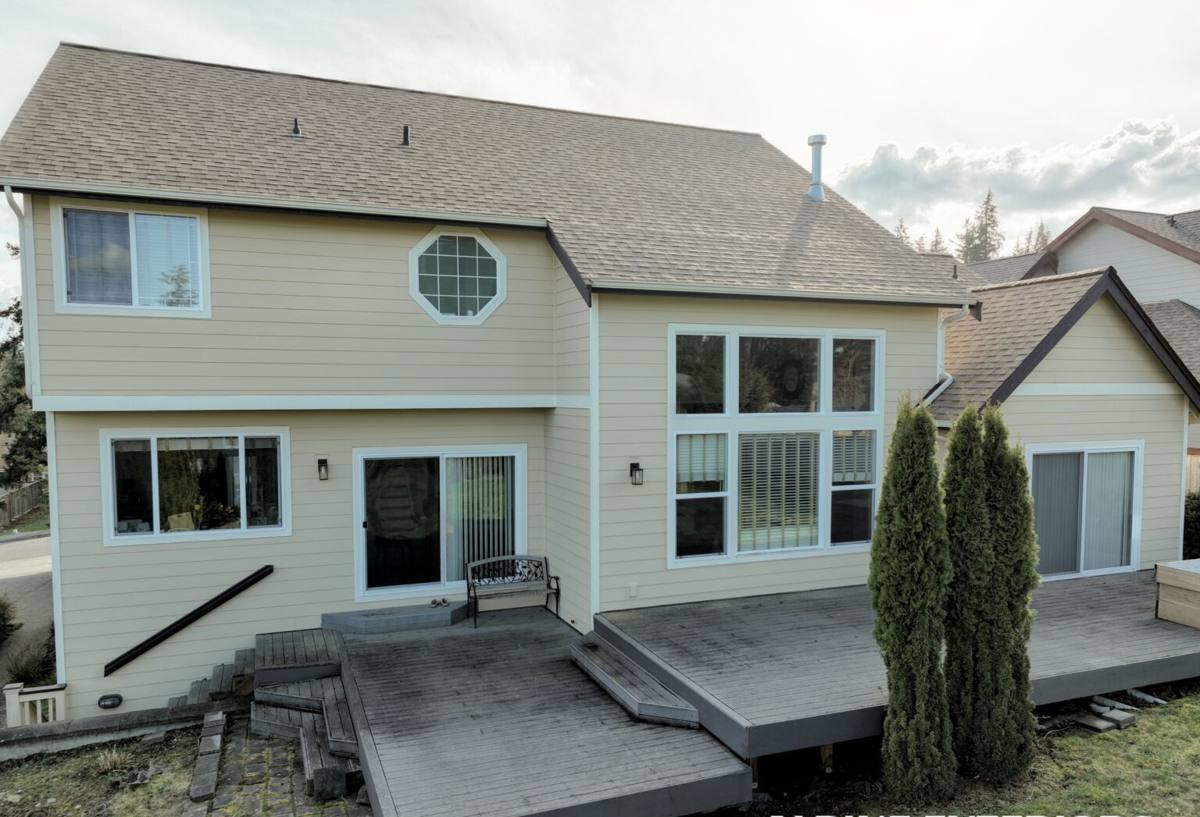
What This Stretch of Coastline Does to a Deck
Wind and Salt Off the Strait of Georgia
Being on open water rather than a sheltered bay or harbor means Cherry Point properties tend to see steadier wind and a more consistent dose of salt-laden air than towns tucked further into the coastline. That salt exposure goes after every piece of exposed metal on a deck — fasteners, joist hangers, post brackets, railing hardware — and corrosion doesn't wait until it looks bad to start costing a fastener its holding strength. Wind adds a structural consideration on top of that: railing posts, guardrails, and any pergola or cover structure need to be sized for real wind load here, not for a calmer, more sheltered site.
Driving Rain and Standing Moisture
Storms coming off open water push rain sideways with more consistency than storms further inland, and that pattern drives moisture into places a straight-down rain never would — up under railings, into ledger connections, between boards that aren't gapped correctly. A deck surface that sheds water fine on a calm day can still trap it the moment wind is involved, which in this location is most of the year rather than the exception.
A Long Moss Season
Mild temperatures and near-constant coastal moisture give moss a long growing season across this part of Whatcom County, and a horizontal deck surface holds water and stays damp longer than a vertical wall does — which makes it one of the first places moss and algae take hold. Properties with mature trees between the house and the water, which is common around Cherry Point, often see heavier moss pressure on the shaded side of the deck than on the side that gets sun through the day.
Wind, Elevation, and Deck Design on This Kind of Site
A lot of properties in this area sit with some elevation change toward the water, whether that's a gentle slope or a more pronounced bluff, and that changes some of the design questions a custom deck needs to answer. An elevated deck has more wind exposure at railing height than a ground-level patio deck does, which affects how open a railing design can be versus how much a partial glass panel or solid section would cut down on wind at the spots people actually sit. Stair placement, footing depth, and substructure bracing all need to account for the site's actual grade rather than a generic flat-lot layout. None of this makes a deck here more complicated to use — it just means the design work up front has to account for the site instead of applying a standard plan to it.
Choosing a Decking Material for This Exposure
The three material categories most Cherry Point homeowners weigh are pressure-treated or cedar wood, capped composite, and cellular PVC. Each holds up differently against sustained salt air and moisture, and the gap between a well-suited product and a poorly-suited one shows up faster on an exposed site like this than it would somewhere more sheltered.
| Material | Handling Salt Air & Wind-Driven Rain | Moss Resistance | Relative Upfront Cost |
|---|---|---|---|
| Cellular PVC | Excellent — no wood fiber to absorb moisture | Strong, smooth non-porous surface | Highest |
| Capped composite | Strong — cap layer resists moisture and staining | Good on most product lines | Mid to high |
| Uncapped composite | Moderate — some absorption at exposed fiber | Fair; more prone to buildup over time | Mid |
| Cedar | Moderate — needs regular sealing to hold up | Fair when sealed and maintained | Mid |
| Pressure-treated wood | Weakest against sustained salt exposure | Poor without regular treatment | Lowest |
None of these materials is wrong for every situation — a shaded, ground-level deck used lightly has different priorities than an elevated deck taking wind and sun most of the day. What matters is matching the material's actual moisture and salt behavior to the specific site, rather than defaulting to whatever's cheapest or most familiar.
What a Correctly Built Deck Involves Here
The decking surface gets most of the attention in a design conversation, but on an exposed site like Cherry Point, the framing and connection details underneath are what actually determine how long the deck holds up. A correct build in this area includes:
- Framing lumber rated for sustained moisture exposure, sized correctly for the span and the load it needs to carry
- Stainless steel or coastal-grade corrosion-resistant fasteners and hardware throughout, not standard-grade hardware that starts corroding within a few salt-air seasons
- Correct board gapping so wind-driven rain and standing moisture can actually drain and dry between boards instead of sitting
- Ledger board flashing done correctly where the deck ties into the house — one of the most common failure points on a poorly built deck
- Footings sized and set to the depth this area's soil and frost conditions call for, not a generic minimum
- Railing post and guardrail attachment sized for the wind load the specific site sees, especially on elevated or more exposed lots
- Grading and airflow underneath the deck so moisture doesn't sit against the framing between storms
Skip any of those and the deck will usually still look fine when it's finished. The problems tend to show up a couple of wet seasons later — a soft joist, a railing post that's started to loosen, or rust staining bleeding through around a fastener.
Our Process for a Cherry Point Deck Project
- Site visit: We walk the property to look at grade and elevation, sun and wind exposure through the day, tree cover, and — for a replacement — the condition of the existing structure.
- Design and material selection: We talk through layout, railing style, and decking material options that fit the budget and how the space will actually get used, with the site's specific exposure factored into the recommendation.
- Permitting: Deck construction in Whatcom County generally requires a permit covering setbacks, structural requirements, and guardrail specifications where applicable. We handle that process as part of the job.
- Construction: Substructure and framing go in first, sized and fastened for the site's actual exposure, followed by the decking surface, railing, and any stairs or trim work.
- Final walkthrough: We go over exactly what the material you chose needs going forward — for most modern decking that's minimal, but it isn't nothing.
Keeping a Deck Sound Season After Season
Even a well-built deck in the right material for this location needs some routine attention to reach its full lifespan. A short checklist worth keeping to:
- Rinse the deck surface periodically to clear salt residue and organic buildup before it works into the surface or cap layer
- Keep the gaps between boards clear of leaves and debris so water and air can move through as designed
- Check railing posts, guardrail hardware, and any structural connectors once a year for early corrosion or loosening, especially before the wet season sets in
- Trim back branches or plantings that shade the deck and hold moisture against the surface longer than necessary
- Address soft framing or standing water underneath the deck right away — that's a structural issue, not a cosmetic one
Why a Crew That Already Works Cherry Point Matters
A deck built by a crew that mostly works more sheltered sites can still be assembled competently, but a Cherry Point project has variables that don't come up as often elsewhere in Whatcom County — corrosion-grade fastener requirements from sustained open-water salt exposure, wind loads tied to a lot with little to break the wind before it reaches the house, and moss pressure that runs longer here than in more sheltered spots inland. Working this specific stretch of coastline regularly means those aren't unknowns we're solving for the first time on your project. We've seen which decking materials and fastener grades actually hold up to this combination of conditions, and which construction details are worth the extra time rather than an upsell.
That familiarity also shows up in smaller judgment calls — how to orient a deck against the wind a particular lot sees, or giving a straight answer about what a deck here realistically needs to last, rather than padding the scope with extras that don't matter for this site.
If you're planning a new deck or replacing one that's showing its age on a Cherry Point property, we're happy to walk the site with you and lay out the options honestly. Reach out below for a free, no-pressure estimate.