 Birch Bay
 Deck Repair Built for Sandy Point's Conditions
Sandy Point sits right up against the Strait of Georgia, and that waterfront location is exactly what makes deck maintenance harder here than it is a few miles inland. Salt-laden air off the water accelerates corrosion on fasteners and hardware, wind-driven rain finds its way into joints and end grain that a calmer climate would leave alone, and the long gray stretch of fall and winter gives moss and algae months to take hold on any horizontal surface that doesn't get regular sun. A deck that would last two decades in a dry inland climate can show real structural problems in half that time out here if it isn't built and maintained with that reality in mind.
We repair decks throughout Sandy Point and the rest of Whatcom County's coastal areas, and the patterns we see on this stretch of shoreline are consistent enough that we can usually spot the likely trouble spots on a deck before we've finished the first walk-around.
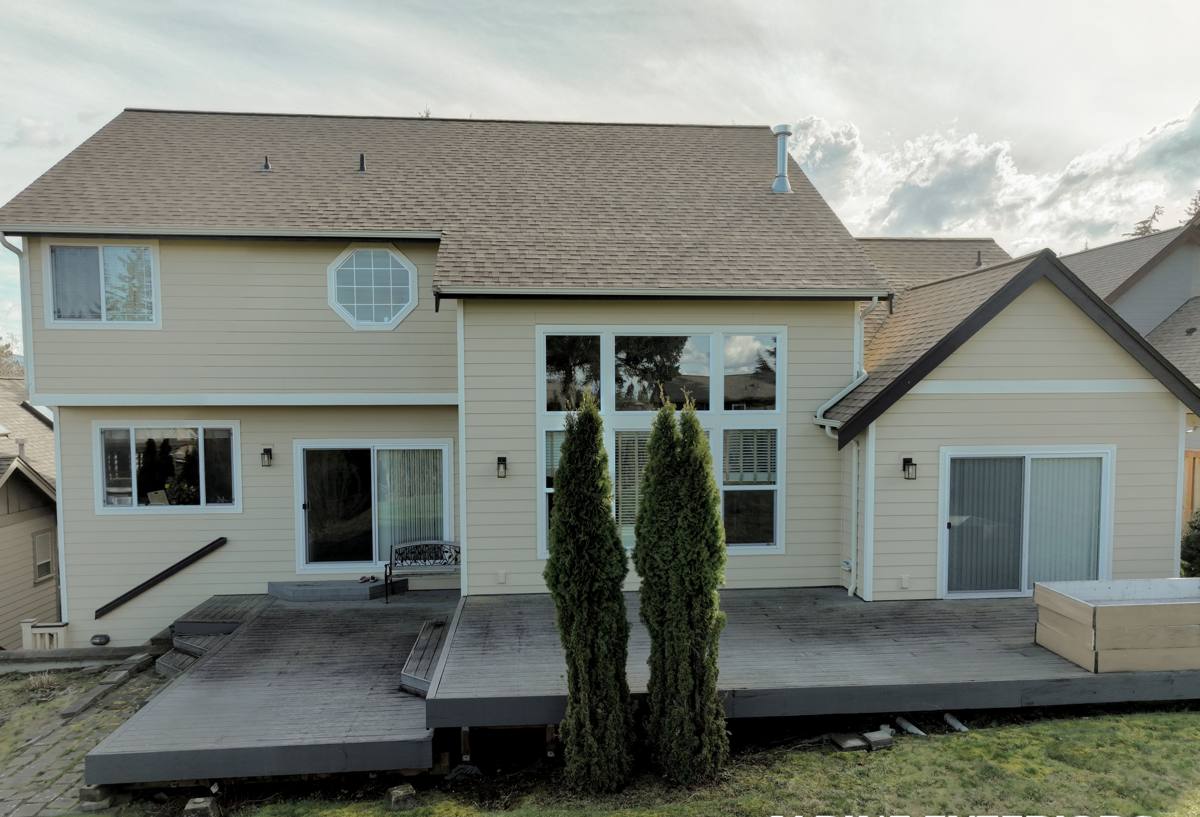
Why Salt Air, Rain, and Moss Are a Tougher Combination Than They Sound
Salt Air and Metal Fasteners
Every deck depends on hundreds of metal connection points — joist hangers, structural screws, bolts, post bases. Standard galvanized coatings hold up fine in most of the country, but airborne salt speeds up the electrochemical process that eats through zinc coatings and exposes bare steel underneath. Once that happens, corrosion spreads fast, and a fastener that looks fine on the surface can be significantly weakened where it actually matters — inside the wood, out of sight.
Driving Rain and Water Intrusion
Storms coming off the water don't just fall straight down; they drive rain sideways into ledger boards, stair stringers, and any place two pieces of framing meet. Water that gets trapped in those joints doesn't dry out quickly in our climate, and that's where rot gets started — usually in spots you can't see without pulling a board or probing with a screwdriver.
Moss, Algae, and Surface Wear
Whatcom County's moss season runs long, and a deck in a shaded or low-sun spot can stay damp for days after a storm passes. Moss and algae hold moisture against the decking surface, make stairs and walkways slick, and — on wood decks — accelerate the surface breakdown that eventually turns into splintering and soft spots.
Common Problems We Find on Sandy Point Decks
- Corroded or failing joist hangers and structural screws, especially near the ledger board and stair connections
- Soft or spongy decking boards where moisture has been trapped against the surface
- Ledger board rot where the deck attaches to the house, often hidden behind flashing that's no longer doing its job
- Moss and algae buildup creating slip hazards on stairs, ramps, and shaded sections
- Loose or wobbly railings and posts from moisture-weakened post bases
- Gaps opening up between boards as wood repeatedly swells and shrinks with wet-dry cycles
- Stair stringers showing early rot at the base, where splashback and standing water concentrate
Repair or Replace? How We Make That Call
Not every deck problem means a full rebuild, and we don't default to recommending one. A lot of what we see is fixable at the board, framing, or hardware level if it's caught before it spreads. The table below covers the factors that actually drive that decision.
| Factor | Usually points to repair | Usually points to replacement |
|---|---|---|
| Structural framing | Joists and beams are sound; problem is isolated | Widespread rot in multiple framing members |
| Ledger board condition | Localized soft spots, flashing issue is fixable | Extensive rot where the deck meets the house |
| Decking boards | A handful of boards are worn, cracked, or cupped | Most of the surface shows rot, splitting, or delamination |
| Fasteners and hardware | Isolated corrosion, hangers still structurally intact | Widespread rust-through on load-bearing hardware |
| Age of original build | Deck is under 15 years old with good bones | Original construction is decades old and undersized by today's standards |
Most deck problems on Sandy Point homes fall into the "repair" column if they're addressed within a few years of showing up. Waiting tends to be what pushes a job from repair into replacement territory.
What a Correct Deck Repair Actually Involves
Structural Inspection First
Before we touch a board, we check the framing underneath — joists, beams, posts, and the ledger connection to the house. Surface-level repairs on top of hidden structural rot are how decks end up needing the same fix again in a year or two. We also check that the ledger flashing is doing its job, since a failed flashing detail is one of the most common root causes of repeat rot on coastal decks.
Matching Materials Correctly
Repairs need to match the load rating and moisture behavior of the surrounding structure, not just the look. Mixing incompatible wood species or fastener metals at a repair joint can actually create new corrosion problems through galvanic reaction between dissimilar metals — a detail that matters more here than in a drier inland climate.
Fastener and Hardware Grade
Given the salt exposure along this shoreline, we use hardware rated for coastal or marine-grade exposure rather than standard interior-grade galvanized fasteners wherever it's called for. It costs a bit more up front and saves a callback down the road.
Permits, When Required
Whatcom County requires permits for deck work that involves structural changes or exceeds certain size and height thresholds; straightforward board and hardware repairs on an existing footprint typically don't trigger that requirement, but we'll flag it if your project does before any work starts.
Decking Materials: What Holds Up in This Climate
Homeowners usually ask us to weigh in on wood versus composite when a repair turns into a partial resurfacing. There's no universally "right" answer — it depends on budget, maintenance appetite, and how much of the existing structure is being reused.
| Material | Maintenance in this climate | Trade-offs |
|---|---|---|
| Pressure-treated wood | Needs regular cleaning, sealing/staining every 1–3 years to resist moisture and moss | Lower upfront cost; more ongoing upkeep |
| Cedar | Naturally moisture-resistant but still needs periodic sealing and moss removal | Attractive appearance; softer, needs care around foot traffic areas |
| Composite (e.g., Trex, TimberTech) | Doesn't absorb moisture or rot, but surface mold/algae still needs occasional washing | Higher upfront cost; long structural warranty, minimal sealing required |
We install and repair all three. For a full resurface on a home this close to the water, composite often makes the most financial sense over a 15-to-20-year horizon, but a well-maintained wood deck can perform just as well if the underlying framing and fasteners are done right.
Our Repair Process
- On-site inspection. We check framing, fasteners, ledger connection, and surface condition, and probe any soft spots to find out how far the damage actually extends.
- Written estimate. You get a clear breakdown of what needs fixing now, what to watch, and what it costs — no pressure to upsell into a full rebuild if a repair will genuinely hold.
- Repair work. We replace damaged framing, boards, and hardware with materials matched to this coastal environment, and correct any flashing or drainage issue that caused the damage in the first place.
- Final walkthrough. We check the repaired area is solid, level, and properly fastened before we consider the job done.
Keeping a Sandy Point Deck in Good Shape Between Repairs
- Sweep debris off the deck regularly — trapped leaves and needles hold moisture against the boards
- Rinse or scrub moss and algae off before it gets a foothold, especially on shaded sections and stairs
- Check fastener heads and hardware once a year for early signs of rust staining
- Reseal or restain wood decking on a regular schedule rather than waiting until it looks obviously weathered
- Keep an eye on the ledger board area where the deck meets the house — it's the first place hidden rot tends to start
- Make sure gaps between boards stay clear so water can drain instead of pooling
Why Local Experience Matters for This Job
A crew that mainly works inland decks doesn't always think to spec marine-grade hardware or check for galvanic corrosion risk at fastener joints — problems that just don't come up as often away from the water. Working regularly in Sandy Point and the surrounding Birch Bay shoreline means we already know where salt air and driving rain typically do the most damage on a deck like yours, and we build the repair to hold up against that, not just against average conditions.
If you've got soft boards, corroded hardware, moss buildup, or a deck that just doesn't feel as solid as it used to, we're happy to take a look and give you an honest read on what it needs. Reach out for a free, no-pressure estimate using the form below.