 Birch Bay
 Why Decks Near Cherry Point Wear Out Faster Than Inland Decks
A deck built three miles inland in Whatcom County and a deck built on a Cherry Point property facing the water are not aging the same way, even if they were built on the same day with the same materials. Homes along this stretch of shoreline near Birch Bay sit in direct line of marine air coming off the water, and that air carries salt. Salt is hygroscopic — it pulls moisture out of the air and holds it against wood fibers, metal fasteners, and connector hardware far longer than plain rainwater would on its own. The result is fasteners that rust from the inside of the wood outward, ledger boards that stay damp long after a storm has passed, and finishes that break down faster than the can label promises.
Add in driving rain that comes sideways off the Strait rather than straight down, and you get water finding its way into joints, under flashing, and along top rails that a purely vertical rainfall would never reach. Then there's moss. Whatcom County's moss season isn't a few weeks — it's most of the year. Moss and algae hold moisture against decking boards, block airflow at the surface, and turn a deck's walking surface into a slip hazard well before the structure underneath is actually failing. Any deck replacement done right in this area has to be designed around all three of these conditions at once, not just built to a generic spec and hoped for the best.
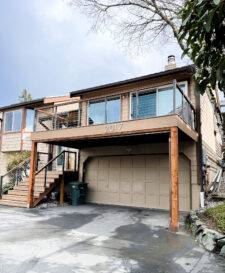
Signs a Cherry Point Deck Needs Replacing, Not Just Repairing
Homeowners often call us thinking they need a few boards swapped, and sometimes that's true. But there's a point where patching a deck costs nearly as much as replacing it and leaves you with mismatched materials and unresolved structural issues underneath. Here's what tells us a deck has crossed that line:
- Soft, spongy, or visibly cupped decking boards, especially near the house or in shaded areas where moss holds moisture longest
- Rot or discoloration at the ledger board where the deck attaches to the house — this is the single most common failure point we see
- Rust streaks running down from fasteners, joist hangers, or post bases
- Noticeable sway, bounce, or movement when you walk across the deck or lean on the railing
- Posts that have shifted, settled unevenly, or show rot at the base near grade
- A railing that no longer feels solid when pushed on — this is a safety issue, not a cosmetic one
- More than one prior repair attempt that didn't actually solve the underlying moisture problem
If you're seeing two or more of these, it's worth having someone look at the framing before you spend money on the surface.
What a Correct Deck Replacement Actually Involves
A deck replacement isn't just tearing off old boards and screwing down new ones. The parts nobody sees are the parts that determine whether the new deck lasts eight years or twenty-five.
Ledger Board and Flashing
The ledger board — the piece that bolts the deck to your house — is where most deck failures actually start, and it's almost always a flashing problem, not a wood problem. Water gets behind an improperly flashed ledger and rots both the ledger and the rim joist behind it, sometimes for years before it shows on the surface. A correct replacement means proper metal flashing integrated with the house's water-resistive barrier, not caulk alone, and lag bolts or through-bolts sized and spaced to code rather than a handful of deck screws.
Framing, Footings, and Hardware
Joists, beams, and posts need to be sized for the actual span and load, not just matched to whatever was there before — older decks in this area were often built to lighter standards than current code requires. Footings need to sit below frost depth and bear on undisturbed soil, which matters more here than people expect given how wet the ground stays for much of the year. All structural hardware — joist hangers, post bases, structural screws — should be stainless steel or a coating rated for the corrosive, high-moisture, salt-air environment this area sits in. Standard galvanized hardware can start showing rust within a few seasons this close to the water.
Decking, Fasteners, and Drainage
Board spacing, fastening method, and how air moves underneath the deck all affect how fast moss and moisture take hold. Hidden fastener systems keep the walking surface free of screw heads that trap water, but they need to be installed to the manufacturer's exact spacing and gap tolerances — done wrong, they trap moisture instead of shedding it. Proper joist tape over the top of each joist also matters more here than in drier climates, since it keeps standing water from sitting directly on framing lumber.
Choosing a Decking Material for This Climate
There's no single "best" decking material — there's a best material for your budget, your maintenance tolerance, and how much direct weather exposure your particular deck gets. Here's how the common options actually perform under salt air, driving rain, and long moss seasons:
| Material | Moisture & Salt Air Behavior | Maintenance | Typical Lifespan |
|---|---|---|---|
| Pressure-treated wood | Prone to cupping, splitting, and fastener corrosion if not sealed regularly | Annual cleaning and re-sealing recommended | 10–15 years |
| Cedar | Naturally rot-resistant but softens and grays without upkeep; salt air accelerates weathering | Sealing every 1–2 years to hold color and resist moisture | 15–20 years |
| Composite decking | Doesn't absorb water like wood, but surface texture affects how well moss and algae wash off | Periodic washing; no sealing or staining needed | 25–30 years |
| PVC / capped polymer decking | Fully sealed surface, best resistance to moisture intrusion and salt exposure | Lowest maintenance; occasional cleaning | 25–30+ years |
For a property with this much marine exposure and moss pressure, we generally steer homeowners away from uncapped wood-composite blends and untreated softwoods for the primary walking surface — not because those products are bad in general, but because the maintenance schedule needed to keep them performing well in this specific climate is a real, ongoing commitment. Capped composite and PVC products cost more up front but ask far less of you over the life of the deck. That said, plenty of homeowners still prefer the look and feel of real wood and are willing to keep up with sealing — it's a legitimate choice as long as you go in knowing the upkeep involved.
Our Deck Replacement Process, Start to Finish
- On-site assessment. We inspect the existing deck, ledger connection, framing, and posts to determine what's actually failing versus what's just cosmetic.
- Structural evaluation. We check footing depth, joist sizing, and hardware condition against current code requirements, not just how the original deck was built.
- Scope and estimate. You get a written breakdown of what's being replaced, what materials are involved, and why — no vague lump-sum guessing.
- Permitting. Where the scope of work requires it, we handle the permit process rather than leaving that on you.
- Demolition and disposal. Full removal of the old structure, including any rotted framing members that need to come out, not just the visible decking.
- Framing and flashing. New ledger flashing, joists, beams, and posts installed to spec, with corrosion-resistant hardware throughout.
- Decking and railing installation. Boards and railing system installed to the manufacturer's specifications, including proper spacing for drainage and airflow.
- Final walkthrough. We go over the finished deck with you before we consider the job done, not before we leave the site.
Permits and Local Code Considerations
Deck replacement work in Whatcom County can require a permit depending on the size, height, and whether the structure is attached to the house — the exact threshold depends on your specific property and scope of work, so it's not something we'll guess at over the phone. What we can tell you generally is that code requirements around footing depth, ledger attachment, guardrail height, and baluster spacing have gotten more specific over the years, and a deck built decades ago often won't meet current standards even if it looks fine. Part of a proper replacement is bringing the structure up to what code actually requires now, not just replicating what was there before.
Maintaining a New Deck Through Whatcom County's Wet Season
A well-built deck in this climate still needs some upkeep — the difference is how much, and how forgiving the material is if you fall behind. A short seasonal routine goes a long way:
- Sweep debris and standing leaves off the deck surface regularly, especially in fall when moss and algae growth accelerates
- Rinse or gently pressure-wash the surface at the start of moss season to keep growth from taking hold in the first place
- Check railings and stair connections once a year for any looseness
- Inspect the ledger board area where the deck meets the house for any signs of staining or soft wood
- Keep gutters and downspouts near the deck clear so runoff isn't dumping extra water onto or near the structure
- For wood decking, re-seal on the schedule appropriate to the product — don't wait until it visibly grays
Why Hiring a Crew That Already Works Cherry Point Matters
Deck-building fundamentals don't change from one town to the next, but the conditions a deck has to survive absolutely do. A crew that mostly works dry, inland projects can build a technically sound deck that still underperforms here because it wasn't detailed for constant marine air and a moss season that runs most of the year. We work Cherry Point and the broader Birch Bay area regularly, so the flashing details, hardware choices, and drainage decisions we make on a deck replacement aren't generic — they're specific to what actually holds up a few hundred yards from the water in this part of Whatcom County. That familiarity also means we're not learning the local permitting process on your project's timeline.
What Deck Replacement Typically Costs
Costs vary widely based on deck size, material choice, structural condition underneath, and whether framing needs to be rebuilt or just the decking surface. Pressure-treated framing with basic wood decking sits at the lower end of the range; full replacement with composite or PVC decking, upgraded railings, and new footings sits higher. Rather than quote a number that won't actually apply to your property, we walk the site, look at what's underneath the current deck, and give you a written estimate based on what your project actually needs — not a generic square-footage formula.
If your deck is showing its age, or you just want an honest opinion on whether it needs replacing versus repair, we're happy to take a look. Estimates are free and there's no pressure — use the form below to get in touch.