 Birch Bay
 Siding Repair Is a Different Job Than a Re-Side
A siding replacement job starts clean — old material comes off, the wall gets a fresh look at what's underneath, and everything goes back together to a known standard. A repair doesn't get that luxury. It means figuring out why one section of a wall failed while the rest is holding up fine, working around siding that may no longer be available in the same profile or finish, and making a decision about how far to open things up without turning a repair into an unplanned replacement. Done well, it's a more exacting job than most homeowners expect from "just a patch."
In Ferndale, that diagnosis usually traces back to the same handful of climate factors no matter what the surface damage looks like. Salt-tinged air off the water corrodes fasteners and trim faster than it would inland. Wind-driven rain gets pushed sideways into laps and seams that were only ever designed to shed water falling straight down. And a moss season that runs long on shaded, north-facing walls keeps organic growth active and moisture sitting against the siding for months at a stretch. A repair that only patches what's visible without addressing which of these let water in will usually need to be redone within a few seasons.
This page walks through what a correct siding repair actually involves, how we decide between repairing and replacing, and why a crew that already works Ferndale regularly — not just occasionally — tends to catch problems faster and match materials better than one seeing the area for the first time.
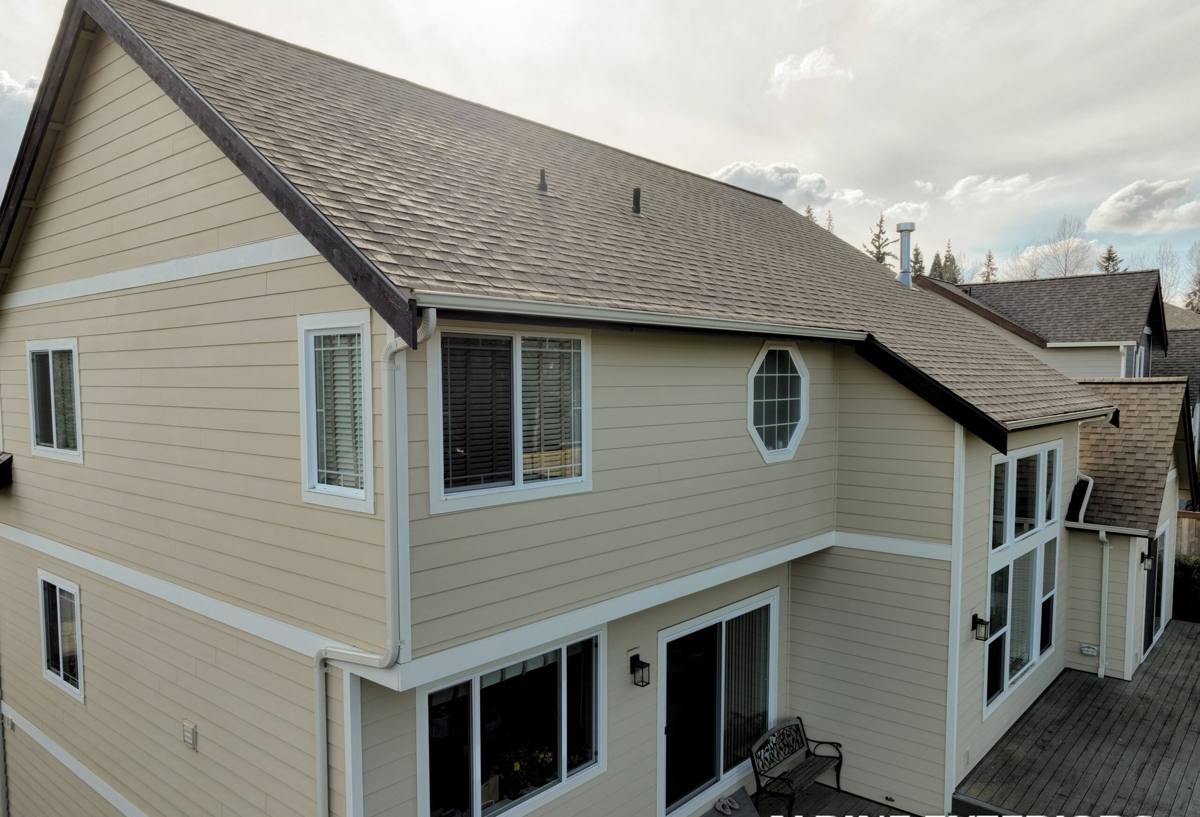
What Actually Causes Most Repair Calls We See in Ferndale
Fastener and Trim Corrosion
Salt-laden air moving in off the water accelerates corrosion in exposed fasteners, flashing, and metal trim. Once a fastener starts to corrode, it loses holding strength and can back out slightly, opening a small gap where water works its way behind the siding. This tends to show up first on trim pieces and fastener heads that sit fully exposed to the weather, well before the siding field itself shows any obvious wear.
Wind-Driven Rain at Seams and Penetrations
Straight-down rain is easy for almost any siding to shed. Rain that comes off the water at an angle is not, because it gets pushed into laps, trim joints, and anywhere a pipe, vent, or fixture penetrates the wall. Storms that push rain sideways test every seam on a house at once, which is why repair issues often cluster around windows, corners, and utility penetrations rather than showing up in the middle of an open wall.
Moss, Mildew, and Trapped Moisture
Mild temperatures and steady moisture keep moss and mildew active on shaded and north-facing walls across most of the year here. Organic growth does more than look bad — it holds water against the siding surface longer than it would otherwise sit there, which extends every wet cycle the material and the fasteners underneath it go through.
Impact and Storm Damage
Wind-thrown debris, fallen branches, and the occasional ladder or equipment mishap during other exterior work account for a smaller but steady share of repair calls. These are usually the most straightforward to diagnose, since the cause is obvious, but they still need to be repaired with the same attention to flashing and sealing as a weather-driven failure — a cracked board patched without addressing the surrounding seal is just a slower version of the same problem.
Repair or Replace? How We Make That Call
Not every damaged section needs a full re-side, and not every damaged section should be patched, either. The right call depends on how far the damage extends, what shape the material behind the siding is in, and whether a clean material match is realistic. We'd rather tell a homeowner the honest answer than talk a repairable wall into a full replacement, or patch over damage that's going to come back in two years.
| Factor | Points Toward Repair | Points Toward Replacement |
|---|---|---|
| Extent of damage | Isolated to one or two sections or elevations | Spread across multiple walls or the whole house |
| Condition behind the siding | Sheathing and framing are dry and sound once opened up | Rot or sustained water damage found in sheathing or framing |
| Age and condition of existing siding | Siding is well within its expected service life | Siding is near or past end of life, with wear showing elsewhere too |
| Material and color match | Matching profile and finish are available or the location is low-visibility | No reasonable match exists and the mismatch would be visible from the street |
| Root cause | A specific, fixable cause (fastener, flashing, impact) | A systemic issue — wrong material for the site, widespread failed detailing |
When the honest answer is replacement, we'll say so and explain why rather than layering a temporary fix onto a wall that's going to keep generating repair calls.
What a Correct Repair Actually Involves
A repair that holds up is rarely just "cut out the bad piece, nail in a new one." The visible board is often the last thing that gets addressed, not the first.
- Diagnose the actual cause of failure before touching the siding — corrosion, flashing gap, seam failure, or impact — so the fix addresses the source, not just the symptom
- Open the area enough to check the water-resistive barrier and sheathing underneath for hidden moisture damage, especially where the failure has been developing for a while
- Correct any flashing or drainage detail that let water in, sequencing it properly with the house wrap rather than just caulking over the gap
- Source a matching material, profile, and finish so the repair blends in rather than reading as an obvious patch
- Refasten with the correct fastener type, spacing, and depth for the material, not whatever is on hand
- Seal and finish cut edges and joints to the manufacturer's specification, not just enough to look finished
Skipping any one of these steps is how a "repair" ends up back on the schedule within a year or two, usually for the same underlying reason as the first time.
Repairing James Hardie vs. Repairing Other Siding Materials
We install James Hardie fiber cement exclusively, but repair calls in Ferndale come in on every kind of siding, and the material on the wall changes what a good repair looks like.
| Material | Repair Characteristics |
|---|---|
| James Hardie fiber cement | Dimensionally stable, so a well-matched repair section stays flush over time; ColorPlus finish can be closely matched when the color and plank profile are still current, though older runs may show slight variation |
| Vinyl siding | Panels fade unevenly with UV exposure, so even a same-brand replacement panel can stand out; brittle older panels can crack further during removal |
| LP SmartSide / engineered wood | Repairs need fully sealed cut edges to avoid the swelling that caused the original failure; matching an older run's exact texture and finish can be difficult |
| Cedar / primed wood | Individual boards can often be replaced and refinished, but surrounding boards showing similar wear are a sign the whole elevation may be close behind |
None of this means other materials can't be repaired competently — it means the repair has to account for how that specific material behaves, which is part of why we're upfront when a repair is realistic and when it's a short-term fix on a material that's reaching the end of what it can reasonably give.
Our Repair Process in Ferndale
- Inspection. We look at the damaged area and the surrounding wall, not just the spot that prompted the call, since related issues often sit just out of sight nearby.
- Diagnosis. Where there's any question about what's happening behind the siding, we open the area enough to check the sheathing and water-resistive barrier before quoting anything.
- A straight answer and a written scope. We tell you honestly whether it's a repair, a larger repair than expected, or a case where replacement makes more sense, along with what the work involves.
- The repair. Matching material, corrected flashing or sealing where needed, proper fastening, and finish work to blend the repair into the surrounding wall.
- A final check. We confirm the repaired area sheds water correctly and walk you through what we found and fixed.
Signs a Ferndale Home May Need Siding Repair Now
- Soft or spongy siding when pressed, especially near the bottom of walls or under windows
- Visible cracking, warping, or a section that's pulled away from the wall
- Peeling or bubbling paint or finish concentrated in one area rather than spread evenly
- Rust streaking from fasteners or trim, particularly on walls facing the water
- Persistent moss or dark staining that keeps coming back on the same section after cleaning
- A musty smell or soft drywall on an interior wall that backs up to an exterior trouble spot
One or two of these on their own aren't cause for alarm, but a cluster of them in the same area is usually a sign the underlying cause has been active for a while.
Why a Crew That Already Works in Ferndale Matters for Repairs
Repair work rewards local pattern recognition in a way replacement work doesn't always demand. A crew that's already worked a number of Ferndale homes has usually seen the same fastener corrosion, the same wind-driven rain entry points, and the same moss-related failures often enough to diagnose a problem quickly instead of guessing. That familiarity also helps with timing — scheduling repairs ahead of the wettest storm stretches or before moss season takes hold on a shaded wall keeps a small fix from turning into a bigger one while it waits. And because we install James Hardie as our standard product, we're set up to source current ColorPlus finishes and profiles for a clean match rather than treating every repair as a one-off scramble to find compatible material.
Keeping a Repair From Becoming a Repeat Call
A correctly done repair should outlast a quick patch by years, but a little upkeep afterward helps it stay that way. Rinsing off moss and organic growth before it gets a foothold, keeping gutters and downspouts clear so water isn't dumping directly onto a wall, and having caulk joints and flashing checked every few years catches small issues while they're still small. That's true whether the repair was done by us or someone else — a wall that gets looked at occasionally rarely turns into an emergency call.
If you're dealing with a section of damaged siding, a spot that keeps growing moss no matter how often it's cleaned, or you just want an honest opinion on whether it's a repair or something bigger, we're happy to take a look. Reach out below for a free, no-pressure estimate.