 Birch Bay
 Why Point Roberts Puts Extra Stress on a House's Siding
Point Roberts sits on its own peninsula at the tip of Whatcom County, surrounded on three sides by water and open to wind and salt spray that most inland Washington homes never deal with. Add the long, wet Pacific Northwest winter and the moss and algae growth that comes with it, and you have a combination that wears out ordinary siding faster than the manufacturer's brochure ever suggests. Homes here don't just get rained on — they get rained on sideways, coated in salt-laden air off the water, and left damp for weeks at a stretch during the darker months.
That combination matters because siding failure almost never starts as a dramatic event. It starts small: a hairline gap at a butt joint that lets moisture behind the cladding, a coating that starts chalking a few years early because of constant UV and salt exposure, or a shaded north wall that never fully dries out and stays green with moss longer each year. On a typical inland lot, those things happen slowly. On a Point Roberts waterfront or near-waterfront lot, they happen faster, and they compound.
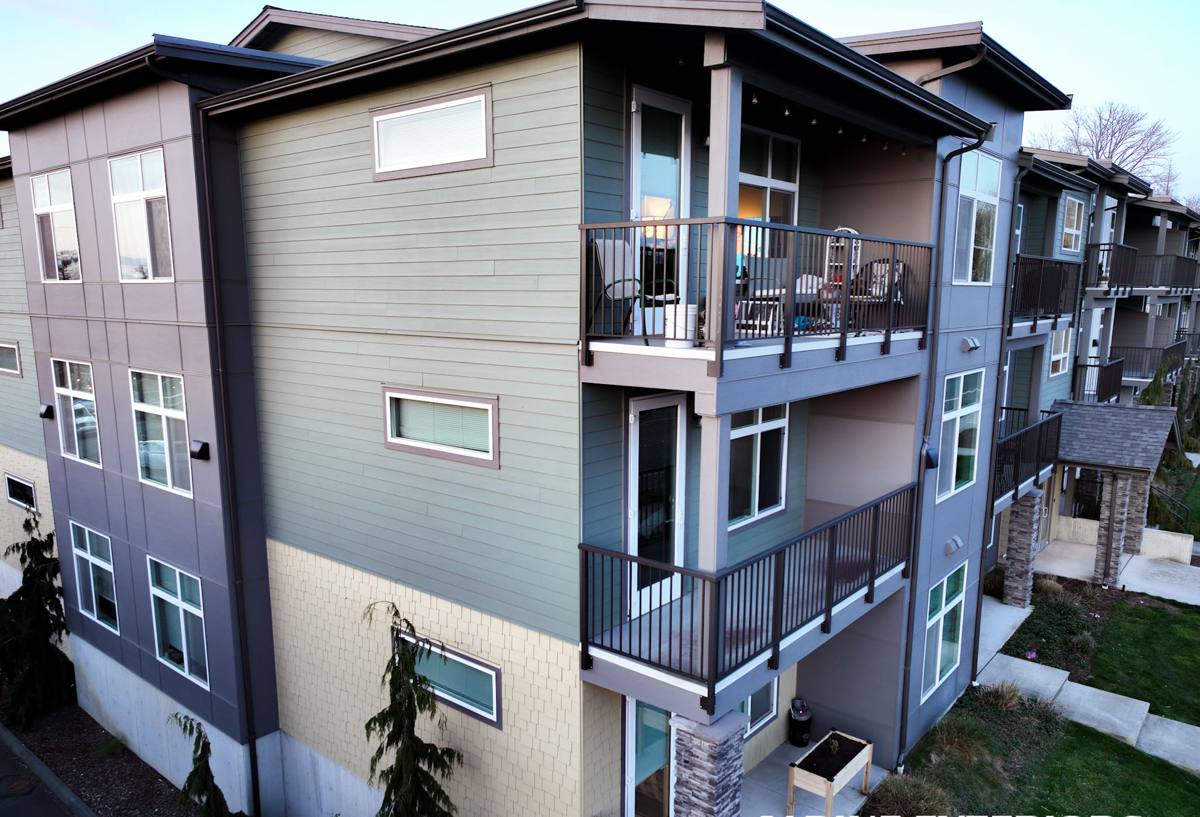
What Salt Air, Wind-Driven Rain, and Moss Actually Do to a House
Salt air
Airborne salt is corrosive to metal fasteners, flashing, and trim, and it can accelerate the breakdown of some coatings over time. Materials and fastener choices that work fine forty miles inland can underperform close to the water.
Wind-driven rain
Rain that comes in sideways doesn't behave like rain falling straight down. It gets pushed up under laps, into seams, and behind trim that would stay dry in a calmer climate. Any siding system installed here needs to assume water will be pushed at it from unusual angles, not just gravity-fed off the top.
Moss and algae
Shade, moisture, and moderate temperatures are exactly what moss wants, and Point Roberts has all three for a good chunk of the year. Moss holds moisture against a wall longer than the surrounding dry siding, which is where soft-material siding problems tend to start.
None of this means Point Roberts is an impossible place to side a house. It means the material and the installation both have to be chosen with this specific exposure in mind — not a generic "siding for the Pacific Northwest" approach, but one that accounts for a peninsula climate specifically.
Why We Only Install James Hardie in This Kind of Exposure
We install James Hardie fiber cement exclusively — not vinyl, not LP SmartSide, not cedar or primed spruce, and not lower-cost fiber cement alternatives. In a climate like Point Roberts', that's not a brand preference; it's a practical decision based on what holds up.
Fiber cement is non-combustible and dimensionally stable, meaning it doesn't expand, contract, warp, or rot the way wood-based products can when they take on repeated moisture cycles. James Hardie's HZ product lines are specifically engineered for different climate zones, and the HZ5 formulation used in this region is built for the wetter, more humid conditions found along the Washington and Oregon coast rather than a one-size-fits-all national product. The factory-applied ColorPlus finish is baked on under controlled conditions and backed by its own finish warranty, which matters in a spot where UV, salt, and moisture are all working on the coating at once.
We've looked at the alternatives homeowners often ask about, and each has a real trade-off in this environment:
- Vinyl siding can warp or become brittle with repeated wind loading and temperature swings, and its seams are a weak point against wind-driven rain.
- LP SmartSide and other engineered wood products use wood strand cores that are more vulnerable to sustained moisture exposure at cut edges and seams than fiber cement is.
- Cedar and primed spruce look great initially but require an ongoing maintenance commitment — refinishing, caulking, and moisture monitoring — that most homeowners underestimate until the first repaint comes due early.
- Off-brand fiber cement (Cemplank, Allura, etc.) can be a reasonable product, but we've standardized on Hardie for consistency of formulation, finish warranty, and product support in this specific climate zone.
We're not saying any of these products are junk — each has situations where it makes sense. We're saying that for a house absorbing this much salt air, wind, and standing moisture, James Hardie is what we're willing to put our name behind.
What a Correct James Hardie Installation Involves Here
The product is only half the equation. A Hardie installation done to spec in a high-exposure environment like Point Roberts looks different in the details than one done in a drier, more sheltered part of the state.
| Detail | Why it matters in this climate |
|---|---|
| Weather-resistant barrier and proper lapping | Wind-driven rain needs a continuous drainage plane behind the siding, not just a barrier with gaps at seams |
| Correct clearances at grade, decks, and roof lines | Standing water and splash-back are more common near the shoreline; gaps prevent wicking |
| Stainless or coated corrosion-resistant fasteners | Salt air accelerates corrosion of standard fasteners over time |
| Manufacturer-specified caulking and sealant at joints | Wind-driven rain finds any gap left by the wrong sealant or a skipped joint |
| Proper field-cut edge sealing | Unsealed cut edges are the most common point where fiber cement takes on moisture |
| Ventilation behind the cladding | Helps the wall assembly dry out between the region's frequent wet stretches |
Every one of those items is a normal part of a manufacturer-compliant Hardie install, but they're also the first things that get shortcut by crews that don't regularly work in a demanding coastal or peninsula environment. The gap between "installed" and "installed correctly for this climate" is exactly where premature siding failure comes from.
Why Local Experience in Point Roberts Specifically Matters
Point Roberts is a bit of an unusual place to schedule and run a construction project. It's part of Whatcom County and the United States, but it's physically separated from the rest of the country — the only land route in and out runs through Canada. That has real, practical effects on a siding job: material deliveries, crew scheduling, and border timing all need to be planned around, not discovered mid-project.
A crew that hasn't worked in Point Roberts before can lose days to logistics they didn't anticipate. A crew that already has a rhythm for getting materials and equipment onto the peninsula, sequencing the work efficiently, and working around border-crossing timing keeps a project moving the way it would anywhere else. That's a real advantage that has nothing to do with the siding product itself and everything to do with the job actually finishing on schedule.
Our Process for a Point Roberts James Hardie Project
- On-site assessment — we look at sun and wind exposure on each elevation, existing moisture damage, current siding condition, and any trim, flashing, or drainage issues under the surface.
- Product and color selection — we walk through Hardie's plank, panel, and shingle profiles along with ColorPlus color options suited to the home and its exposure.
- Prep and moisture check — sheathing is inspected for existing rot or water damage before anything new goes on; this step gets skipped by rushed crews and it's the step that causes callbacks later.
- Weather barrier and flashing installation — done to manufacturer spec with attention to the drainage plane, since this is the layer doing the real work during a wind-driven rain event.
- Hardie installation — correct fastening, clearances, joint treatment, and edge sealing throughout, not just on the visible elevations.
- Final walkthrough — trim, caulking, and touch-up review before we consider the job finished.
What Point Roberts Homeowners Should Expect Year to Year
Properly installed James Hardie siding is low-maintenance, but "low-maintenance" doesn't mean zero attention, especially in this climate. A quick annual look at a few things keeps a Hardie exterior performing the way it's designed to:
- Rinse off accumulated salt residue and grime on exposed and windward elevations once or twice a year
- Check caulking at trim, window, and door joints for cracking or separation
- Keep gutters clear so water isn't overflowing directly onto siding below
- Trim back vegetation that shades a wall and keeps it damp longer than the rest of the house
- Watch shaded, north-facing sections for early moss growth and address it before it spreads
None of this is a heavy lift, and it's considerably less than what cedar, primed wood, or vinyl typically demand in this environment. It's the kind of upkeep that, done consistently, lets the siding reach the long service life the product is designed for.
Cost Factors on a Point Roberts Project
Every home is different, so we don't quote pricing without seeing the house, but a few things consistently move the number on a Point Roberts job:
| Factor | Effect on the project |
|---|---|
| Home size and wall complexity | More corners, gables, and trim detail mean more labor and cut edges to seal |
| Current siding removal and disposal | Tear-off adds cost but is often necessary to inspect and repair sheathing underneath |
| Existing moisture or rot damage | Sheathing repair found during prep is a common — and important — added cost |
| Siding profile chosen | Lap, panel, and shingle-style Hardie products have different material and labor costs |
| Site access and logistics | Waterfront or limited-access lots can affect staging and delivery time |
A Short Checklist for Hiring the Right Crew for This Job
- Ask whether they install James Hardie as a manufacturer-recognized installer, not just "a brand they carry"
- Ask how they detail fastening, flashing, and caulking specifically for wind-driven rain and salt exposure
- Ask whether they've worked on Point Roberts before and how they handle material delivery and scheduling logistics
- Ask what happens if they find water damage or rot once the old siding comes off
- Get a written scope that names the specific Hardie products, not just "fiber cement siding"
If you're weighing your options for a home in Point Roberts, we're happy to take a look and walk you through what we'd recommend for your specific exposure — no pressure, no obligation. A free estimate is the easiest way to find out what your home actually needs.