 Birch Bay
 Sandy Point's Waterfront Setting Is Harder on Siding Than Most Homeowners Realize
Sandy Point sits close enough to the water that homes here take a different kind of beating than a house a few miles inland in Birch Bay or Blaine. The combination of salt-laden air, wind-driven rain coming off the water, and a long stretch of the year when moisture just doesn't fully dry out adds up over time. It's not one dramatic storm that ruins siding in a community like this — it's the slow, cumulative wear from conditions that never really let up.
Sandy Point is one of the shoreline neighborhoods that make up the greater Birch Bay area of Whatcom County, sitting right up against the water rather than set back from it. That proximity is exactly what makes it a desirable place to live, and exactly what puts extra demands on anything installed on the outside of a house here.
Salt air is corrosive to exposed metal fasteners, flashing, and trim. Driving rain finds any gap, seam, or fastener hole that wasn't sealed correctly and pushes water behind the cladding instead of down and off it. And Whatcom County's long moss season — shaded, damp conditions that can stretch from fall through spring — gives organic growth a real foothold on any siding material that holds moisture at the surface. None of this means siding fails fast in Sandy Point. It means siding that isn't matched to the exposure, or wasn't installed with the details done right, fails early instead of lasting the decades it should.
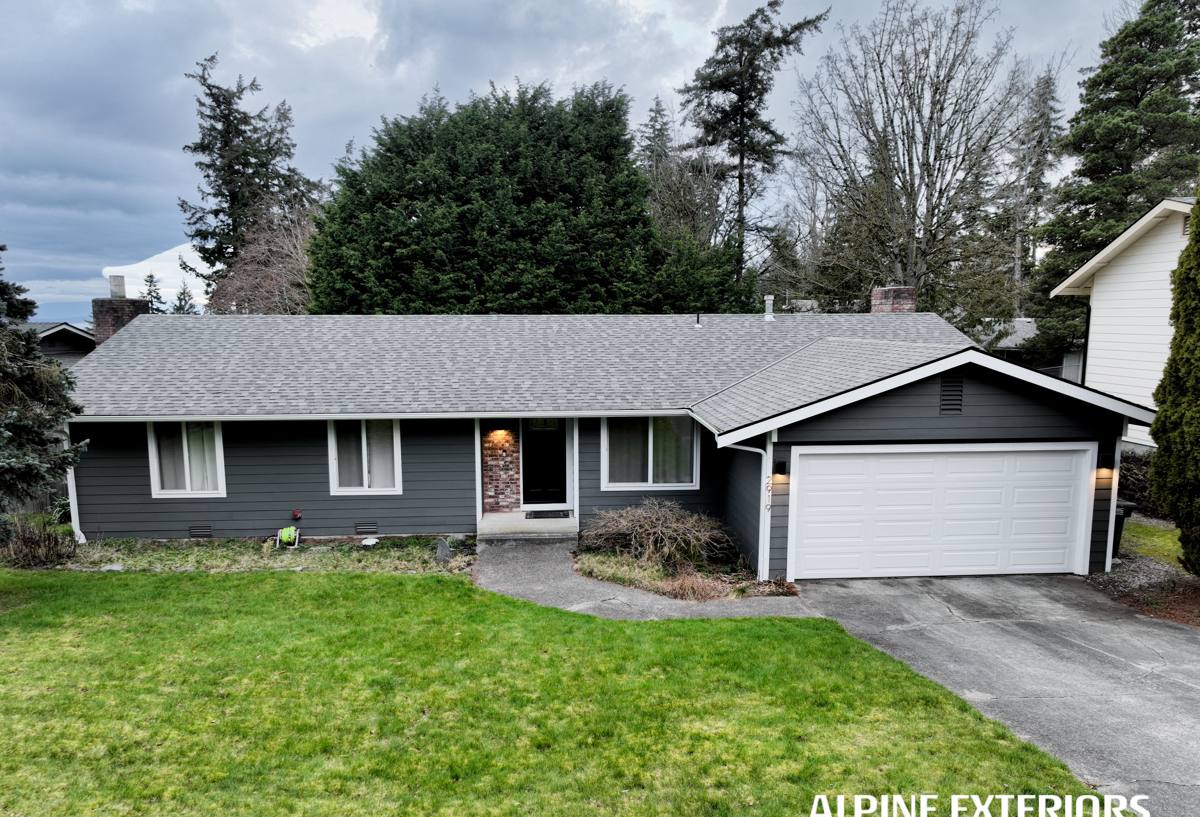
What a Waterfront Home in Sandy Point Actually Needs From Its Siding
Before talking about installation, it's worth being clear about what the material and the assembly behind it need to do here:
- Resist moisture absorption at the panel itself, not just at the paint layer
- Hold a factory finish that won't need repainting every few years in a climate that's hard on exposed paint
- Shed wind-driven rain at every seam, corner, and penetration, not just on a flat wall
- Stay dimensionally stable through repeated wet-dry cycles without warping, cupping, or splitting
- Resist mold and moss growth on shaded elevations and under tree cover
- Stand up to salt exposure without accelerating fastener or trim corrosion
That list rules out more products than it includes. It's also exactly why we standardized on one material for every home we side in this area.
Why We Only Install James Hardie Fiber Cement in Sandy Point
We don't install vinyl, LP SmartSide, Cemplank, Allura, primed spruce, or cedar. That's not a marketing position — it's a standard we set based on how each of those materials tends to perform in wet, salt-exposed, coastal Pacific Northwest conditions, and because we'd rather stand behind one system we install correctly every time than offer a menu of options with different failure points. James Hardie fiber cement is the material that, installed to spec, holds up to everything Sandy Point's climate throws at it without the recurring maintenance or moisture problems the alternatives tend to develop.
HardieZone HZ5: Engineered for This Exact Climate
James Hardie manufactures its siding in different formulations for different climate zones. Western Washington, including Birch Bay and Sandy Point, falls into HardieZone HZ5 — the formulation engineered for colder, wetter regions with freeze-thaw cycles and sustained damp weather. That's a meaningful distinction: it means the product on your wall was built for conditions like the ones Sandy Point actually sees, not a generic national spec.
ColorPlus Factory Finish
Most of the siding we install carries Hardie's ColorPlus finish — a coating baked on in a controlled factory environment rather than sprayed or brushed on-site. In a climate where field-applied paint on wood or fiber cement trim is fighting damp, low-sun conditions for months at a stretch, a factory-cured finish resists fading, chipping, and moisture intrusion at the surface far better, and it comes with its own finish warranty separate from the product warranty.
Non-Combustible and Dimensionally Stable
Fiber cement doesn't expand and contract with moisture the way wood-based products do, and it won't support the kind of surface mold growth that plagues shaded, damp walls. It's also non-combustible, which increasingly matters for insurance and building code considerations even in a coastal county that isn't thought of as wildfire country.
What Correct Siding Installation Actually Involves
The material is only half the equation. Most siding failures we get called out to inspect in this area aren't a material problem — they're an installation problem. Water got behind the cladding somewhere it shouldn't have, and nobody caught it until the sheathing underneath was already compromised. Here's what a correct job looks like on a Sandy Point home, from tear-off to finished trim.
Tear-Off and Inspection, Not Cover-Up
We remove the existing siding rather than installing over it. That's the only way to actually see the sheathing, framing, and window flashing underneath before they get closed back up for another 30 years. In a waterfront community, this step matters more than most places — hidden moisture damage behind old siding is common, and it needs to be found and repaired now, not discovered during the next remodel.
Timing the Job Around Whatcom County's Wet Season
Whatcom County doesn't have a short rainy season — it has a long one, and a crew working this close to the water needs to plan around it instead of ignoring it. We sequence tear-off and dry-in so a wall isn't left with exposed sheathing overnight or through a stretch of forecasted rain, and we don't rush a section closed just to keep to a schedule. An afternoon of exposed sheathing in the wrong weather can undo weeks of otherwise careful work, so the schedule bends around the forecast, not the other way around.
Water-Resistive Barrier and Flashing Details
A correctly installed weather-resistive barrier, properly lapped and taped, is what actually keeps bulk water out of the wall assembly — the siding itself is the first line of defense, not the only one. Every window, door, and penetration gets flashed so water is directed out and down, never trapped behind the cladding. This is the detail that separates a siding job that lasts from one that leads to a rot call five years later, and it's the detail that's easiest to rush.
Fastening, Clearances, and Joint Treatment
Hardie panels need to be fastened per the manufacturer's specification for the HZ5 zone — correct nail or screw type, spacing, and depth, none of which is optional if you want the warranty to hold. Ground and roofline clearances are set to keep the bottom edge of the siding away from splash-back and standing moisture. Butt joints and trim seams are caulked and detailed to shed water rather than collect it, which matters especially on elevations that take the brunt of wind-driven rain off the water.
Trim, Corners, and Accessory Integration
Corner boards, trim, and any accessory pieces need to be compatible with fiber cement's movement characteristics and installed with the same attention to flashing and sealant as the field panels. A siding job with excellent panels but poorly detailed trim will still leak at the trim first.
Signs Your Current Siding May Already Be Struggling
If your home in Sandy Point currently has vinyl, wood, or an older fiber cement product, it's worth knowing what early warning signs look like before a small problem becomes a sheathing replacement:
- Soft or spongy spots when you press on the siding, especially near the bottom courses
- Visible moss or algae streaking that keeps coming back after cleaning
- Paint that's peeling, bubbling, or chalking faster than it should for its age
- Gaps opening up at seams, corners, or trim joints
- Warping, cupping, or panels that no longer sit flat against the wall
- A musty smell or visible staining on interior walls that share an exterior wall
- Rising heating bills that suggest the wall assembly is no longer insulating the way it should
Any one of these on its own isn't necessarily an emergency, but in a salt-air, high-rainfall setting like Sandy Point, they tend to compound quickly once they start.
What Drives the Cost of a Siding Installation Here
Every home is different, so we won't quote a number without seeing the house, but these are the real factors that move the price up or down on a Sandy Point project:
| Cost Factor | Why It Matters in Sandy Point |
|---|---|
| Full tear-off vs. what's underneath | Waterfront homes more often need sheathing repair once old siding comes off, which affects both cost and timeline |
| Home size and number of stories | More wall area and higher elevations mean more material, more staging, and more labor time |
| Trim complexity and architectural detail | Bay windows, multiple rooflines, and dormers all add cutting, flashing, and fitting time |
| Panel profile and finish selection | Lap siding, shingle-style panels, and specialty ColorPlus colors carry different material costs |
| Site access | Some Sandy Point lots have tighter access or limited staging space near the water, which affects setup and logistics |
| Existing moisture damage | Rotted sheathing or framing found during tear-off is repaired before new siding goes on, as a separate line item from the siding itself |
Why It Matters That We Already Work in This Neighborhood
Siding crews that mostly work farther inland don't always think about the details that matter on a waterfront lot — the extra attention flashing and sealant joints need, the way shaded, tree-covered elevations hold moisture longer, or how much harder wind-driven rain hits certain sides of a house near open water. A crew that's already done work in Sandy Point and along the Birch Bay shoreline knows what to look for during tear-off, knows which elevations typically show the worst wear, and doesn't treat this like a generic siding job with the address changed.
It also means we're easy to reach if a question comes up after the job is finished. Warranty service and follow-up are simpler when a contractor is already active in the neighborhood, rather than an hour away with no other reason to come back. That local familiarity shows up in fewer surprises during the project and a finished install that's actually built for the exposure your home sees.
Caring for James Hardie Siding After It's Installed
Part of why we stand behind Hardie is how little ongoing maintenance it asks for compared to the alternatives — but "low maintenance" doesn't mean "no maintenance," especially this close to the water.
- Rinse the exterior periodically to clear salt residue and organic buildup, particularly on shaded or north-facing walls
- Keep gutters and downspouts clear so water isn't sheeting down the siding face
- Trim back vegetation that keeps a wall shaded and damp longer than it needs to be
- Recaulk trim and joint sealant if it shows cracking, well before it fails outright
- Have flashing and caulking spot-checked every few years, especially after a hard windstorm off the water
Done consistently, that short list is most of what it takes to get the full service life out of a correctly installed Hardie system in this climate.
Ready for a Straight Answer on Your Sandy Point Home
Whether your siding is already showing its age or you're just planning ahead before it becomes a problem, we're happy to take a look and give you an honest read on what's going on and what it would take to fix it right. Reach out for a free, no-pressure estimate — there's a form below to get started.