 Birch Bay
 Siding Replacement for the Terrell Creek Area of Birch Bay
Homes along the Terrell Creek corridor near Birch Bay sit in one of the more demanding microclimates in Whatcom County. You've got the creek's own moisture and shade from mature tree cover on one side, and the open salt air coming off Birch Bay itself on the other. That combination — humidity that lingers under the canopy, salt-laden wind off the water, and a moss season that can run eight months or more — is hard on any exterior material, but it's especially hard on siding that isn't built to shed water and resist rot at the seams.
We work in this specific pocket of Whatcom County regularly, which means we're not guessing at how a wall assembly performs here — we've seen what holds up and what fails early, and we install accordingly.
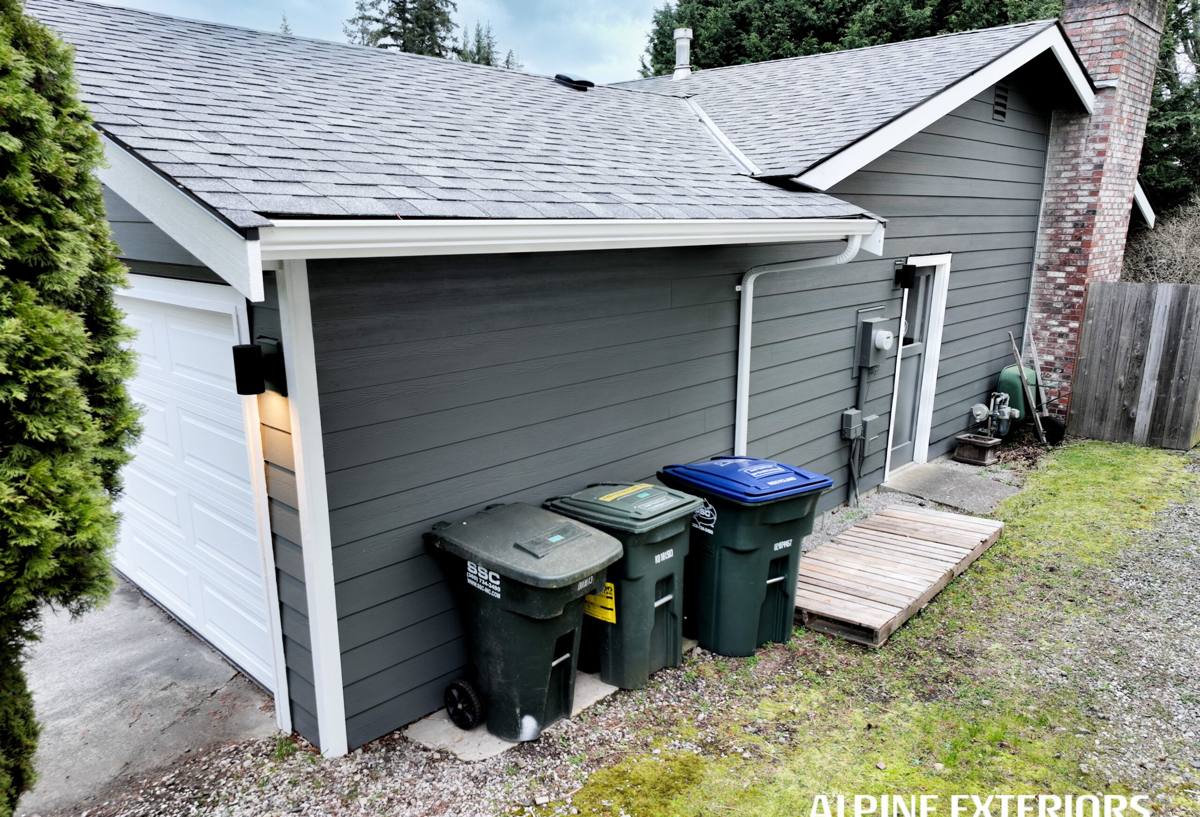
Why Terrell Creek Homes Wear Out Siding Faster
Three conditions stack on top of each other in this neighborhood, and each one shortens the life of the wrong siding material on its own.
Salt Air
Even a mile or two inland from Birch Bay, airborne salt reaches painted and metal surfaces and accelerates the breakdown of caulking, fasteners, and factory finishes that weren't engineered for a marine environment. Over years, that shows up as chalking paint, corroding trim fasteners, and seams that open up sooner than they should.
Driving Rain
Storms off the Strait of Georgia don't just fall straight down here — wind-driven rain hits siding at an angle and gets forced into any gap, lap joint, or fastener hole that isn't properly sealed and flashed. A siding system with weak water management will trap that moisture behind the cladding, where it can sit against sheathing for weeks between dry spells.
Moss and Shade
Wooded lots near the creek keep siding shaded and damp longer after a storm than an open lot would. Moss and algae take hold fastest on porous or textured surfaces that stay wet, and once established they hold moisture against the wall around the clock, not just when it's raining.
Signs a Terrell Creek Home Is Due for Siding Replacement
Because the damage here tends to start at seams, corners, and low, shaded wall sections, it's worth checking those areas specifically rather than just eyeballing the siding from the street.
- Soft or spongy spots when you press on the siding near the bottom courses or under windows
- Paint that's peeling, bubbling, or chalking heavily, especially on the sides that face prevailing wind and rain
- Persistent moss or dark staining that comes back within weeks of cleaning
- Visible gaps opening at butt joints, corner boards, or trim where caulk has failed
- Warping, cupping, or delamination in older wood, hardboard, or engineered wood siding
- Interior signs — musty smell, discolored drywall, or a spike in heating bills — that point to moisture getting past the exterior wall
- Fasteners that are rusting, backing out, or leaving streak marks down the siding face
Any one of these on its own might be a spot repair. Several at once, especially combined with siding that's already older than its expected service life, usually means a full replacement is the more honest recommendation.
Why We Install Only James Hardie Fiber Cement
We don't install vinyl, LP SmartSide, Cemplank, Allura, primed spruce, or cedar. That's a deliberate standard, not a limitation on what we know how to work with — we've made the call that in a climate like this one, those materials come with trade-offs we're not willing to put our name behind.
How It Handles the Wet Season Here
James Hardie fiber cement is engineered from cement, sand, and cellulose fiber, which makes it dimensionally stable in a way wood-based products aren't — it doesn't swell, cup, or delaminate the way engineered wood siding can when it takes on repeated moisture. It's also non-combustible, which matters less for the marine climate specifically but is part of why we standardized on it across every job we take. Hardie's HZ5 product line is engineered for the kind of freeze-thaw and moisture cycling the Pacific Northwest sees, and it holds up to the driving rain and salt exposure common around Birch Bay far better than vinyl, which can warp or crack in temperature swings, or bare wood, which needs a maintenance schedule most homeowners can't realistically keep up with.
ColorPlus Factory Finish vs. Field-Painted Siding
Most of the failures we see on older siding in this area start at the paint, not the substrate. Hardie's ColorPlus finish is baked on at the factory in multiple coats under controlled conditions, which gives it better adhesion and UV resistance than siding painted on site after installation. That matters directly here: less chalking and fading from salt air exposure, and a finish that doesn't need repainting on the timeline field-applied paint does.
Warranty Backing
Hardie backs its siding with a long, transferable limited warranty, and ColorPlus finishes carry their own separate finish warranty. That's a meaningfully different position than most vinyl or engineered wood manufacturers offer, and it's part of the reason we can stand behind the material on a home that's going to be exposed to salt air and rain for decades.
What a Correct Siding Replacement Actually Involves
Replacing siding is not just pulling off old panels and nailing up new ones. On a lot with the moisture exposure Terrell Creek homes see, the details underneath the siding matter as much as the siding itself.
Tear-Off and Sheathing Inspection
Once the old siding is off, we inspect the sheathing and framing underneath for rot, soft spots, or prior water damage — this is often the first time a homeowner sees exactly how much moisture has been getting behind the old material. Any damaged sheathing gets replaced before anything new goes up; covering over compromised sheathing just hides a problem that will resurface.
Weather-Resistive Barrier and Flashing
A correctly installed weather-resistive barrier, properly lapped and taped, is what actually keeps wind-driven rain from reaching the sheathing — the siding itself is the first line of defense, not the only one. Flashing at windows, doors, and any roof-to-wall intersections has to be integrated with that barrier in the right shingle-lap order, or water finds its way behind the wall exactly where those transitions happen.
Fastening and Clearances
Hardie siding has specific fastener spacing, embedment depth, and clearance requirements — from grade, from roof lines, from decks — that are part of the manufacturer's installation instructions and directly affect the warranty. Panels fastened too tight, spaced wrong, or installed with insufficient ground clearance are common causes of premature failure, regardless of how good the material itself is.
What Drives the Cost of a Siding Replacement Here
Every home is different, but the same handful of factors move the price up or down on most Terrell Creek jobs. We walk through these directly with homeowners during the estimate rather than giving a number without context.
| Factor | Why It Matters |
|---|---|
| Home size and number of stories | More wall area and taller walls mean more material, more labor, and more scaffolding or lift work |
| Condition of existing sheathing | Rot found during tear-off adds repair work that can't be scoped until the old siding is off |
| Trim and corner detail complexity | Homes with more window trim, corner boards, and architectural detail take more time to flash and finish correctly |
| Siding profile chosen | Lap width, shingle-style panels, and board-and-batten each have different material and labor costs |
| Site access | Tree cover, slope, and tight lot lines common near the creek can slow staging and material handling |
| Old siding removal and disposal | Multiple prior layers or hazardous materials like old paint add to disposal scope |
We give a written, itemized estimate before any work starts, so a homeowner knows exactly what's driving the number rather than getting a flat quote with no explanation behind it.
Our Process for a Terrell Creek Siding Job
- On-site walkthrough to assess current siding condition, wall exposure, and any visible moisture or rot
- Written estimate with the scope, material, and cost factors specific to your home
- Tear-off and sheathing inspection, with any rot or damage documented and addressed before new material goes up
- Weather-resistive barrier and flashing installed per manufacturer specification at every window, door, and transition
- James Hardie panels installed to manufacturer fastening and clearance requirements
- Final walkthrough with the homeowner before we consider the job complete
Why a Crew That Already Works Terrell Creek Matters
A siding crew that's worked this specific stretch near Birch Bay knows which wall exposures take the worst of the wind-driven rain, where moss tends to establish first under the tree cover, and how much ground clearance actually holds up against the creek corridor's dampness versus the manufacturer minimum. That's not something you get from a crew that mainly works drier inland neighborhoods and treats every job the same way. Local experience also means faster response if something needs a look after a bad storm season, and a crew that's accountable in the same community they're working in — not a name that shows up once and is hard to reach afterward.
Maintenance After Replacement
James Hardie siding is low-maintenance, not no-maintenance, and a little attention goes a long way in a climate like this one.
- Rinse siding annually, focusing on shaded and low-clearance areas where moss and algae take hold first
- Keep gutters clear so overflow doesn't run down the wall face
- Trim back vegetation and tree limbs that keep siding shaded and damp longer than necessary
- Re-caulk joints and trim intersections if you notice gaps opening up, rather than waiting for water to get behind them
- Have caulking and flashing points checked periodically, since these fail well before the siding panels themselves typically do
If you're seeing signs of wear on your current siding, or you just want an honest read on how much life it has left, we're happy to take a look. The estimate is free, there's no pressure attached to it, and you'll get a straight answer about whether replacement makes sense now or can wait — just fill out the form below to get started.