 Birch Bay
 Fiber Cement Siding Built for Terrell Creek's Climate
Terrell Creek is one of the residential pockets that make up the greater Birch Bay area of Whatcom County, set back a bit from the open shoreline but still well within reach of everything that makes this stretch of coastline hard on exterior building materials. Homes here deal with the same salt-laden marine air that moves off Birch Bay, the same wind-driven rain that arrives sideways as often as it falls straight down, and a moss and mildew season that can stretch across most of the calendar year on shaded, tree-lined lots near the creek. If you're planning a re-side or replacing damaged siding on a Terrell Creek home, the material you choose and how it's installed matter more here than they would on a drier, more sheltered property further inland.
This page is specifically about fiber cement siding: what it needs to do in this climate, what a correct installation actually involves, and how we handle the work on homes in and around Terrell Creek. We install James Hardie fiber cement exclusively. Everything below explains why that's the standard we hold to on a property like this, not a generic sales pitch for siding in general.
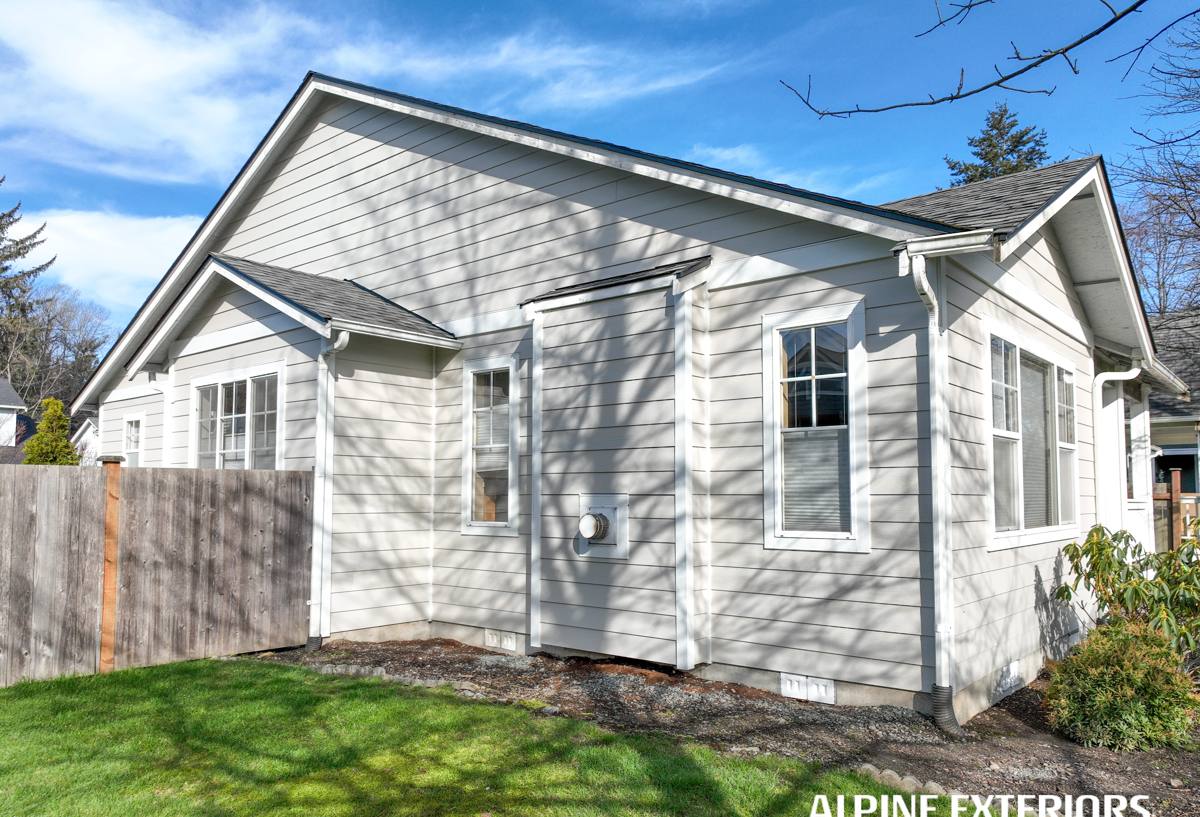
What Terrell Creek's Climate Asks of Siding
Salt Air, Even Set Back From the Water
Terrell Creek sits back from Birch Bay's open shoreline, but salt-laden air doesn't stop at a property line. It travels inland on prevailing winds and settles on siding, trim, and fasteners across most of the surrounding area, not only on homes with a direct water view. Salt speeds up corrosion in metal hardware and accelerates the breakdown of lower-quality finishes, so material and fastener choices need to account for that exposure even a mile or more back from the beach.
Driving Rain That Doesn't Fall Straight Down
Wind off the bay pushes rain sideways into wall assemblies, window flashing, and lap joints, which is a different and heavier test than a simple annual rainfall number suggests. Siding and flashing details that hold up fine on a calm, sheltered lot can still fail on a Terrell Creek property because water is finding its way in horizontally, through seams and laps that weren't built to handle that kind of pressure.
A Long Moss and Mildew Season
The mix of mature trees, creek-adjacent moisture, and mild year-round temperatures around Terrell Creek adds up to a moss and mildew season that runs most of the year on shaded and north-facing walls. Any siding material that's even slightly porous, or that holds moisture against its own substrate, becomes a growth surface over time. Shaded, tree-covered lots near the creek generally need more attention than open, sun-exposed properties nearby.
Why James Hardie Fiber Cement Is the Right Fit Here
We used to install a wider range of siding products. We stopped, and that change came directly from what we kept finding on service calls and tear-offs in this kind of climate — salt air, sustained moisture, and heavy moss exposure — not from a supplier relationship or a sales incentive.
- Non-combustible core: Fiber cement doesn't feed a fire the way wood-based siding can, which matters for both safety and, in many cases, insurance underwriting.
- Factory-applied ColorPlus finish: The color is baked on under controlled factory conditions instead of brushed on in the field, and it holds up longer against fading, chalking, and moisture intrusion than site-applied paint.
- Climate-engineered HZ product lines: Hardie's HZ5 formulation is built for regions with heavy moisture exposure and freeze-thaw cycling, which describes this part of Whatcom County well.
- Dimensional stability: Fiber cement doesn't swell, cup, or warp the way engineered wood products can after repeated wetting over a long wet season.
- Strong transferable warranty: Hardie backs its product with one of the more substantial warranty structures in the industry, provided installation follows their spec.
We don't install LP SmartSide, vinyl siding, Cemplank, Allura, primed spruce, or cedar. Each of those has a legitimate place in the market and homeowners who are satisfied with them elsewhere. On a property exposed to this much salt air, moisture, and moss, though, we've made a professional call that we'd rather stand fully behind one system than offer a cheaper option that quietly shifts long-term maintenance risk onto the homeowner.
What a Correct Fiber Cement Installation Involves
Fiber cement only performs the way it's engineered to when it's installed to Hardie's published specifications. A rushed or out-of-spec install can undercut even the best siding material, and on a Terrell Creek property the margin for sloppy detailing is smaller than it would be somewhere drier.
| Installation Detail | Why It Matters in This Climate |
|---|---|
| Manufacturer-specified clearances from grade, roofline, and deck | Keeps splash-back and standing moisture off the board edge during the wet season |
| Correct fastener type, spacing, and depth | Prevents cracking and preserves the water-resistive barrier behind the panels |
| Proper flashing at windows, doors, and penetrations | Directs wind-driven rain away from seams instead of trapping it against the wall |
| Factory-cut edges used wherever possible; field cuts sealed per spec | Preserves the factory finish's protection at every cut edge |
| Rain screen or drainage plane behind the siding | Lets moisture that gets past the surface drain and dry instead of sitting against the sheathing |
We send certified installers to every job rather than treating fiber cement as an interchangeable swap for whatever a crew happens to be used to hanging. A material that resists moisture and combustion in its core can still underperform if the details around it are wrong.
Our Process for a Terrell Creek Siding Project
- On-site assessment: We walk the property and look specifically at how the existing siding, trim, and flashing have handled moisture and salt exposure over time, not just how the surface looks from the street.
- Written scope and timeline: Before any work begins, you get a clear, itemized scope so there's no ambiguity about materials, fastener specs, or what's included.
- Prep and moisture check: Old siding comes off with an eye toward what's underneath — sheathing condition and any signs of past water intrusion get addressed before new siding goes up, not covered over.
- Installation to spec: Certified installers follow Hardie's clearance, fastening, and flashing requirements as the baseline for every board, not as an upsell option.
- Final walkthrough: We go over the finished work with you directly and explain what maintenance, if any, the new siding actually needs going forward.
Cost Factors for Fiber Cement Siding in This Area
Every property is different, but a few factors tend to move the price of a fiber cement re-side in Terrell Creek more than others.
| Factor | How It Affects Cost |
|---|---|
| Home size and wall complexity | More square footage and more corners, gables, and trim details mean more labor and material |
| Condition of existing sheathing | Rot or moisture damage found once old siding comes off adds repair scope before new siding goes on |
| Siding profile chosen | Lap siding, shingle-style panels, and board-and-batten each carry different material and labor costs |
| Trim and accessory work | Corner boards, window trim, and soffit work add to the total scope beyond the field siding itself |
| Site access and lot conditions | Tree cover, tight lot lines, or limited staging space near the creek can affect labor time |
Signs a Terrell Creek Home's Siding Needs Attention
- Soft spots, bubbling, or visible warping anywhere on the siding surface
- Persistent moss or dark staining that returns quickly after cleaning, especially on shaded or north-facing walls
- Cracked, peeling, or chalking paint that keeps recurring despite repainting
- Visible gaps at seams, corners, or trim where caulking has failed or pulled away
- Rust streaking from fasteners or trim hardware, a common sign of salt-air corrosion
- Interior signs like musty odors or soft drywall near exterior walls, which can point to moisture getting past the siding
Any one of these on its own isn't necessarily an emergency, but if you're seeing more than one, it's worth having someone look at what's happening behind the surface, not just at the paint.
Why a Crew That Already Works Terrell Creek Matters
A contractor who regularly works this specific area already knows how salt air, wind exposure, and prolonged moisture behave differently here than they do just a few miles inland. That familiarity shows up in the small decisions — how flashing gets lapped, which fastener grade gets used, where extra drainage detailing gets added around a shaded, creek-adjacent lot — and those details are exactly what determines whether a siding job lasts one wet season or several decades. It also means fewer surprises during the estimate: a crew that's worked Terrell Creek before has a realistic sense of what's usually hiding behind older siding in this area before the first board comes off.
Before You Hire Anyone for Fiber Cement Siding
- Confirm they hold current Washington contractor licensing and active liability insurance
- Ask whether their installers are manufacturer-certified for the specific product they're proposing
- Ask how they detail flashing at windows, doors, and roof-to-wall transitions for wind-driven rain
- Ask what happens if hidden rot or sheathing damage turns up once old siding comes off
- Get a written scope of work, including fastener spec and clearances, before signing anything
If you're weighing a fiber cement re-side or repair on a Terrell Creek property, we're glad to walk the exterior with you and give an honest read on what it actually needs. Reach out using the form below for a free, no-pressure estimate.