 Birch Bay
 Why Siding Repair Looks Different at Cottonwood Beach
Cottonwood Beach sits along the Birch Bay shoreline in Whatcom County, and homes here take on exterior wear differently than houses set back a few miles inland. Salt-laden air moves off the bay continuously, not just during storms. Rain doesn't fall straight down as often as it gets driven sideways into walls by onshore wind. And a moss and mildew season that can stretch across most of the year settles into shaded and north-facing siding runs and stays there. Those three factors compound each other, and they're exactly why siding repair on a shoreline property like this needs a different level of scrutiny than a routine patch job somewhere drier and more sheltered.
This page is about repair specifically — fixing damaged, aging, or failing siding on an existing Cottonwood Beach home — not a full re-side. A lot of repair calls out here start with a homeowner noticing one obvious problem: a cracked board, a stained patch, a section that's come loose in a windstorm. The real work is figuring out whether that visible problem is isolated or a sign of something spreading behind the wall, and then fixing it in a way that actually holds up to this exposure instead of needing to be redone again in a season or two.
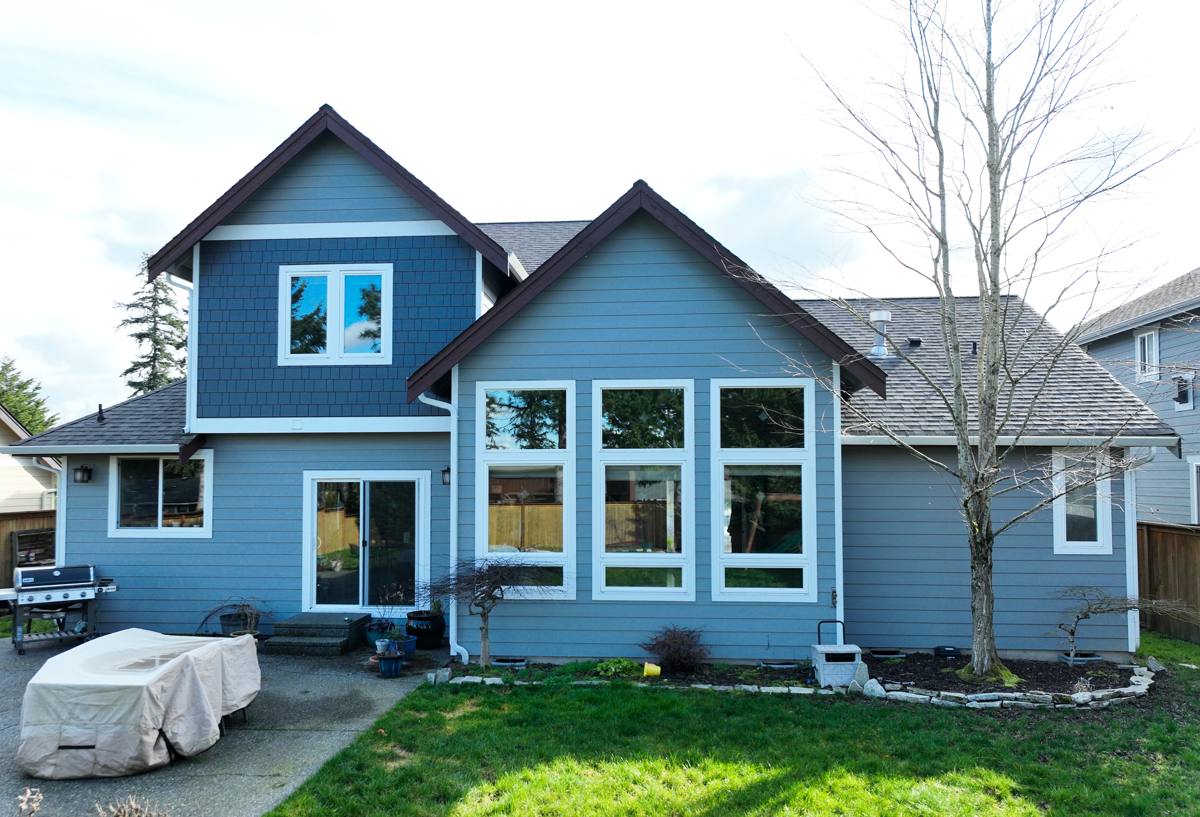
What Actually Damages Siding at Cottonwood Beach
Salt Air and Fastener Corrosion
Direct waterfront exposure means Cottonwood Beach homes deal with more concentrated salt in the air than most of Whatcom County sees. Salt accelerates corrosion in fasteners, flashing, and trim hardware well before that corrosion is visible from the ground. A nail or staple that's lost holding strength to rust doesn't announce itself — it shows up later as a panel that's started to separate, a corner trim piece that's pulling away, or a board that flexes when it shouldn't. Repair work that doesn't account for this corrosion risk from the start tends to fail again on roughly the same timeline as whatever failed the first time.
Wind-Driven Rain Hitting Walls Sideways
Being this close to open water means more wind, and wind-driven rain behaves differently than a straight-down summer shower. It gets pushed into seams, laps, and trim joints from the side, reaching places a wall assembly wasn't necessarily built to shed water from directly. This is a common reason a small, seemingly cosmetic gap in a caulk joint or lap seam turns into a real moisture problem behind the siding faster here than it would on a sheltered inland lot.
A Long Moss and Mildew Season
Mild temperatures, shade from trees or neighboring structures, and near-constant moisture add up to a moss and mildew season that runs long on this stretch of the Whatcom County coast. It shows up first on shaded or north-facing walls, and it favors any siding surface that's even slightly porous or already holding moisture at a crack or seam. Once organic growth establishes itself at a repair site, it tends to accelerate whatever breakdown was already happening underneath.
Cosmetic Wear vs. a Structural Problem
Not every mark or blemish on a Cottonwood Beach wall means the same thing, and telling the difference correctly is the actual job of a repair estimate — not just naming what's visible.
| Symptom | Usually Cosmetic | Often Structural |
|---|---|---|
| Hairline cracking in a caulk joint | Yes, if the wall behind is firm | Only if the area also feels soft when pressed |
| Chalky or faded finish on a sun-facing wall | Yes | Rarely on its own |
| Panel or board that's bowed or lifted at a seam | Sometimes | Often — usually moisture behind the panel |
| Soft or spongy spot when pressed | No | Yes — likely moisture in the sheathing |
| Moss or staining that returns quickly after cleaning | Sometimes | Can be masking a moisture issue underneath |
| Gap or shift where siding meets a window or trim | No | Yes — a flashing or water-entry point |
Cosmetic issues can usually be scheduled as routine maintenance. Anything that presses soft, or that's clustered around a window, door, or roof-to-wall transition, deserves a closer look before it's written off as minor.
How We Diagnose a Repair Before Recommending Any Work
A repair estimate that's worth anything starts with an actual inspection, not a guess from the driveway. On a Cottonwood Beach home, that typically includes:
- Press-testing the area around the visible damage, and the courses above and below it, for soft or spongy spots that indicate moisture has already spread
- Checking caulk joints, laps, and trim intersections near the damaged area for gaps that could be letting wind-driven rain in from the side
- Looking at fastener condition in the surrounding boards, since corrosion in this environment often extends beyond the one visibly failed spot
- Assessing whether shaded or north-facing sections near the repair are holding moss or mildew that's kept the wall damp longer than it should be
- Checking for signs of moisture on the interior side of the same wall, when accessible, since exterior damage and interior staining often show up together
- Confirming what siding material is actually on the house, since repair options differ meaningfully between fiber cement, vinyl, engineered wood, and cedar
We walk through what we find plainly — what's isolated and repairable, what's spreading, and what's purely cosmetic — before recommending a scope of work.
Repair vs. Replace: How That Decision Actually Gets Made
Homeowners often assume any siding damage means a full re-side, or the opposite — that a patch will always be the cheaper, equally good option. Neither assumption holds up consistently. The honest factors that drive this decision:
- How far the moisture has spread. Damage isolated to one or two boards or a single panel is usually a straightforward repair. Moisture that's tracked along the sheathing behind multiple courses is a different scope entirely.
- What's already on the house. A sound fiber cement wall with one damaged board is a strong repair candidate. A wall where the underlying material itself — aging cedar, degraded engineered wood — is the source of repeat failures is a different conversation.
- How many times this same spot has already been repaired. A wall that's had the same section patched more than once usually has a cause that hasn't been addressed yet, and another patch is likely to fail on a similar timeline.
- Age and remaining service life of the existing siding. Siding nearing the end of its practical lifespan may only have a repair cycle or two left before a full re-side is genuinely the more cost-effective path.
We'll give a straight answer on which category a given repair falls into, including when patching isn't the sensible long-term move, rather than defaulting to whichever job is smaller or larger.
What a Correct Siding Repair Involves
Matching What's Already There
A repair should hold up structurally and blend in, not read as an obvious patch. That means matching board profile, lap exposure, and, where possible, color or finish. On James Hardie fiber cement, ColorPlus finish colors that are still in the current catalog can usually be matched closely; older or discontinued colors sometimes require a field-applied touch-up that we'll discuss honestly before starting rather than promising a perfect match we can't deliver.
Fasteners and Flashing Built for This Exposure
When we replace fasteners or trim hardware as part of a repair, we use materials rated for salt air and sustained moisture, not a like-for-like swap with whatever grade failed in the first place. The same goes for flashing at any window, door, or trim intersection near the repair — if the original flashing detail was part of why water got in, we correct that detail as part of the repair, not just the visible board.
Fixing the Cause, Not Just the Symptom
A cracked or stained board is a symptom. A gap in flashing, a failed caulk joint, or moisture that's been sitting behind a shaded wall too long is usually the cause. Replacing the visible damage without correcting what let water in tends to produce a repair that fails again in the same spot, often faster the second time because the underlying path for water was never closed off.
When the Existing Material Itself Is the Problem
Sometimes a repair call reveals that the siding material itself — not the installation or a one-time event — is the reason a wall keeps failing. Cedar and engineered wood siding in a wet, salt-air climate like this one can reach a point where board after board needs attention because the material is doing what that kind of material does under sustained coastal moisture. In that situation, we'll say so directly. We repair what's there when repair is the honest answer, and when a wall is past the point where patching makes sense, James Hardie fiber cement is what we recommend and install, because it's the only siding product we stand behind for this climate.
Comparing How Common Siding Materials Take a Repair
| Material | How It Takes a Patch Repair | Color/Profile Matching | Repeat-Repair Risk in This Climate |
|---|---|---|---|
| James Hardie fiber cement | Individual boards cut in and fastened cleanly | Current ColorPlus colors match closely; older runs may need touch-up | Low — repairs tend to hold |
| Vinyl siding | Interlocking panels can often be unclipped and swapped | Sun-faded older panels are frequently hard to match exactly | Moderate — seams reopen under sustained wind |
| LP SmartSide / engineered wood | Repairable, but cut edges need immediate resealing | Visual match is possible; edge sealing is the recurring weak point | Higher — same failure mode often returns |
| Cedar / primed wood | Individual boards can be swapped | Grain and species can be matched; finish needs reapplication to blend | Higher without a disciplined refinishing schedule |
Why a Crew That Already Works Cottonwood Beach Matters
A contractor who regularly works this stretch of the Birch Bay shoreline already knows how salt exposure, wind direction, and shade patterns vary from one Cottonwood Beach lot to the next — a water-facing wall and a tree-shaded wall on the same house can be dealing with genuinely different problems. That familiarity shows up in the details of a repair: which fastener grade actually holds up here, where extra flashing attention is worth it even if it wasn't part of the original scope, and how to tell a one-time storm-related fix from a symptom of a bigger moisture problem. Those judgment calls are what separate a repair that lasts a few seasons from one that lasts the rest of the siding's service life.
A Simple Checklist Before Hiring for Siding Repair Here
- Ask whether they inspect beyond the visibly damaged area, including fasteners and flashing nearby, before scoping the repair
- Confirm current Washington contractor licensing and active liability insurance
- Ask what fastener and hardware grade they use for repairs on a waterfront property specifically
- Ask them to explain, in plain terms, what likely caused the damage — not just what they plan to replace
- Get a written scope of work, including whether the fix addresses the underlying cause, before agreeing to anything
Our Process
We start with an on-site look at the damaged area and the wall around it, checking fasteners, flashing, and moisture signs before we scope anything. From there we explain plainly what we found — isolated and repairable, more extensive than it looked, or a sign the existing material has reached the end of its useful run — and put together a clear, written scope before any work begins. Correct fastener grade, flashing detail, and cause-first repair are standard practice on every job we take on at Cottonwood Beach, not upgrades tacked on at extra cost.
If you've got a section of damaged siding, a spot that keeps coming back after past repairs, or you just want a straight read on what a wall actually needs, we're glad to take a look. Reach out below for a free, no-pressure estimate.