 Birch Bay
 Siding for a Coastline That Doesn't Let Up
Point Whitehorn sits right at the edge of the Salish Sea, and that location shapes everything about how a house ages here. Homes in this stretch of Whatcom County take on salt-laden air off the water, long stretches of driving rain through fall and winter, and a moss season that seems to start earlier and last longer every year. Siding that would hold up fine twenty miles inland can start showing problems in half the time out here. If you're planning a siding project in Point Whitehorn, the material and the installation both need to be chosen with this specific exposure in mind, not a generic Pacific Northwest spec.
We install James Hardie fiber cement siding exclusively, and this page walks through why that choice matters for homes in this particular area, what a correct installation looks like given the climate, and how our process handles the details that get skipped when a crew doesn't already know this coastline.
What Salt Air, Driving Rain, and Moss Actually Do to a House
Salt Air
Airborne salt from the water settles on every exterior surface, including siding, trim, and fasteners. Over years, it accelerates corrosion on any metal component that isn't properly rated or protected — nail heads, flashing, hose bibs, light fixtures. It also breaks down cheaper paint films faster than inland exposure would, which is part of why factory-applied, baked-on finishes hold up better here than field-applied paint.
Driving Rain
Point Whitehorn gets wind-driven rain, not just straight-down rain. That means water gets pushed sideways into laps, seams, corners, and penetrations that a calmer climate would never test. A siding system that isn't detailed correctly at these transition points — window and door trim, outside corners, the bottom of the wall where siding meets foundation — will let water in eventually, whether the siding material itself is rated for wet climates or not.
Moss and Sustained Moisture
Whatcom County's moss season runs long, and Point Whitehorn's tree cover and marine humidity give moss and algae plenty to work with. Moss holds moisture against a wall surface far longer than open air would, which is a problem for any siding material that isn't dimensionally stable or that absorbs water into its core. It's also cosmetically relentless — north-facing and shaded walls in particular need a surface that doesn't feed organic growth or trap it against wood substrate underneath.
Why We Install James Hardie and Nothing Else
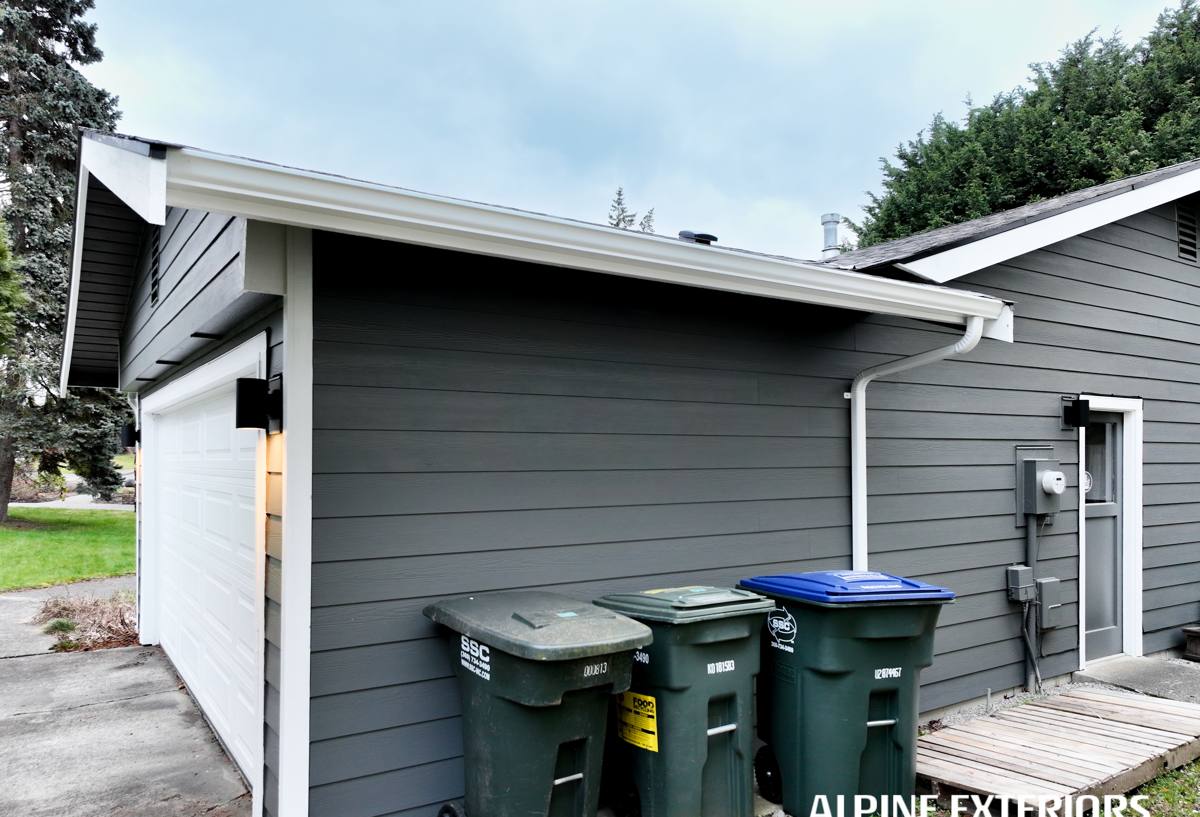
We made a deliberate decision as a company to install only James Hardie fiber cement siding — not vinyl, not LP SmartSide, not Cemplank or Allura, not primed spruce or cedar. That's not a marketing position, it's a maintenance and moisture-behavior decision built around exactly the conditions described above.
- Non-combustible core — fiber cement doesn't feed a fire the way wood-based products can, which matters as wildfire smoke seasons have crept into this region's summers.
- ColorPlus factory finish — a baked-on finish resists the fading and chalking that salt air and UV cause faster on field-painted products, and it holds color consistency across a full wall better than repeated touch-up painting ever will.
- Dimensional stability — fiber cement doesn't swell, cup, or rot the way wood-based siding can when it stays damp for weeks under moss or shade.
- Climate-engineered HZ product lines — Hardie manufactures different formulations for different climate zones, and the HZ5 line specified for the Pacific Northwest is built around freeze-thaw and moisture cycling, not a generic national spec.
- Transferable warranty backed by a manufacturer with decades in the fiber cement category — that matters if you sell the house before the siding's service life is up.
Vinyl, engineered wood, and lower-tier fiber cement alternatives each have real strengths in the right application. We just don't think any of them are the right long-term answer for a wall assembly that has to shed wind-driven rain and resist salt and moss for decades without babysitting. That's a professional judgment call we're willing to explain to any homeowner who wants to hear the trade-offs directly.
What a Correct Installation Looks Like Here
Fiber cement siding is only as good as the water management system behind it. In a coastal, high-rain environment like Point Whitehorn, the details matter more than they would in a drier climate, and most siding failures we get called to inspect trace back to installation shortcuts, not the material itself.
Weather-Resistive Barrier and Drainage Plane
Every installation starts with a properly lapped weather-resistive barrier and a drainage gap behind the siding, so any moisture that does get past the cladding has a path to drain and dry rather than sitting against sheathing.
Flashing at Every Penetration
Windows, doors, hose bibs, light fixtures, and vents all need integrated flashing detailed to shed water outward and downward — never sealant alone. Sealant fails; flashing, done correctly, doesn't depend on staying intact for thirty years.
Fastener Selection
Given the salt exposure this close to the water, fastener corrosion resistance is not optional. We use fasteners rated for the coastal environment, not standard-grade nails that will bleed rust streaks through the siding within a few seasons.
Clearances
Hardie specifies minimum clearances from grade, roofing, and decking surfaces for a reason — those gaps keep splash-back moisture and sustained dampness away from the bottom edge of the siding, which is exactly where moss and rot problems start on homes that don't have them.
Caulking and Joint Treatment
Butt joints, corners, and trim intersections get treated to manufacturer spec, not just caulked and painted over. Done wrong, these are the first places driving rain finds its way in.
Our Process on a Point Whitehorn Project
| Stage | What We're Checking |
|---|---|
| Site assessment | Wall exposure to prevailing wind/rain direction, existing moisture damage, moss buildup, current flashing condition |
| Removal and sheathing inspection | Condition of sheathing and framing once old siding is off — this is where hidden water damage from a prior installation often shows up |
| Weather barrier and drainage plane | Correct lap sequence, integration with existing roofline and window flashing |
| Hardie installation | Correct fasteners, clearances, joint treatment, and panel/lap alignment per manufacturer spec |
| Trim and detail work | Corners, window and door surrounds, penetrations sealed and flashed correctly |
| Final walkthrough | Visual and physical check of every seam, corner, and clearance before we call it done |
We don't shortcut the sheathing inspection step. On a lot of older Whatcom County homes near the water, that's where we find the real story — moisture damage that's been hidden under the old siding for years, sometimes with no visible sign from outside.
Comparing Siding Options for This Climate
| Factor | James Hardie Fiber Cement | Vinyl | Engineered Wood (e.g. LP SmartSide) |
|---|---|---|---|
| Salt air resistance | Strong — non-organic core, factory finish | Moderate — can become brittle over time | Weaker — wood-based core sensitive to moisture |
| Wind-driven rain tolerance | Strong when correctly flashed | Moderate — seams and panel joints are common leak points | Moderate — dependent on coating integrity staying intact |
| Moss/algae resistance | Good — doesn't feed organic growth or hold moisture in a core | Good on the surface, but can trap moisture behind panels | Weaker — wood-based substrate is vulnerable if coating fails |
| Fire resistance | Non-combustible | Combustible | Combustible |
| Finish longevity | Factory-baked ColorPlus finish | Color molded through material but can fade/chalk | Field or factory finish, maintenance-dependent |
This is a general comparison of material characteristics, not a claim that every vinyl or engineered wood installation will fail — installation quality and maintenance matter for any product. It's simply the reasoning behind why we standardized on one system rather than offering all three.
Living With Fiber Cement Siding in a Moss-Prone Climate
Correctly installed Hardie siding is low-maintenance, not no-maintenance. A few habits go a long way toward getting the full service life out of it in a place like Point Whitehorn:
- Rinse siding and check north- and shade-facing walls for moss buildup once or twice a year — a soft wash, not pressure washing directly into seams.
- Keep gutters clear so overflow isn't running down the wall face during heavy rain events.
- Trim back vegetation and tree cover that keeps a wall section shaded and damp longer than the rest of the house.
- Watch for caulking that's cracked or pulled away at trim and corner joints, and have it addressed before a rainy season, not after.
- Have flashing and clearances checked periodically, especially after any deck, landscaping, or grading work near the house.
Why a Crew That Already Works Point Whitehorn Matters
Coastal Whatcom County installations aren't the same job as a siding project twenty miles inland. A crew that already works this area knows which wall orientations take the worst of the wind-driven rain, how aggressive the moss season really gets on shaded elevations, and what local permitting and inspection expectations look like in Whatcom County. That local pattern recognition is what keeps small details — a flashing lap, a clearance gap, a fastener spec — from getting missed on a house that's going to spend the next several decades taking on salt air and rain straight off the water.
If you're weighing a siding replacement or new installation in Point Whitehorn, we're glad to walk your home, point out what we're seeing, and give you a straight answer on what it would take to do it right. Reach out for a free, no-pressure estimate — there's a form below.