 Birch Bay
 James Hardie Siding Built for the Semiahmoo Spit
Semiahmoo sits out on a narrow spit between Semiahmoo Bay and Drayton Harbor, near Blaine and the Canadian border in Whatcom County. It's one of the more exposed residential settings in the county — open water on more than one side, wind with almost nothing to break it, and a marine climate that stays active most of the year. Siding on a Semiahmoo home isn't just a finish material; it's the first line of defense against conditions that are noticeably harder on a house than what you'd find a few miles inland.
We install James Hardie fiber cement siding, and only James Hardie, on every home we side in this area. This page is about that one product, in this one place: what the local climate demands from it, what a correct installation actually looks like, how we choose the right product line and profile for a waterfront property, and how we approach the work when a home sits this close to the water.
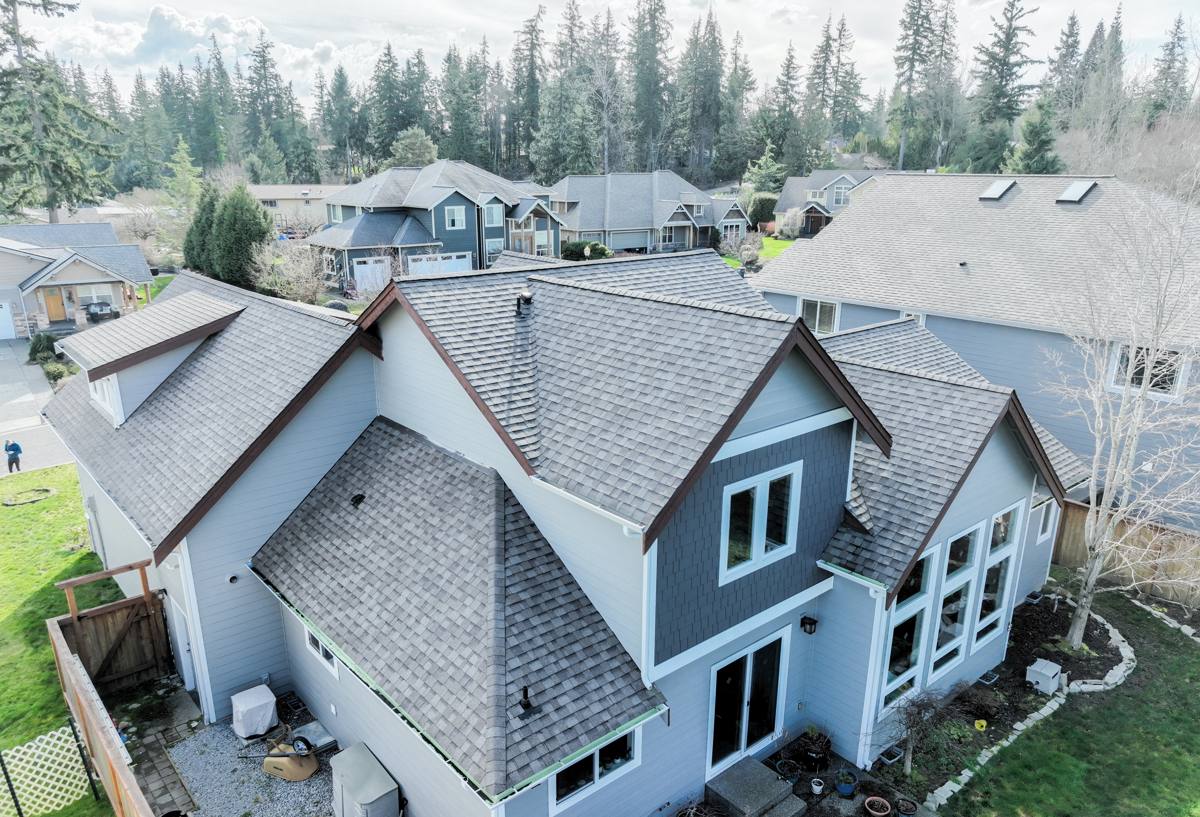
What Salt Air, Driving Rain, and a Long Moss Season Do to Siding
Salt Air From More Than One Direction
Because the spit is bordered by water on multiple sides, homes here take on salt-laden air from more than one prevailing direction rather than the single exposure most inland properties deal with. Salt accelerates corrosion in fasteners, flashing, and any exposed metal trim, and it breaks down lower-grade paints and finishes faster than they'd wear in a drier setting. Siding material and hardware both need to be chosen with that corrosion load in mind from day one, not addressed after rust or finish failure shows up.
Wind-Driven Rain That Doesn't Fall Straight Down
With little to break the wind, rain on the spit routinely gets pushed sideways into wall assemblies instead of simply running down them. That means water finds its way into laps, seams, and trim joints under real pressure, not the gentle, straight-down soak that most siding installation details are built to shed. Panels and joints that hold up fine on a sheltered inland lot can fail here specifically because the water is arriving from an angle they weren't detailed to handle.
A Moss Season That Runs Most of the Year
Mild temperatures, near-constant humidity, and shaded north-facing walls combine to give Whatcom County's coastal properties a moss and mildew season that runs long, and a waterfront spit location doesn't shorten it. Porous or moisture-holding siding materials are usually the first place it takes hold, especially on walls that don't get much direct sun. Siding that can't shed water quickly, or that absorbs moisture into its surface, stays damp longer and gives moss and mildew more time to establish.
Why We Only Install James Hardie Siding Here
We don't offer a menu of siding brands and let homeowners pick on price. We install James Hardie fiber cement, full stop, and that standard applies to every Semiahmoo project we take on. It's a decision built on what we've seen hold up, and what hasn't, on exposed, salt-air properties over years of installs and service calls in this part of the county.
- Non-combustible core: fiber cement doesn't feed a fire the way wood-based siding can, which matters for both safety and, often, insurance underwriting.
- Factory-applied ColorPlus finish: color is baked on under controlled conditions rather than brushed on in the field, and it resists fading, chalking, and moisture intrusion far longer than site-applied paint.
- Climate-engineered HZ formulation: Hardie builds its HZ5 product line specifically for regions with heavy moisture exposure and freeze-thaw cycling, a fit for waterfront Whatcom County.
- Dimensional stability: fiber cement doesn't swell, cup, or warp the way wood or engineered-wood siding can after repeated wetting over a long wet season.
- A strong transferable warranty: Hardie backs its product with one of the more substantial warranty structures in the industry, provided installation follows spec.
We won't install LP SmartSide, vinyl, Cemplank, Allura, primed spruce, or cedar. Every one of those products has a legitimate place in the market, and plenty of homeowners are satisfied with them in more sheltered settings. On an exposed spit property, though, we've made a professional call that we'd rather install and stand behind one system fully than offer a cheaper option that quietly shifts long-term maintenance risk onto the homeowner.
The Hardie Product System for This Exposure
James Hardie doesn't sell one universal product; the company engineers different formulations, called HZ zones, for different climate conditions. HZ5 is built for regions with sustained moisture and freeze-thaw cycling, which describes this stretch of coastline well. HZ10 is formulated for hot, humid climates and isn't the right match here. Using the correct HZ line matters as much as the brand itself, because it determines how the panel's core is engineered to handle water over decades of exposure.
ColorPlus finish is the other half of the equation. Instead of field-painting siding after installation — a step that introduces both labor variability and a finish that has to hold up against salt air on its own — Hardie applies the ColorPlus coating in a factory setting with multiple baked-on coats. On a property that takes as much direct salt and UV exposure as Semiahmoo does, that difference shows up as years of extra service life before repainting becomes a conversation at all.
What a Correct Installation Actually Involves
Fiber cement only performs the way it's engineered to when it goes on according to Hardie's published installation specifications, and on an exposed property, the margin for a shortcut is smaller than it would be a few miles inland.
Drainage Behind the Panel
A rainscreen or drainage gap behind the siding gives any moisture that does get past the outer layer somewhere to go, rather than trapping it against the sheathing. On a wind-driven-rain site like this one, that detail is part of the baseline assembly, not an optional upgrade.
Flashing at Every Transition
Windows, doors, roof-to-wall intersections, and any other penetration need properly lapped, sequenced flashing so water sheds outward at every layer. Wind-driven rain finds the one joint that wasn't detailed correctly, so flashing gets treated as a system, not a series of individual fixes.
Fasteners and Fastening Pattern
Corrosion-resistant fasteners — stainless steel or hot-dip galvanized, driven to Hardie's specified pattern and embedment — are non-negotiable in a salt-air environment. Fasteners that are undersized, over-driven, or the wrong grade are one of the most common causes of early siding failure we see on tear-offs near the water.
| Material | Moisture Behavior on This Coastline | Maintenance in Salt Air |
|---|---|---|
| James Hardie fiber cement (HZ5) | Dimensionally stable; resists swelling and warping | Low; factory finish resists fading and chalking for years |
| Vinyl siding | Can distort with heat and settle or crack under sustained wind exposure | Low upfront, but seams and fasteners remain exposure points |
| LP SmartSide / engineered wood | Wood-strand core is moisture-sensitive at cut edges and joints | Moderate; edge sealing and caulk upkeep matter a great deal |
| Cedar / primed wood | Absorbs and releases moisture readily with each wet cycle | High; regular refinishing needed to keep pace with salt air |
The pattern across that comparison isn't about any one product being bad — it's about how much ongoing attention each material needs to keep performing once it's exposed to this specific combination of salt, wind, and sustained moisture. That's the trade-off we weighed when we standardized on one system.
Choosing Panel Profile and Color for a Semiahmoo Home
Hardie's lap siding, panel, and shingle profiles all perform to the same engineering standard, so the choice between them on a Semiahmoo home usually comes down to the look you want rather than durability. Traditional lap siding remains the most common choice on this coastline; panel systems and shingle-profile Hardie work well for accent areas or a more contemporary look, and all three can be mixed on the same home if the design calls for it.
Color is worth more thought here than it would be inland. Darker ColorPlus colors absorb more heat and show dust and salt residue differently than lighter tones, and a home facing open water gets more direct exposure to both sun and salt spray than a sheltered lot. None of that rules a color out — it's simply worth weighing against how often you want to rinse the siding down and how the color will read against the light off the bay.
Our Process on a Semiahmoo Hardie Installation
- On-site assessment: we look at the existing siding, the sheathing underneath it, and how the current wall assembly has handled moisture and salt exposure over time.
- Written scope and timeline: a clear plan before any work begins, so there's no ambiguity about what's included.
- Weather barrier and drainage prep: housewrap, flashing details, and rainscreen furring go in before a single piece of siding is hung.
- Installation to Hardie spec: correct fastener type, spacing, and clearance from grade and roof lines, with joints detailed for this exposure.
- Trim, caulking, and final walk-through: we finish the details that keep water moving out and away from the wall, then walk the job with you before calling it done.
Living With Hardie Siding Through the Moss Season
James Hardie siding needs far less upkeep than wood-based alternatives, but "far less" isn't "none," especially on a property that stays damp and shaded for long stretches of the year.
- Rinse siding gently with a garden hose or low-pressure setting; skip high-pressure washing directly against panels and joints
- Keep landscaping trimmed back from north-facing and shaded walls so air and sunlight can reach the siding and discourage moss growth
- Check caulking at trim, windows, and joints annually, and re-caulk anywhere it's cracked or pulled away
- Maintain proper ground clearance so soil, mulch, or plantings aren't holding moisture against the bottom course
- Walk the exterior after major windstorms off the water to check for lifted trim, damaged flashing, or fastener issues before small problems become water intrusion
Why a Crew That Already Works Semiahmoo Matters
A contractor who regularly installs siding on this stretch of coastline already knows how salt air, open wind, and sustained moisture behave differently here than they do even a short drive inland toward Blaine. That familiarity shows up in decisions that don't make it onto a spec sheet: how much extra drainage detailing a particular wall orientation needs, which fastener grade to use without being asked, where wind-driven rain is most likely to test a joint. Those are exactly the details that decide whether a siding job lasts one wet season or several decades on an exposed property like this, and they're easy for a crew that mostly works sheltered inland lots to underestimate.
If you're considering new siding for a home on or near Semiahmoo, we're glad to walk the exterior with you and give an honest read on what it needs. Reach out below for a free, no-pressure estimate.