 Birch Bay
 Building New in California Creek Means Getting Windows Right From Day One
California Creek sits close enough to Birch Bay and the Strait of Georgia that every new home built here inherits the same weather pattern: salt-laden air, long stretches of driving rain off the water, and a moss season that seems to start earlier and last longer every year. If you're framing a new home or an addition in this area, the window installation stage is one of the few points in the build where mistakes get sealed inside the wall for good. Get the flashing, the fin attachment, and the water-shedding sequence wrong now, and you won't see the consequences until years later — usually as a soft spot under a sill or a stain creeping down interior drywall.
New-construction windows are a different job than swapping out an old window in an existing wall. There's no old frame to work around, no compromise dictated by what's already there. That's an advantage — but only if the crew doing the work treats it like one, instead of installing windows the same way regardless of the situation.
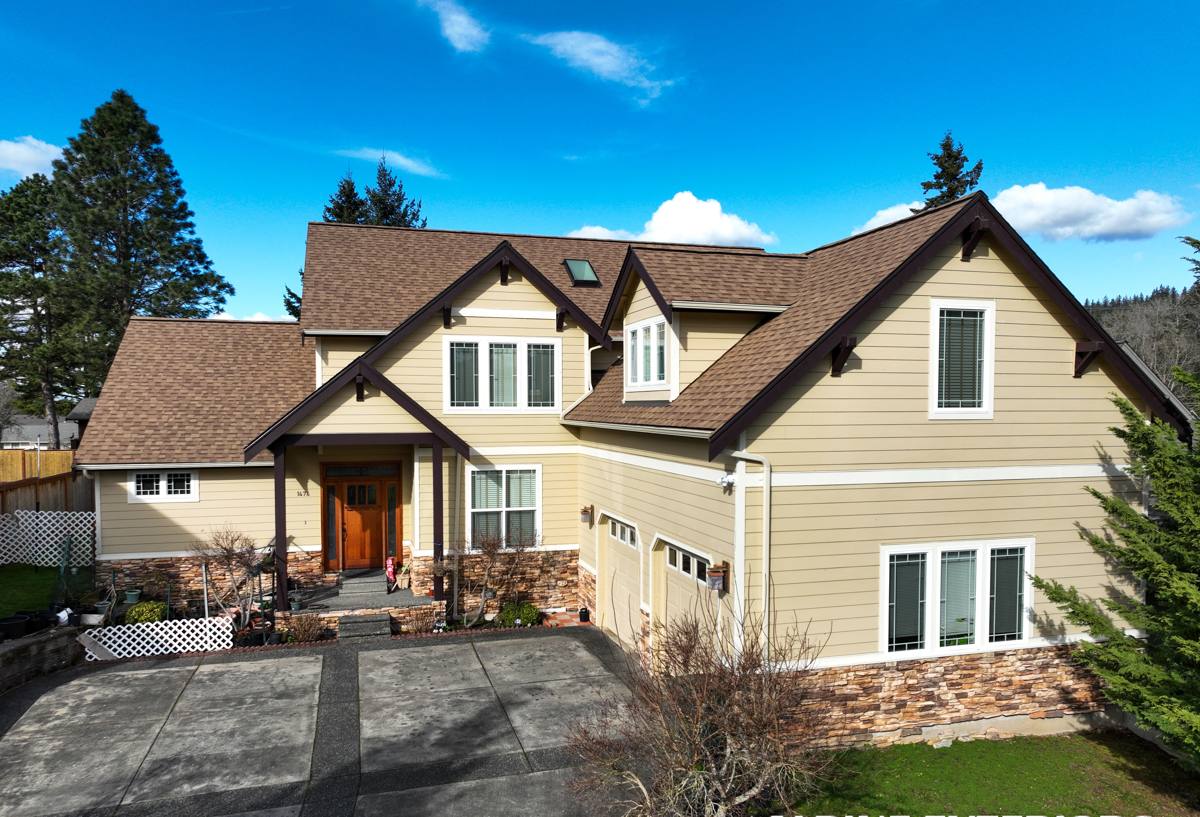
What Whatcom County's Climate Demands From a New Window Install
Salt Air and Metal Fatigue
Homes near Birch Bay's shoreline deal with airborne salt that finds its way into hardware, screws, and unprotected metal flashing. Over time, the wrong fasteners or flashing material corrode faster than they would even a few miles inland. For new construction, this means choosing corrosion-resistant fasteners and flashing products up front, not after the first rust streaks show up on the siding below a window.
Driving Rain, Not Just Rain
Whatcom County gets plenty of straight-down rain, but the rain that causes problems here is wind-driven — pushed sideways into wall assemblies during winter storms. A window that's watertight in calm conditions can still leak under wind pressure if the flashing details around the head, jambs, and sill weren't built to shed water that's moving sideways and even slightly upward at the head flashing.
Moss and Prolonged Moisture Exposure
The long damp season that grows moss on roofs and siding also means any wood trim, sill, or sheathing around a window stays wet longer between dry spells than it would in a drier climate. New-construction detailing has to assume the wall will be damp more often than not for months at a time, and build in the drainage and drying paths to handle that reality rather than fighting it after the fact.
New-Construction vs. Replacement Windows — Why the Distinction Matters
Homeowners sometimes assume any window installer can handle a new build the same way they'd handle a retrofit. The two jobs use different window designs and different sequencing with the rest of the building envelope.
| Factor | New-Construction Window | Replacement/Pocket Window |
|---|---|---|
| Frame design | Has a nailing fin for direct fastening to sheathing | No nailing fin; fits inside the existing frame |
| Sequencing | Installed before or during siding/WRB work | Installed into a finished wall, siding intact |
| Flashing access | Full access to sheathing and house wrap for proper layering | Limited — existing frame stays in place |
| Best use case | New builds, additions, full wall reconstruction | Existing homes where the frame is sound |
Because California Creek has a mix of established homes and newer builds and infill lots, we do both kinds of work — but for a ground-up build or addition, new-construction windows with a proper nailing fin are almost always the right call. They let us integrate the window directly into the water-resistive barrier instead of working around an existing opening.
Window Materials and Glass That Hold Up on This Coastline
Material choice matters more here than in a dry inland climate. We steer new-construction clients toward options that have a track record of handling coastal Whatcom County conditions without excessive maintenance:
- Vinyl — resists corrosion entirely, low maintenance, and a solid value option for most new builds; quality varies a lot between manufacturers, so frame rigidity and weld quality matter more than the marketing.
- Fiberglass — more dimensionally stable than vinyl across temperature swings, holds paint well if you want a custom color, and shrugs off moisture exposure — a good fit for larger openings.
- Wood-clad — attractive interior wood look with an exterior-facing clad shell, but the cladding has to be fully intact and well-flashed since any breach exposes wood to our wet season; we're honest with clients that this option carries a higher long-term maintenance commitment near the water.
- Aluminum — strong and slim-profile, but a poor thermal performer unless it's a thermally broken frame, and standard aluminum hardware needs upgraded coatings to resist salt-air corrosion long-term.
On glass, we generally recommend low-E coated, argon-filled double-pane units as the baseline for new construction here — the coating helps manage the region's overcast-heavy solar gain profile while the sealed unit resists the condensation issues that come with our humidity levels.
The Flashing and Weatherproofing Sequence That Actually Prevents Rot
This is the part of a new-construction window install that homeowners never see once the siding goes on — and it's the part that determines whether the window performs for thirty years or leaks in five. A correct sequence, done in order, looks like this:
- Sill pan flashing installed first, sloped to drain outward, so any water that gets past the window body has somewhere to go besides the framing.
- Weather-resistive barrier (house wrap) cut and prepped so the lower flap can be integrated into the sill pan before the window ever goes in.
- Window set into the rough opening, leveled, and fastened through the nailing fin per the manufacturer's schedule — not just at the corners.
- Side flashing tape applied over the fins, followed by head flashing that laps over the top of the window and under the house wrap above it.
- Every layer shingled correctly — meaning each piece overlaps the one below it, so water is always directed outward and down, never trapped or funneled behind the cladding.
Skip the sill pan, tape the layers in the wrong order, or staple through a flashing tape instead of pressing it down properly, and you've built a hidden leak path into a brand-new wall. This is where experience with this exact climate shows — a crew that's only worked drier regions doesn't always treat sill pan flashing and shingled house wrap as non-negotiable.
Our Process for a California Creek New-Construction Install
We keep the process straightforward and coordinate closely with the builder or homeowner so window installation doesn't become the bottleneck on the framing schedule:
- Rough opening review — we check every opening against the actual window unit dimensions before install day, not after the windows show up on site.
- Flashing plan walkthrough — sill pan, tape, and house wrap sequencing confirmed with whoever is doing the WRB, so there's no gap in responsibility between trades.
- Install and fastening — units set square and plumb, fastened per manufacturer spec, with shims placed to avoid frame distortion.
- Flashing and sealant — layered per the sequence above, with sealant used only where it belongs — not as a substitute for correct flashing.
- Final check — operation, seal, and squareness verified on every unit before we call the job done.
Cost Factors for New-Construction Window Installation
Every new build is different, so we won't quote a number without seeing the plans, but these are the variables that move the price up or down:
| Factor | Effect on Cost |
|---|---|
| Number and size of openings | More and larger windows mean more material and labor hours |
| Frame material (vinyl vs. fiberglass vs. wood-clad) | Material cost varies significantly; wood-clad is typically the highest |
| Glass package (standard low-E vs. upgraded coatings/gas fills) | Higher-performance glass adds cost per unit |
| Site access and building stage | Coordinating install timing with framing/siding crews affects scheduling and labor efficiency |
| Custom shapes or oversized units | Non-standard sizes or shapes require special ordering and more careful installation |
Pre-Install Checklist for California Creek Builders and Homeowners
- Confirm window schedule (sizes, egress requirements, tempered glass locations) matches the approved plans before ordering.
- Verify rough openings are framed square and to the correct dimensions before window delivery.
- Decide on frame material and glass package early — lead times on custom colors or upgraded glass can affect the build schedule.
- Confirm who is responsible for the WRB and flashing integration — window installer and siding crew need to be coordinated, not working from separate assumptions.
- Ask for the manufacturer's installation instructions to be followed, including fastening schedule — this matters for warranty coverage.
- Walk the site after install, before siding closes up the wall, so any flashing issue can be caught while it's still visible.
Why a Crew That Already Works California Creek Matters
New-construction window installation isn't complicated in theory, but the details that separate a dry wall from a wet one — sill pan drainage, shingled flashing order, fastener corrosion resistance — are exactly the details that get rushed or skipped when a crew is unfamiliar with what a coastal Whatcom County winter actually does to a building. A crew that regularly works in and around Birch Bay has already seen what happens when those steps are shortcut, and builds every new install assuming this area's rain and salt air, not fair-weather conditions, are the standard to design for.
We also know the practical side of building here — coordinating with framers and siding crews on realistic schedules, working around the wetter months when timing allows, and communicating clearly with builders and homeowners so nothing falls through the cracks between trades.
If you're planning new construction or an addition in California Creek and want windows installed the way this climate actually requires, we're happy to walk the plans with you and provide a free, no-pressure estimate — no obligation, just a straight answer on what your project needs.