 Birch Bay
 Why California Creek Roofs Wear Differently
California Creek sits close enough to Birch Bay's shoreline that roofs here take a different kind of beating than roofs even a few miles inland in Whatcom County. Salt-laden air corrodes exposed metal faster than it does inland — fasteners, flashing, and vent hoods all show it first. Add the driving rain that comes off the water sideways during winter storms, and you get wind-driven moisture finding its way under shingles and around penetrations that would stay dry in a calmer setting. Then there's the moss. Birch Bay's long, damp shoulder seasons give moss and algae months at a time to establish themselves on north-facing slopes and shaded sections, and once they take hold they hold moisture against the roofing material year-round.
None of this means a California Creek roof needs exotic materials or gimmicks. It means the replacement has to be done with this specific combination of stressors in mind — the right underlayment, the right fastener spec, and flashing details that don't cut corners in the places wind-driven rain actually gets in.
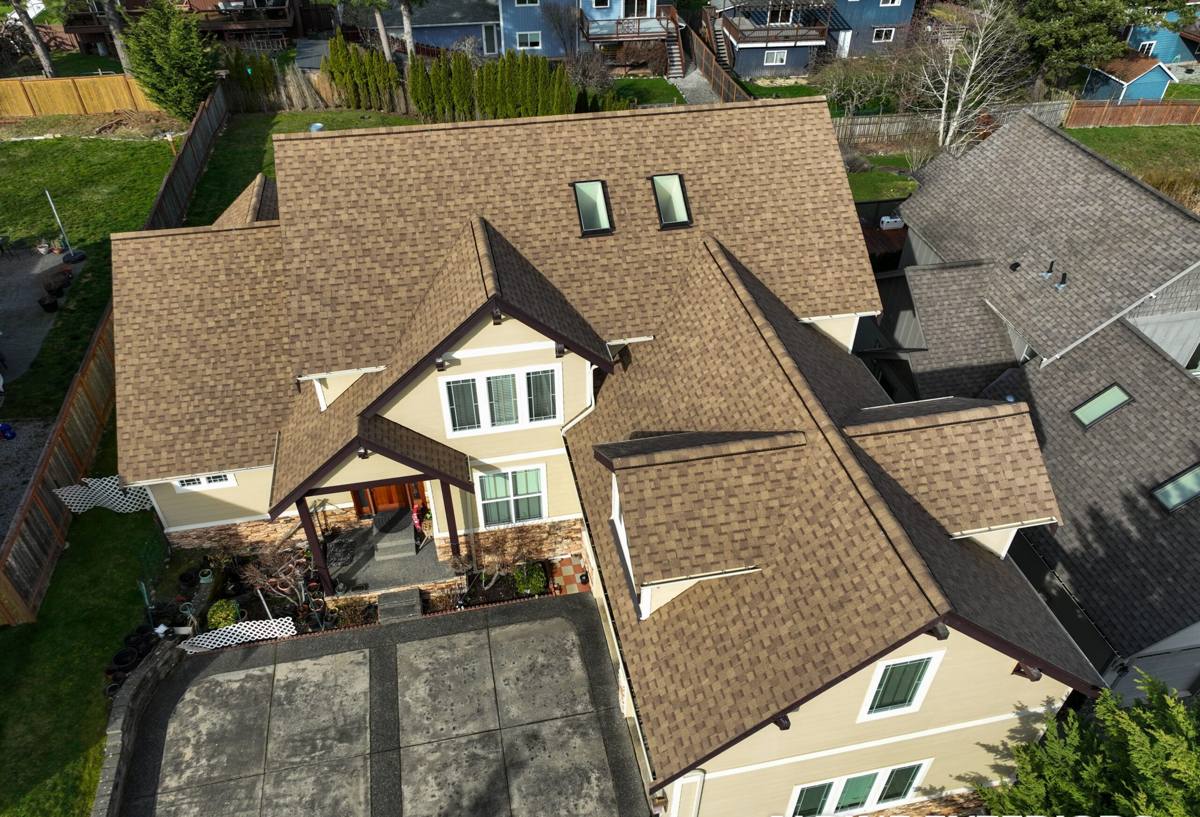
Signs a Repair Won't Cut It Anymore
Not every roof problem calls for a full replacement, and we'll tell you plainly when a repair is the honest answer. But there are signs that point to a roof at the end of its useful life rather than one with an isolated issue:
- Granule loss heavy enough that you're finding grit in gutters and downspouts every time it rains
- Shingles that are cupping, curling, or cracking across large sections rather than in one spot
- Soft or spongy decking felt underfoot when walking the roof, a sign moisture has reached the sheathing
- Moss that keeps returning to the same areas within a season or two of cleaning
- Daylight visible through the roof deck from inside the attic, or staining on attic insulation
- A roof already past 20–25 years old with multiple prior repairs
If you're seeing one or two of these in isolation, a targeted repair may still make sense. If you're seeing several at once, or the roof is old enough that repairs are becoming a pattern, replacement is usually the more cost-effective path — you stop paying to patch a system that's failing everywhere at once.
Choosing a Roofing System for This Climate
Asphalt Shingles
Architectural asphalt shingles remain the most common choice in California Creek, and for good reason — they're cost-effective, widely available, and perform well when installed correctly. For this specific area, we lean toward algae-resistant shingle lines, which include copper granules that slow moss and algae regrowth on shaded or north-facing sections. It's not a permanent fix — nothing is — but it buys years between cleanings.
Metal Roofing
Standing-seam metal holds up well against driving rain because there are far fewer seams and edges for wind-driven water to work into. It also sheds moss more easily than shingles since there's less texture for spores to grip. The trade-off is upfront cost and the need for coatings and fasteners rated for coastal exposure — using standard-grade metal or fasteners near salt air invites premature corrosion, which is why we specify marine-grade or coated hardware on every metal install out here.
What We Steer Clients Away From
Wood shake looks great on paper for a Pacific Northwest home, but in a shaded, moisture-heavy microclimate like California Creek it's a high-maintenance choice — it holds water against the wood and needs frequent treatment to resist rot and moss colonization. We'll install what a homeowner wants after an honest conversation about the upkeep, but we don't recommend it as a low-maintenance option here.
| Material | Typical Lifespan | Moss/Algae Resistance | Salt Air Suitability | Relative Cost |
|---|---|---|---|---|
| Architectural Asphalt (algae-resistant) | 25–30 years | Good with AR granules | Good | $ |
| Standing-Seam Metal | 40–50+ years | Very good | Excellent (with coastal-rated coatings/fasteners) | $$$ |
| Standard 3-Tab Asphalt | 15–20 years | Fair | Fair | $ |
| Wood Shake | 20–30 years with upkeep | Poor without regular treatment | Fair | $$ |
What a Correct Replacement Actually Involves
A roof replacement is more than swapping old shingles for new ones. The parts that determine whether a roof performs well in Birch Bay's climate are mostly the parts you can't see once the job is done.
Tear-Off and Deck Inspection
We remove the old roofing down to the deck rather than laying new material over old — that's the only way to actually see the plywood or OSB underneath. Any decking that's soft, delaminated, or water-stained gets replaced before anything new goes down. Covering up bad decking is how a new roof ends up with problems within a few years.
Underlayment
Given how much wind-driven rain this area sees, we don't treat underlayment as an afterthought. A synthetic underlayment with ice-and-water shield at eaves, valleys, and around penetrations gives the roof a second line of defense if wind-driven water gets past the shingles — which, in a coastal storm, it eventually will somewhere.
Flashing
Flashing failures, not shingle failures, are the most common source of roof leaks. Chimneys, skylights, vent pipes, and roof-to-wall transitions all need flashing that's properly lapped and sealed, not just caulked over. We replace flashing rather than reuse it during a full roof-off — old flashing has usually already taken corrosion damage from salt air that isn't visible from the ground.
Ventilation
See the next section — this one deserves its own explanation.
Ventilation and Moisture: The Overlooked Factor
A roof in a damp climate needs to breathe. Without balanced intake and exhaust ventilation, warm moist air from inside the house gets trapped in the attic, condenses against the underside of the roof deck, and creates the exact conditions moss and rot need to take hold from the inside out — not just from rain hitting the surface. We check existing ventilation as part of every replacement estimate and correct it where it's inadequate, because installing a good roofing material over a poorly ventilated attic just delays the same problem.
Our Process for California Creek Projects
1. On-Site Inspection and Written Estimate
We walk the roof, check the attic, and look at the specific exposure of the property — how much shade it gets, which slopes face the water, and what condition the decking and flashing are in. You get a written estimate that spells out material, scope, and price, not a verbal ballpark.
2. Scheduling Around the Weather
We plan tear-off and dry-in around the forecast, not the calendar. A roof deck should never sit exposed overnight if there's rain in the picture, and in Birch Bay that means watching the forecast closely rather than assuming a dry week.
3. Tear-Off, Deck Repair, and Dry-In
Old material comes off, decking issues get fixed, and underlayment goes down the same day wherever possible to minimize exposure.
4. Installation and Detail Work
Shingles or metal panels go on to manufacturer spec, with flashing, fasteners, and ventilation components matched to coastal exposure requirements.
5. Final Walkthrough
We walk the finished roof with you, confirm cleanup is complete — including a magnetic sweep for stray nails — and go over warranty paperwork.
Why Local Experience in California Creek Matters
A crew that's worked roofs throughout Birch Bay and the surrounding Whatcom County coastline already knows which slopes in this neighborhood tend to hold moss, which fastener grades actually hold up to the salt air here, and how far wind-driven rain can travel under improperly lapped flashing during a winter storm. That's knowledge that only comes from having done the work in this specific environment repeatedly — it's the difference between a roof that's built to a generic spec and one that's built for the conditions it will actually face.
Roof Replacement Checklist for California Creek Homeowners
- Get an on-site inspection that includes the attic, not just a look from the ground or a photo estimate
- Ask what underlayment and ice-and-water shield spec is included, not just the shingle brand
- Confirm flashing will be replaced, not reused, during a full tear-off
- Ask whether attic ventilation will be assessed and corrected if needed
- Get material, warranty terms, and total price in writing before work starts
- Ask about fastener and hardware grade if you're considering metal roofing near the water
- Confirm how tear-off day and dry-in will be handled if rain moves in unexpectedly
Getting Started
If your roof is showing its age — or you just want an honest read on how many years it has left — we're happy to take a look. We offer free, no-pressure estimates for California Creek homeowners, and we'll tell you straight whether you're looking at a repair or a replacement. Fill out the form below and we'll get in touch to schedule a time to walk the roof with you.