 Birch Bay
 Siding Installation in Lynden: What the Climate Actually Demands
A siding installation is one of the few home improvement projects where the install matters as much as the material — sometimes more. In the Lynden area, that's not a throwaway line. Whatcom County's marine-influenced climate puts a steady, cumulative load on exterior walls: salt-laden air drifting in off the coast, rain that drives sideways instead of falling straight down, and a moss and mildew season that can run most of the year on shaded or north-facing walls. A siding installation that doesn't account for all three won't fail on day one — it'll fail quietly, a few winters in, in ways that are expensive to trace back to the source.
This page is specifically about siding installation for homes in the Lynden area — what the local climate requires, what a correct installation involves from tear-off to final trim, and why the crew doing the work matters as much as the product going on the wall. We install James Hardie fiber cement exclusively, and that standard shapes every part of the process described below.
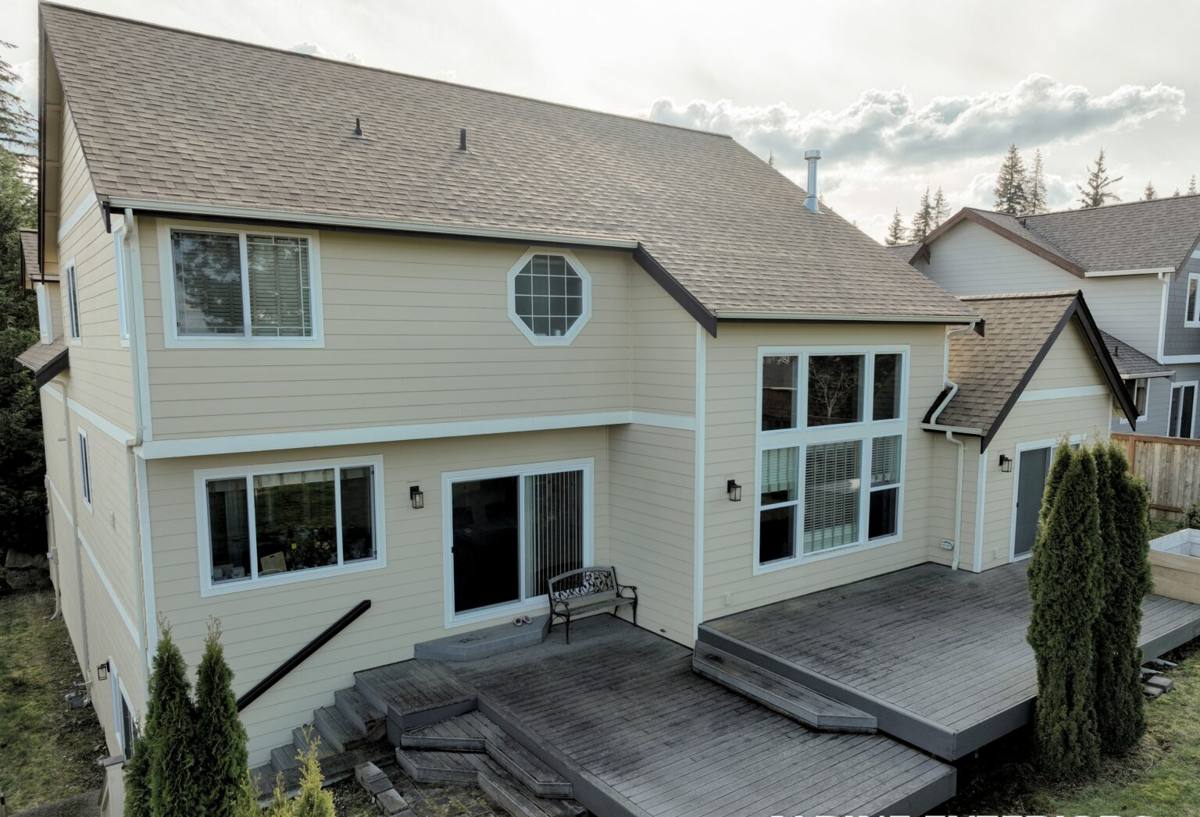
What a Siding Installation in the Lynden Area Has to Hold Up Against
Salt Air
Marine air moves well inland across this part of Whatcom County, and it doesn't need to be blowing straight off the water to matter. Over years, salt exposure accelerates corrosion on fasteners, flashing, and lower-grade trim hardware. A siding installation that uses undersized or the wrong-grade fasteners might look fine for a season or two before rust streaking and loosening trim start showing the hardware wasn't matched to the exposure.
Driving Rain
Rain through fall and winter in this region rarely falls straight down — wind pushes it sideways into wall assemblies, window flashing, and the joints where roof meets wall. That sideways load is exactly what separates an installation built for decades from one that starts letting water in behind the cladding within a few wet seasons. It's also the load that a rushed or corner-cutting install misses most often, because the failure point — a gap behind a butt joint, a poorly lapped flashing detail — isn't visible once the siding is up.
A Long Moss Season
Mild temperatures, shade, and near-constant moisture add up to a moss and mildew season that can run close to year-round on shaded walls. Any siding material that's porous, or that holds moisture against the substrate instead of shedding it, becomes a growth surface over time. Around Lynden, that plays out differently from lot to lot — a wall facing open farmland dries out fast between storms, while a wall shaded by trees or a neighboring structure often doesn't dry out at all through the wetter months.
Why We Install Only James Hardie Fiber Cement
We used to install a broader range of siding products. We narrowed to one system after seeing, on repeated tear-offs and service calls, what actually holds up in a climate like this versus what looks fine on a spec sheet and struggles a few winters into real exposure.
- Non-combustible core: fiber cement doesn't feed a fire the way wood-based siding can, which matters for safety and can matter for insurance underwriting.
- Factory-applied ColorPlus finish: baked on under controlled conditions rather than brushed on in the field, holding color and adhesion far longer under sustained moisture and UV.
- Climate-engineered HZ product lines: Hardie's HZ5 formulation is built for regions with significant moisture exposure and freeze-thaw cycling — a close match for the Lynden area and the rest of Whatcom County.
- Dimensional stability: fiber cement doesn't swell, cup, or warp the way engineered wood siding can after repeated wetting cycles over a wet season.
- A strong transferable warranty: backed by one of the more robust structures in the industry, provided the installation follows Hardie's published specifications.
We don't install LP SmartSide, vinyl siding, Cemplank, Allura, primed spruce, or cedar. Each has a place in the market and homeowners who are satisfied with them elsewhere. Our call is a professional one: in a climate with this much sustained moisture and salt exposure, we'd rather install and stand fully behind one system than offer a cheaper option that quietly shifts maintenance risk onto the homeowner a few years down the line.
What a Correct Siding Installation Actually Involves
Sheathing and Substrate Check
Once old siding comes off — or before new siding goes up on new construction — the sheathing underneath gets checked for rot, soft spots, or existing moisture damage. Covering a compromised substrate with new siding just hides a problem that keeps getting worse behind the wall; catching it at this stage is far cheaper than finding it again in five years.
Weather-Resistive Barrier and Flashing
Given how much of this region's siding failures trace back to water getting behind the cladding rather than through it, the house wrap, window flashing, and every wall penetration get careful, deliberate attention during installation. This step is easy to rush and nearly impossible to inspect once the siding is on, which is exactly why it shouldn't be treated as routine.
Fastening and Clearances to Manufacturer Spec
James Hardie's warranty depends on installation following their published specifications — correct fastener type and spacing, proper clearance above grade and roofline, and correct field-cutting and sealing at every edge. We install to that spec as the baseline for every job, not as an upgrade option.
Trim, Joints, and Corners
Butt joints, corner boards, and trim-to-siding transitions are where a lot of installations quietly fail, because they're the points where wind-driven rain has the most direct path inward. Correct flashing and sealing at these details is what keeps a driving rainstorm from becoming a slow leak two winters later.
Comparing Siding Materials for a Lynden-Area Installation
| Material | Moisture behavior | Common trade-off in this climate |
|---|---|---|
| James Hardie fiber cement | Dimensionally stable, sheds moisture, doesn't swell or warp | Requires correct installation to spec to realize the full warranty |
| Vinyl siding | Can warp or distort under sustained UV and temperature swings | Panel seams and gaps give wind-driven rain an entry point |
| LP SmartSide / engineered wood | Wood-strand core is moisture-sensitive at cut edges and fastener points | Needs consistent edge-sealing and caulk maintenance to avoid swelling |
| Primed spruce or cedar | Absorbs and releases moisture readily | Ongoing repainting and moisture upkeep to avoid rot |
Our Installation Process, Step by Step
- Inspection and estimate: a real look at the house — current siding condition, signs of trapped moisture, and how sun, shade, and wind exposure vary wall to wall.
- Tear-off: removal of existing siding (or prep of bare sheathing on new construction), with debris cleared as the job proceeds.
- Substrate repair: any rot or soft sheathing found gets addressed before anything new goes up.
- Weather barrier and flashing: house wrap and flashing installed or repaired at every penetration and wall transition.
- Hardie installation to spec: panels or lap siding installed with correct fastening, spacing, and clearances per manufacturer requirements.
- Trim and finish work: corners, joints, and trim sealed and finished to match the estimate.
- Final walkthrough: we walk the completed job with the homeowner and cover care and maintenance expectations.
Signs an Existing Lynden-Area Home Needs a New Siding Installation
- Moss or dark staining that returns quickly after cleaning, especially on shaded or north-facing walls
- Soft or spongy siding, particularly low on the wall or around window and door trim
- Peeling paint or visible warping, most common on older wood-based or engineered wood siding
- Cracked, buckled, or missing panels after a windstorm
- Rust staining running down from fasteners or trim hardware
- Musty odors or interior staining on walls that back up to exterior siding
- Siding installed 20-25+ years ago with no documented repairs or replacement
None of these automatically mean a full reinstallation is necessary, but each is worth a professional look before another wet season adds to whatever damage is already there.
What Affects the Cost of a Siding Installation
| Factor | Why it moves the estimate |
|---|---|
| Total square footage and number of stories | More wall area and access complexity mean more labor and material |
| Trim and detail work around windows and rooflines | Detailed elevations take more time to flash and finish correctly |
| Sheathing condition once old siding comes off | Rot or moisture damage found mid-project needs repair before new siding goes up |
| James Hardie product line and color selected | Panel profile, plank width, and ColorPlus color each carry different material costs |
Every estimate is specific to the house rather than a flat per-square-foot number, and we walk through these factors directly during the estimate so a homeowner knows what's driving the price, not just what the total is.
Why a Crew That Already Installs Siding in Lynden Matters
A siding installation is only as good as the details nobody sees once the job is finished — the flashing behind a window, the fastener spacing under a lap course, the clearance at the bottom trim. A crew that installs siding in this area regularly already knows which wall orientations around Lynden stay wet longest, where the sideways rain load hits hardest, and which install-day details are worth the extra time so a homeowner isn't dealing with a callback two winters later. It also means that if a warranty question comes up years down the line, it's a call to a crew still working in the same area, not a company that's moved on.
If your Lynden-area home needs a new siding installation, we're glad to come take a look and walk through what it would actually involve for your house. Reach out using the form below for a free, no-pressure estimate.