 Birch Bay
 Asphalt Shingle Roofing Built for Blaine's Coastal Climate
Blaine sits right up against the water and the Canadian border, which means homes here take a different kind of weather beating than roofs twenty miles inland. Salt-laden air off Semiahmoo Bay and the Strait works on metal fasteners and flashing year-round. Driving rain off Puget Sound arrives sideways more often than straight down, testing every lap and seal in a roof system rather than just the field of the shingles. And Whatcom County's long, damp shoulder seasons give moss and moisture months to work into a roof that isn't detailed correctly. An asphalt shingle roof that's specified and installed for this environment holds up. One that's installed the same way it would be in a dry inland town usually doesn't, and the difference shows up as premature granule loss, moss colonies, and soft decking within the first decade instead of the second or third.
We work on homes throughout Blaine and the surrounding Birch Bay area regularly, which means we're not guessing at what this climate does to a roof — we're replacing and repairing the ones it's already gotten to.
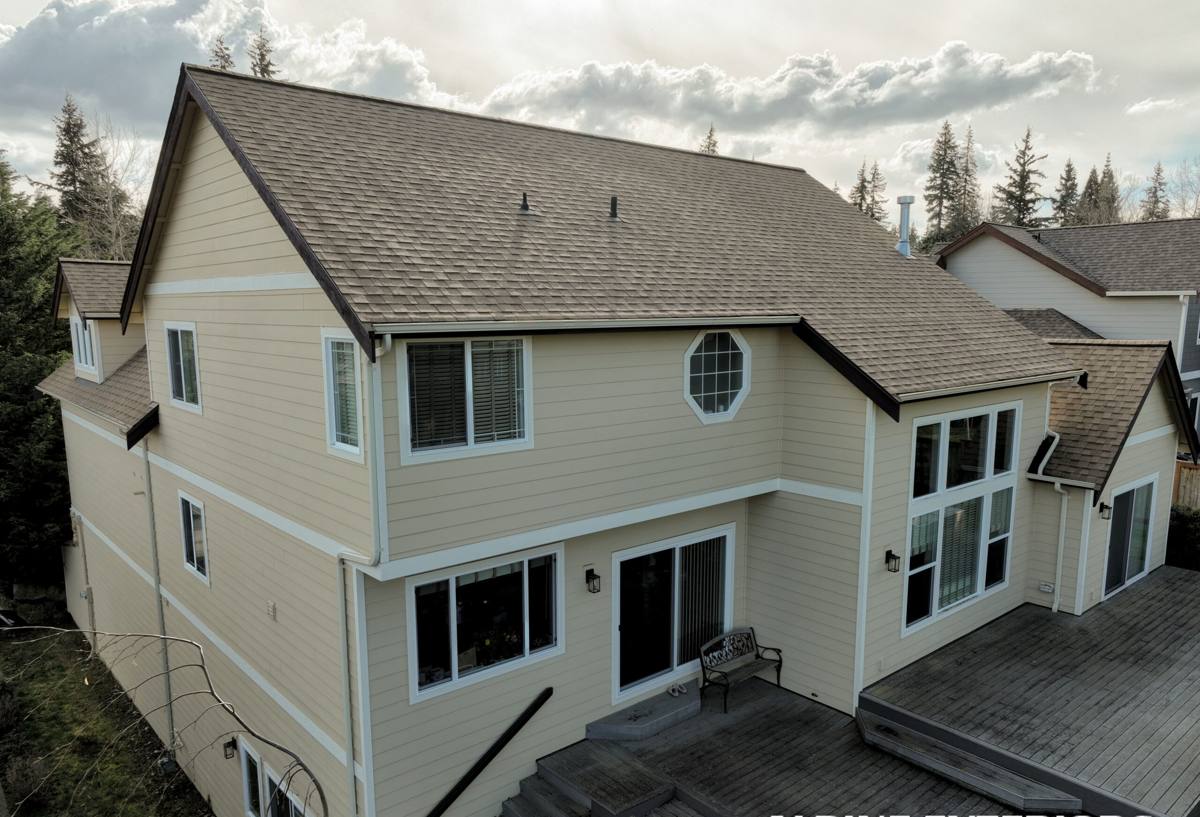
What the Local Climate Actually Does to a Shingle Roof
Salt Air and Metal Components
Asphalt shingles themselves tolerate salt air reasonably well, but the metal parts of a roof system — nails, drip edge, step flashing, valley metal, vent housings — are where salt exposure shows up first. Cheaper fasteners and bare galvanized flashing corrode faster this close to the water. We spec corrosion-resistant fasteners and flashing on every Blaine roof for this reason, not as an upsell but because it's the difference between flashing that lasts the life of the roof and flashing that needs attention in year eight.
Driving Rain and Wind-Driven Wetting
Wind off the water pushes rain sideways and upward under normal circumstances more than inland homes ever experience. That means laps, nail patterns, and underlayment matter more here — a roof that would shed water fine in still conditions can still take on water at Blaine when wind drives rain under an edge that's a half-inch short or a shingle course that's slightly under-lapped.
Moss Season
Whatcom County's wet season runs long, and north-facing or heavily shaded roof sections in Blaine and Birch Bay stay damp for weeks at a stretch. Moss doesn't just sit on top of shingles — it lifts tabs, holds moisture against the granule surface, and works its way toward the fastener line over time. A roof with no moss-resistant strategy at all will grow it eventually; the question is how much damage accumulates before anyone notices.
What a Correctly Installed Shingle Roof Includes Here
A shingle roof is a system, not a single product. For Blaine's conditions, the details below are what separate a roof that performs for its full service life from one that needs early repairs:
- Ice-and-water shield at eaves and valleys — self-adhered membrane in the areas most exposed to wind-driven rain and ice damming, not just a code minimum strip
- Synthetic underlayment across the full deck — a durable water-resistant layer under the shingles, which matters more here given how many weeks a year the roof stays wet
- Corrosion-resistant fasteners and flashing — appropriate for salt-air exposure this close to the water
- Properly lapped step and counter-flashing at every wall intersection, chimney, and dormer
- Balanced intake and exhaust ventilation — so moisture doesn't condense inside the attic and attack the deck from underneath
- Zinc or copper moss-control strips at the ridge on shaded or north-facing roof planes
- Correct nail placement and count per shingle, matched to the wind exposure of the specific roof plane
Skip any one of these and the roof will likely still look fine on installation day. The failures from skipped details show up years later, which is exactly why they're easy for a rushed installer to skip and hard for a homeowner to catch at the time.
Shingle Options and How They Perform in This Climate
Not every asphalt shingle product is equally suited to a marine, moss-prone climate. Here's how the common tiers compare for a Blaine roof specifically:
| Shingle Type | Typical Lifespan Here | Moss/Algae Resistance | Wind Rating Fit |
|---|---|---|---|
| 3-tab (economy) | 12–18 years | Low unless treated | Lower wind ratings — a concern on exposed lots near the water |
| Standard architectural | 20–25 years | Moderate; algae-resistant granules common | Good for most Blaine exposures |
| Premium architectural (algae-resistant, high-wind rated) | 25–30+ years | High — copper-infused granules resist moss/algae growth | Best fit for waterfront and high-exposure lots |
We don't install the bottom tier on homes in this area as a matter of professional standard — the labor cost to install a roof is nearly identical regardless of shingle grade, so putting a short-lived product on a home that faces this much moisture and salt air doesn't serve the homeowner well over time. We'll talk through the honest trade-offs of each option for your specific roof rather than steering you to the most expensive one by default.
Our Process for a Blaine Roofing Project
1. On-Site Assessment
We walk the roof and attic, not just the ground-level view. That means checking deck condition, existing ventilation, flashing detail at every penetration, and how much shade and moss exposure each roof plane actually gets — north slopes and tree-shaded sections get treated differently than open, sun-exposed ones.
2. A Written, Itemized Estimate
You'll see the shingle line, the underlayment and ice-and-water shield coverage, flashing and fastener specs, ventilation work, and tear-off/disposal — not a single lump-sum number. That way you know exactly what you're paying for and can compare it apples-to-apples against any other estimate.
3. Tear-Off and Deck Inspection
We remove the old roofing down to the deck and inspect for soft or delaminated sheathing before anything new goes down. Covering over a compromised deck is one of the most common shortcuts in this trade, and it's one we don't take — any deck repair is priced and confirmed with you before it's replaced, not buried in the final bill.
4. Installation
Underlayment, ice-and-water shield, flashing, shingles, and ventilation components go in per the manufacturer's specification for the wind and moisture exposure of your specific site.
5. Final Walkthrough
We walk the finished roof and the property with you, including gutters and ground areas for stray debris and fasteners, before we consider the job done.
Repair, Recover, or Replace?
Not every Blaine roof needs full replacement. The right call depends on age, deck condition, and how widespread the damage is:
- Repair makes sense for isolated issues — a damaged flashing detail, a section of wind-lifted shingles, a leak with a clearly identifiable source — on a roof that's otherwise sound and not near the end of its service life.
- Recover (new layer over existing) is rarely something we recommend in this climate. Trapping moisture and existing moss or granule damage under a second layer tends to shorten rather than extend the roof's remaining life, and it's not something we do as standard practice.
- Full replacement is the right call when the deck shows soft spots, when shingles are past their granule life across most of the roof, or when moss has been established long enough to have lifted tabs broadly rather than in a single spot.
Maintenance That Actually Extends Roof Life Here
A shingle roof in Blaine benefits from a bit more attention than the same roof would need somewhere drier, mostly because of the moss and moisture exposure:
- Keep gutters clear so water isn't backing up under the eave edge during heavy rain events
- Have shaded or north-facing sections checked for early moss growth before it spreads — a light growth is a quick treatment; an established colony is a bigger job
- Trim back overhanging branches that keep roof sections shaded and damp longer than they need to be
- Have flashing and fastener condition checked periodically, particularly on older roofs, since this is where salt-air corrosion shows up first
Why a Crew That Already Works This Area Matters
A roofer who mostly works drier, inland jobs isn't wrong about roofing in general — they're just calibrated for a different set of conditions. The underlayment coverage, fastener spec, moss strategy, and ventilation balance that make sense for a Spokane roof aren't the same as what a Blaine roof on Whatcom County's coastline actually needs. We price and detail these jobs based on what we see failing on real roofs in this area, not a generic national spec sheet.
If you'd like an honest look at your roof's condition and a straightforward, itemized estimate, we're happy to come take a look — no pressure, no obligation. The form below gets you started.