 Birch Bay
 Composite Decking Built for Point Whitehorn's Coastal Conditions
Point Whitehorn sits close enough to the water that every exterior surface on a home takes a different kind of beating than it would a few miles inland. Salt-laden air off the Strait, driving rain that comes in sideways during winter storms, and a moss season that can stretch from October through May all work against wood decking in ways that show up fast — soft boards, green film, warped fasteners, and rot at the joints where water sits longest. Composite decking, installed correctly, is one of the more sensible answers to that combination, but "installed correctly" is doing a lot of work in that sentence. A composite deck is only as good as the framing underneath it, the fastening system holding it down, and the drainage plan that keeps water from pooling where it shouldn't.
We work Point Whitehorn and the rest of the Birch Bay area regularly, which means we're not guessing at how this climate treats a deck — we're seeing the callbacks and repair jobs from decks that were built without the coastal exposure in mind.
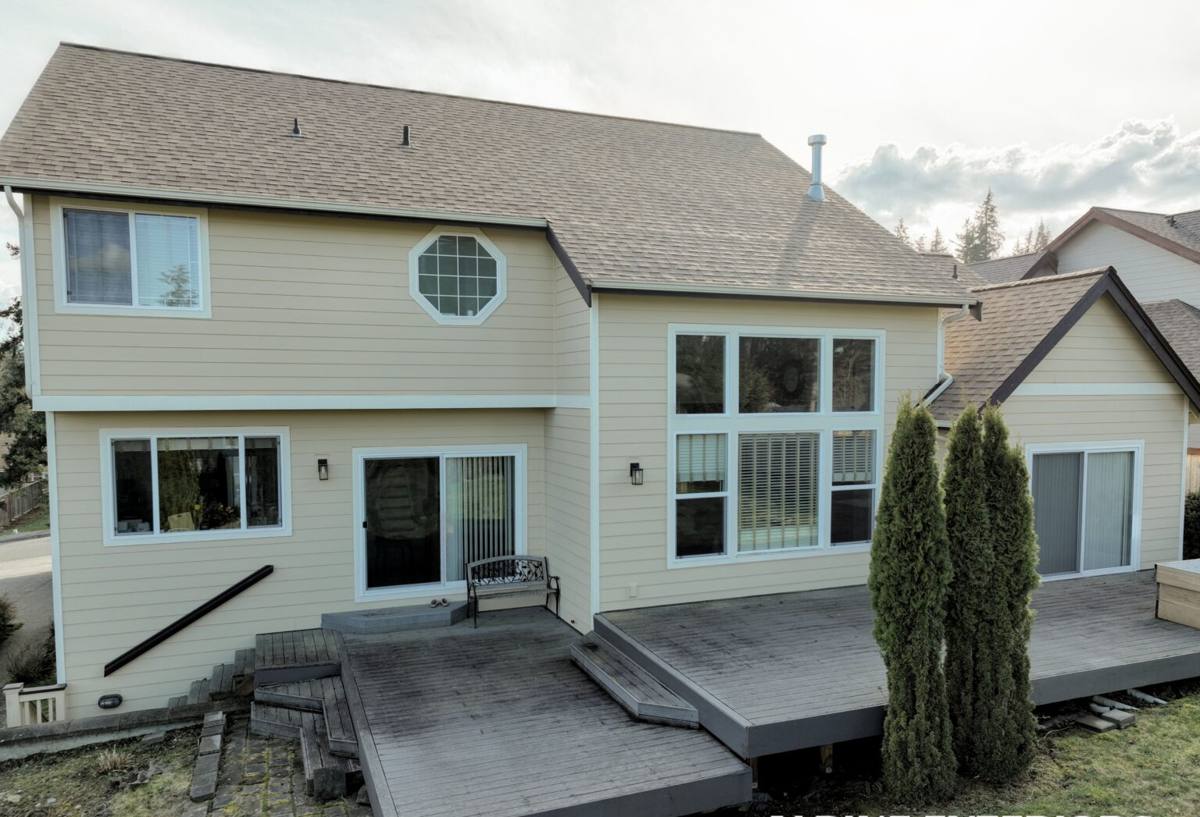
What This Climate Actually Does to a Deck
Salt Air and Metal Fasteners
Airborne salt accelerates corrosion on anything metal — screws, joist hangers, structural connectors. On a deck close to the water, standard fasteners can start showing rust streaks and weakening well before their rated lifespan. This matters more with composite decking than people expect, because the boards themselves may outlast the hardware holding them down if the wrong fasteners were used.
Moss and Algae Growth
Whatcom County's damp, mild winters are ideal moss-growing conditions. Any deck surface that stays shaded and wet — under trees, on the north side of a house, near the ground — will grow moss and algae unless it's built to shed water and dry out between rains. Moss on a walking surface isn't just unattractive; it's slick and genuinely dangerous underfoot.
Driving Rain and Water Intrusion
Wind-driven rain finds its way into gaps that would stay dry in a calmer climate. Ledger board connections, stair stringers, and any spot where the deck meets the house siding are the places we see water intrusion problems most often — not because the decking material failed, but because flashing and sealing details were skipped or done wrong.
Why Composite Makes Sense Here — With Honest Caveats
Composite decking doesn't rot, doesn't need annual staining, and resists the moss and algae buildup that plagues untreated wood in this climate — the cap layer on most modern composite boards sheds water and doesn't offer the same foothold for organic growth. That's a real advantage for a Point Whitehorn property near the water.
That said, composite isn't maintenance-free — it's lower-maintenance. It still needs periodic washing to keep the surface from developing a film, and it still depends entirely on what's underneath it. We won't install composite decking over a substructure that isn't built to handle the moisture load of this area, because the material warranty on the boards means nothing if the frame underneath fails first.
| Factor | Wood Decking | Composite Decking |
|---|---|---|
| Moss/algae resistance | Low — needs regular cleaning and treatment | Higher — cap layer resists organic growth |
| Refinishing needs | Staining/sealing every 1-3 years in this climate | Periodic washing only, no staining |
| Upfront cost | Lower material cost | Higher material cost |
| Long-term cost | Higher — labor and materials for upkeep add up | Lower ongoing cost, higher initial investment |
| Fastener corrosion risk | Same risk if hardware isn't coastal-rated | Same risk if hardware isn't coastal-rated |
| Structural dependency | Depends on frame condition | Depends entirely on frame condition |
What a Correct Composite Deck Build Involves
Substructure First
Before a single composite board goes down, the framing has to be right for this environment. That means pressure-treated or naturally durable framing lumber, joist spacing that matches the composite manufacturer's span requirements (composite typically needs tighter joist spacing than wood decking), and joist tape or flashing on top of the framing to keep moisture from wicking into the wood underneath the boards.
Ledger Attachment and Flashing
Where the deck attaches to the house is the single most common point of water intrusion we see on coastal decks. Proper flashing behind the ledger board, correctly lapped with the house's water-resistive barrier, is not optional in a climate that gets driving rain off the water. This is also where a lot of corner-cutting happens on lower-bid jobs, because it's hidden once the decking is on.
Fastening System
We use coastal-rated, corrosion-resistant fasteners and hidden fastener systems appropriate for composite boards. Hidden fasteners also mean no exposed screw heads to trap water and grime — one less spot for moss to get a foothold.
Drainage and Airflow Underneath
A deck built low to the ground or over a space with poor airflow stays damp longer after every rain, which extends the window for moss growth and speeds up any moisture-related wear on the substructure. Where grade and height allow, we build in ventilation and drainage paths so the underside of the deck actually gets to dry out.
Stairs, Railings, and Transitions
Stair stringers and railing posts see concentrated water flow and foot traffic, which is why these components often fail before the deck field does. We treat these as structural elements, not just cosmetic ones — proper post attachment, correct stringer material, and flashing at any point where these elements meet the house or ground.
Our Process for a Point Whitehorn Deck Project
- On-site assessment — We walk the property, look at existing structure if there's a deck to replace, check grade and drainage, and note sun/shade exposure that affects moss risk.
- Design and material selection — We talk through composite board options, color, and railing systems based on your budget and how the space will be used.
- Written estimate — A clear scope covering framing, fasteners, decking, railings, and any flashing or structural work needed. No vague line items.
- Permitting — Deck projects in Whatcom County often require a permit depending on size and height; we handle that coordination.
- Build — Substructure first, then flashing and waterproofing details, then decking installation, then railings and stairs.
- Final walkthrough — We go over the finished deck with you, including basic care and cleaning guidance specific to this climate.
Maintenance Guidance for This Climate
Even low-maintenance composite decking benefits from a routine here, given the moss and salt exposure Point Whitehorn homes deal with.
- Rinse or sweep the deck surface periodically through fall and winter to keep organic debris from sitting and feeding moss growth
- Wash with a soft-bristle brush and mild soap a couple of times a year, focusing on shaded areas and spots under furniture
- Keep gutters and downspouts near the deck clear so runoff isn't dumping extra water onto the deck surface
- Check railing posts and stair connections annually for any looseness, especially after winter storms
- Trim back vegetation that shades the deck and keeps it from drying out between rains
Why a Local Crew Matters for This Job
A composite deck built to a generic spec sheet, without accounting for what Whatcom County's coastal weather actually does over a few winters, tends to show its weak points early — usually at the ledger connection, the fasteners, or a low spot where water collects. Working Point Whitehorn regularly means we've already seen which details matter most out here: the flashing that has to be right, the fastener grade that has to hold up to salt air, and the framing choices that keep moss from getting a foothold in the first place. That's not something you get from a crew that treats every deck the same regardless of where it sits.
We also know the practical side of building here — permit requirements through Whatcom County, how grade and drainage typically run on lots in this area, and what kind of exposure a given property faces based on its position relative to the water.
Getting a Decking Estimate Done Right
A good estimate for a Point Whitehorn deck project should walk your specific site — grade, sun exposure, proximity to the water, and condition of any existing structure — rather than quoting off a square-footage number alone. We look at all of that before giving you a number, so what you get is a scope that reflects the actual job, not a generic template.
If you're planning a new composite deck or replacing an aging wood deck in Point Whitehorn, we're happy to walk the site and put together a straightforward, no-pressure estimate. Use the form below to get started.