 Birch Bay
 Board & Batten Siding for the Lynden Area
Board and batten keeps showing up on remodel wish lists in Lynden, and it's easy to see why — the vertical lines suit both the newer builds going up on the edges of town and the older farmhouses further out, giving either one a cleaner, more deliberate look than a standard lap profile. What doesn't always make it into that conversation is that board and batten is a different animal to install correctly than horizontal siding. Every seam where a batten covers the gap between two boards is a joint, and a wall built with this profile has a lot more of those joints per square foot than a lap-sided wall does. In a part of Whatcom County that gets steady marine air, sideways rain, and a moss season that barely lets up, how those joints are built matters as much as which product goes up.
We're based in Birch Bay and our crew works this profile across Lynden regularly, not as an occasional add-on to jobs closer to the water. We install James Hardie fiber cement board and batten exclusively, and every seam, fastener, and flashing detail on a Lynden project gets built around what this specific climate does to a wall over ten, twenty, and thirty years — not around what looks tight on the day the crew packs up.
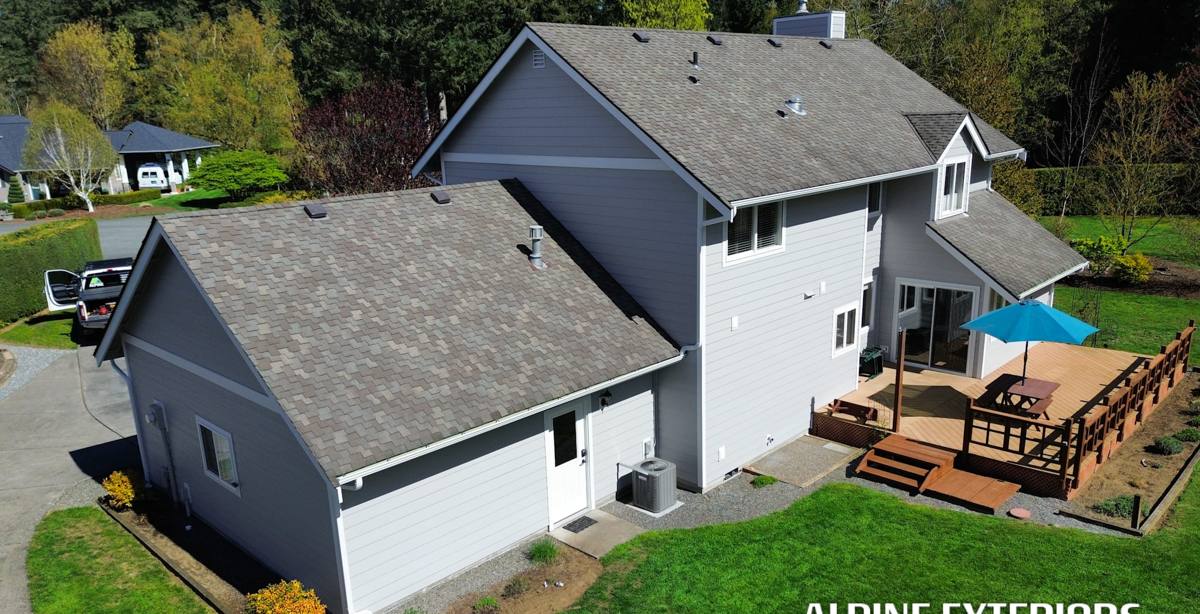
What This Climate Asks of a Board & Batten Wall
Wind-Driven Rain Finds the Seams
Lynden sits back from the immediate shoreline, but it's still inside the same weather system that pushes rain sideways across the rest of the county rather than letting it fall straight down. A vertical profile like board and batten puts full-height seams directly in the path of that wind-driven rain. A batten that's nailed down tight with no room to move, or that relies on caulk instead of a proper lap and back-priming, turns into a channel that pulls water toward the fasteners instead of shedding it back off the wall.
Salt Air Doesn't Stop at the Shoreline
It's a common assumption that salt exposure is only a waterfront problem. Marine air moves across this whole stretch of Whatcom County, and over years it works on fasteners, flashing, and trim hardware even well inland. Board and batten uses more fasteners per square foot than lap siding, since both the boards and the battens need to be secured — which means getting the fastener spec right carries more weight on this profile than it does on a simpler one.
A Moss Season That Doesn't Take a Break
Between tree-lined lots and the open farmland around Lynden, shade exposure varies a lot more from property to property than it would in a uniformly built-up town. Shaded and north-facing walls hold moisture longer, and that's exactly the environment moss and mildew need. A batten set tight against a board with no room to ventilate traps that moisture right where it can't dry, which shows up eventually as staining, soft substrate, and paint failure right along the seam.
Why the Material Choice Matters More on This Profile
Board and batten magnifies whatever weaknesses a siding material already has, simply because there's more seam length and more exposed edge per square foot of wall. That's a big part of why we don't offer LP SmartSide, vinyl, Cemplank, Allura, primed spruce, or cedar board and batten. Those are legitimate products, and other contractors install them competently — but on a profile with this many joints, in a climate that stays wet this much of the year, we made the call to stand behind one system rather than spread our crew's attention across several.
| Material | Behavior at Batten Seams | Upkeep in This Climate | Realistic Lifespan |
|---|---|---|---|
| James Hardie fiber cement | Stays dimensionally stable; doesn't swell or cup at the joint | Low — factory finish resists moss growth and fading | 30+ years with correct install |
| LP SmartSide (engineered wood) | More sensitive to moisture at cut edges and fastener points | Moderate — cut edges need ongoing sealing | 15-25 years, climate-dependent |
| Vinyl | Can gap or warp at battens under heat and cold cycling | Low, but hidden moisture behind panels is hard to catch | 20-30 years, variable |
| Cedar | Absorbs moisture at every seam without regular sealing | High — refinishing on a recurring cycle | 15-25 years with consistent upkeep |
Fiber cement's core doesn't expand and contract with moisture the way wood-based products do, and that's the exact property that matters most on a profile built entirely around vertical seams. James Hardie's factory-applied ColorPlus finish also means the only field-painting on a project is priming cut edges, not depending on site-applied paint to hold up across every board face for years.
What a Correct Install Actually Involves
The finished look of board and batten is simple, but there's more going on behind it than most siding profiles require:
- House wrap or weather-resistive barrier installed and properly lapped before any siding goes up
- A drainage gap behind the siding so moisture that gets past the surface can dry out instead of sitting against the sheathing
- Corrosion-resistant fasteners at the spacing James Hardie's install spec calls for, not just enough to hold the board in place
- Battens set with proper clearance rather than caulked tight, so the wall can shed water instead of trapping it
- Correctly flashed and lapped transitions at windows, doors, corners, and the base of the wall
- Cut boards primed on any field-cut edge to protect the factory finish where it's been exposed
Skip any one of these and the wall can still look right for a season or two. The problems that come from skipping them — staining along seams, soft spots low on the wall, paint failure at the battens — take a few wet winters to surface, which is exactly why a corner-cutting install can pass a quick look and still fail the homeowner down the road.
Our Process for a Lynden Board & Batten Project
Walkthrough and Assessment
We look at the specific walls involved first — which face the weather head-on, which stay shaded and slow to dry, and whether the existing wall assembly already has moisture issues that need addressing before new siding goes up. Putting board and batten over a wall with hidden rot just buries the same problem under new material.
Planning the Details Before Install Day
Batten spacing, corner treatment, and how the siding will meet windows, trim, and rooflines get worked out before any material is cut. On a profile with this many joints, deciding those details on paper first keeps the crew from improvising in the field, which is usually where corners get cut.
Installation to Manufacturer Spec
Fastener type, spacing, clearance, and flashing laps follow James Hardie's published requirements for this climate zone rather than a generic national standard. That's what keeps the manufacturer's warranty intact, and it's the same reason the wall performs the way it's supposed to for decades instead of a handful of years.
Final Walkthrough
We walk the finished job with you, cover what little maintenance board and batten actually needs, and make sure you know what a healthy wall looks like if you ever want to check it yourself.
Why Hire a Crew That Already Works the Lynden Area
Board and batten rewards local experience in a way a lot of siding profiles don't, mostly because its failure points are subtle and slow to show up. A crew that's installed this profile across Lynden and the surrounding area through multiple wet seasons already knows which wall orientations need extra flashing attention because of shade and tree cover, how much batten clearance actually holds up in this climate versus what a generic install guide suggests, and where a farmhouse-style property's open exposure changes the plan compared to a tree-sheltered lot in town. Being based in Birch Bay means we're working this same weather system year-round, not visiting for one job and moving on — so if a warranty question or maintenance question comes up years later, it's a call to a crew still working in the area.
Cost Factors for Board & Batten in the Lynden Area
Board and batten typically runs more per square foot than standard lap siding, mainly because of the extra material — battens layered over boards — and the added labor of fastening and detailing two layers instead of one. Beyond that baseline, a few things move the number on a given Lynden home:
| Factor | Why It Matters |
|---|---|
| Wall height and complexity | More corners, dormers, and transitions mean more cuts and flashing details |
| Existing wall condition | Rot or moisture damage found during tear-off needs repair before new siding goes up |
| Batten spacing and reveal | Tighter spacing uses more material and more fastening labor |
| Window and trim detailing | More openings mean more flashing and finish work around each one |
| Site access | Larger lots, outbuildings, or limited access can add labor time |
We'd rather walk your specific property and give you real numbers than a rough estimate based on square footage alone — two Lynden homes with the same footprint can land at very different price points depending on which of these factors are actually in play.
Getting It Right the First Time
Board and batten isn't a forgiving profile to fix after the fact. Because the battens cover the seams between boards, correcting a bad install usually means pulling battens, boards, or both, rather than a simple patch job. That's why we treat the planning and detailing phase as seriously as the install itself on every project — the cost of getting it right the first time is a lot lower than the cost of tearing out a wall that went up wrong.
If you're considering board and batten for a home in the Lynden area, we're glad to come take a look, walk through what your specific walls need given their exposure and orientation, and give you a straightforward, no-pressure estimate. There's a form below — reach out and we'll set up a time to stop by.