 Birch Bay
 Composite Decking for Terrell Creek Homes
Terrell Creek sits close enough to Birch Bay's shoreline that homes here deal with a version of coastal weather that inland Whatcom County properties don't have to think about as much. Salt-laden air moves in off the water, driving rain comes in sideways more often than most people expect, and the shaded, damp stretches of the neighborhood hold onto moss and algae longer into the season than you'd get further from the coast. A deck built here has to be chosen and installed with all three of those things in mind, not just the general Pacific Northwest rain everyone talks about.
This page covers composite decking specifically for Terrell Creek properties: what the local climate actually does to a deck over time, what a correctly built composite deck involves, how we approach the work, and why it matters to hire a crew that has already built decks in this exact area rather than one working from general regional experience.
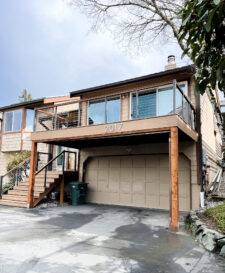
What Terrell Creek's Climate Actually Does to a Deck
Salt Air and Hardware
Salt air doesn't just affect houses right on the water. It travels, and in a community like Terrell Creek it settles into anything metal — fasteners, joist hangers, railing brackets, even the screws holding fascia boards on. Over years, standard galvanized hardware can corrode faster here than the same hardware would in a drier, inland part of the county. That corrosion is usually invisible until a board starts to loosen or a railing post develops play, which is well past the point where it was cheap to fix.
Driving Rain and Water Path
Birch Bay gets plenty of straight-down rain, but the wind off the water pushes a lot of it sideways, especially during fall and winter storms. That matters for a deck because water doesn't just fall on the surface — it gets driven under railings, into ledger connections, and behind fascia. A deck that only handles vertical rainfall well can still let water track back into the house framing or pool where it shouldn't.
Moss, Algae, and Long Shaded Seasons
Terrell Creek has enough tree cover and damp, shaded pockets that moss and algae growth can start earlier in the fall and hang on later into spring than it would on a fully open, sun-exposed lot. On a wood deck this often means yearly power washing and re-staining just to stay ahead of it. On composite, the surface itself won't rot from it, but a slick, un-maintained board is still a slip hazard, and buildup left too long can stain certain board finishes.
What a Correct Composite Deck Build Involves Here
Composite boards solve some problems automatically — they don't splinter, rot, or need annual staining — but the board itself is only part of a deck. Most of the failures we get called out to fix on composite decks in this area trace back to the structure underneath or the fasteners, not the decking material.
Substructure and Drainage
The framing under a composite deck should be pressure-treated lumber (or in some cases a coated/composite joist system) with real attention paid to how water sheds off it. That means proper slope away from the house, joist tape or flashing on top of the framing so water doesn't sit in the wood under the boards, and gaps at board ends for drainage and airflow. Skipping joist protection is one of the more common shortcuts we see, and it's the kind of thing that doesn't show up as a problem for a few years — then shows up as soft framing that has to be torn out.
Fasteners and Hardware
Given the salt exposure in this area, we treat fastener selection as a real decision, not an afterthought. Stainless steel or coated fasteners rated for coastal/corrosive environments cost more up front than standard galvanized hardware, but replacing rusted-through hangers or brackets under a finished deck is far more expensive than the difference in materials ever was.
Board Selection for a Wet, Salty Climate
Not all composite boards perform the same way in this environment. Capped composite (composite core with a plastic protective shell) handles moisture and staining better than uncapped composite, which can absorb water at cut edges over time. We'll walk through the realistic differences between board lines for a Terrell Creek property — grain pattern, slip resistance when wet, and how the manufacturer's warranty actually treats coastal/marine installations, since some warranties have specific language about proximity to salt water.
Composite vs. Wood vs. PVC: How They Hold Up Here
| Material | Salt Air & Moisture | Moss/Algae Handling | Ongoing Maintenance | Typical Lifespan |
|---|---|---|---|---|
| Pressure-treated wood | Absorbs moisture; hardware corrosion risk higher | Needs regular cleaning/treatment or moss takes hold fast | Annual cleaning, periodic staining/sealing | 10-15 years before major repair/replacement |
| Standard composite | Good; some absorption possible at cut/exposed edges | Cleans up easily; occasional wash recommended | Occasional washing, no staining | 20-25+ years, per manufacturer warranty |
| Capped composite / PVC | Very good; minimal moisture absorption | Cleans up easily; smooth cap resists staining | Occasional washing, no staining | 25+ years, per manufacturer warranty |
Cost generally follows that same order — pressure-treated is the least expensive material up front, standard composite is a step up, and capped composite or PVC boards cost the most per square foot. For a Terrell Creek property, we usually recommend at least capped composite for any deck that gets regular salt exposure or heavy shade, since the extra material cost tends to pay for itself in reduced maintenance and fewer callbacks over the deck's life.
Our Process, Start to Finish
We keep the process straightforward and don't push a sale before we've actually looked at the site.
- On-site assessment. We look at sun/shade exposure, drainage slope, proximity to the water, existing framing condition if this is a replacement, and any ledger or attachment points on the house.
- Honest material walkthrough. We go over board options, hardware grade, and railing choices with real trade-offs explained — not just the upsell.
- Written estimate. Clear scope, materials, and price before anything is scheduled.
- Framing and flashing first. We don't put composite boards over framing that hasn't been properly protected — this is the step that determines whether the deck lasts.
- Board installation. Hidden fastener systems where the board line supports it, correct expansion gaps, and attention to how board ends meet the house and railings.
- Final walkthrough. We check the deck with you before calling the job done, including drainage under load and railing solidity.
Maintaining a Composite Deck in This Climate
Composite decking is low-maintenance, not no-maintenance, especially this close to the water. A little seasonal attention goes a long way toward keeping the surface safe and the warranty intact.
- Rinse the deck surface periodically to clear salt residue, pollen, and organic debris before it builds up
- Sweep leaves and needles out of corners and against railings promptly — trapped debris holds moisture against the board
- Use a soft-bristle brush and a manufacturer-approved cleaner on any moss or algae spots rather than a pressure washer on high setting, which can damage the cap
- Check railing posts and fastener points once or twice a year for any looseness, especially after winter storm season
- Keep gutters and downspouts near the deck clear so runoff isn't dumping extra water onto or under the deck surface
- Trim back overhanging branches where practical to reduce the shaded, damp conditions that favor moss growth
Why a Crew That Works Terrell Creek Regularly Matters
A lot of decking problems we get called to fix weren't caused by bad boards — they were caused by a build that didn't account for this specific environment. A crew that mostly works drier, inland jobs may default to standard hardware, skip extra joist protection, or not think twice about drainage under a shaded deck, because in their usual conditions it doesn't matter as much. In Terrell Creek, it does.
Working this neighborhood regularly means we already know which corners of a lot tend to stay damp longest, how exposed a given site is to wind-driven rain off the bay, and which hardware and board choices actually hold up here rather than just on paper. That local pattern recognition is the difference between a deck that needs attention in year three and one that's still solid well past the manufacturer's warranty window.
Permits and Local Considerations
Most deck projects in Whatcom County require a building permit, and requirements can vary depending on deck height, size, and attachment to the structure. We handle the permitting conversation as part of the estimate process so there are no surprises once work is scheduled. If your property has specific setback or shoreline-related considerations due to its location, we'll flag that early rather than after materials are ordered.
Get a Free Estimate for Your Terrell Creek Deck
If you're planning a new composite deck or replacing one that's showing its age, we're happy to come take a look and give you a straightforward, no-pressure estimate. We'll walk the site with you, talk through material options honestly, and explain exactly what the job involves before you decide anything. Use the form below to get started.